
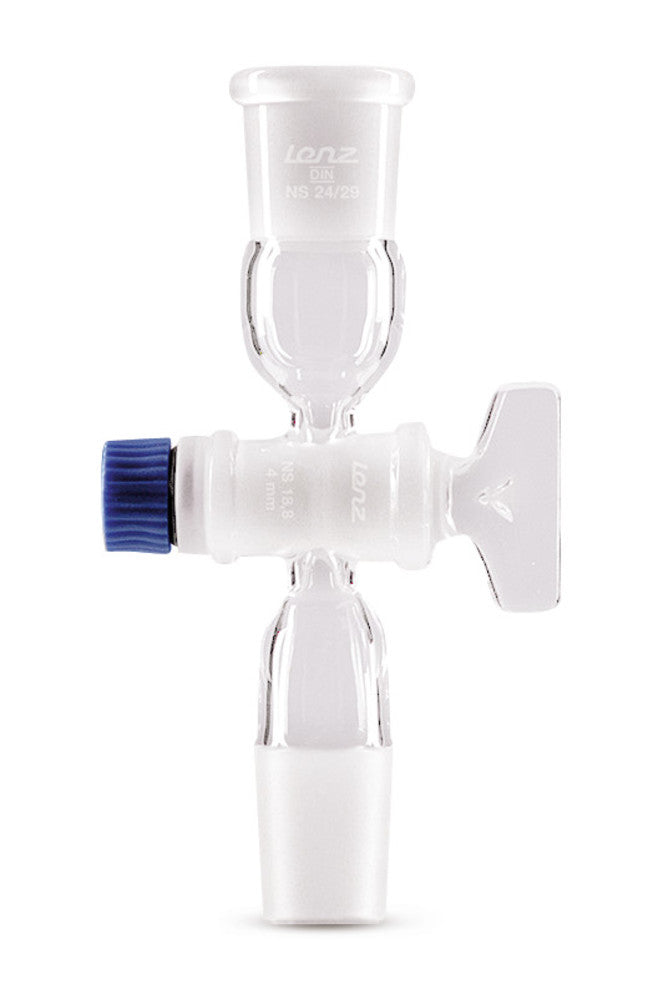



Description
Adapter with stopcock, socket and cone NS 29/32 is a ground-glass joint component for laboratory distillation, extraction and general glassware assemblies. It combines a stopcock with matching NS 29/32 socket and cone ends so flow can be opened or closed within a modular joint train without changing the joint size. The adapter is intended for standardized laboratory glass setups where controlled transfer between flasks, condensers, receivers or intermediate vessels is required. Supplied as 1 pc and weighing 0,150 kg, it fits routine bench-scale configurations used in organic synthesis, solvent handling and teaching laboratories. This component from manufacturer Lenz belongs to the category of glass parts with ground joints and supports interchangeable NS 29/32 connections common in European labware systems. Its dual socket-and-cone geometry allows flexible orientation when building or extending distillation and extraction trains. Laboratories that already work with NS 29/32 apparatus can add stopcock control at a defined joint without redesigning the entire assembly, keeping setups compact and serviceable for research, quality control and preparative work.
This article is part of Stopcocks & valves, in Tubing, hoses & fittings.
Key features
- Pack size: 1 pc
- Product type: Adapter with stopcock
- Joint size: NS 29/32
- Connection: Socket and cone
- Weight: 0,150 kg
Recently viewed
You may also like
Browse related categories
Category
Sub-category
Catalogue
Brand
Questions about Adapter with stopcock, socket and cone (NS) 29/32, 1 unit(s)
What is this article?
Adapter with stopcock, socket and cone (NS) 29/32, 1 unit(s) is the article on this page. Luminix Health distributes Lenz for laboratory use. It sits in Stopcocks & valves, inside Tubing, hoses & fittings, in Labware.
A stopcock opens and closes a line, or directs it between ports. Glass stopcocks have a ground plug that needs grease or a PTFE key. The bore decides the flow. A two-way and a three-way key are different parts.
Tubing is how a liquid or a gas moves between two vessels without being poured. Silicone stays flexible and survives repeated autoclaving. PTFE resists almost every solvent and is stiff. PVC is the ordinary flexible line for water and for mild aqueous work. The fitting, not the tube, is what usually leaks: the barb, the thread and the stopcock have to match the tube bore. Glass and plastic apparatus around these lines is indexed under ISO laboratory ware.
Which category should I open next?
The category is Tubing, hoses & fittings. The sub-category is Stopcocks & valves. The catalogue is Labware.
Shelves beside this one are Hose connectors, adapters & fittings, PVC, PTFE & other tubing, Silicone tubing and Tubing accessories.
What should I check before I order?
The technical information on this page is the manufacturer's sheet. Read that, not a rewritten specification.
When this page shows a safety data sheet, use that manufacturer file. Hazard text does not belong in the sales description. For a pack size, a grade or a certificate that is not on the page, send a quote request or contact the team.
How does ordering and shipping work?
Luminix Health distributes this article from the heart of Europe. Articles in stock ship within 2–5 business days. Standard delivery is free from €250 excl. VAT. Cold-chain goods and dangerous goods under ADR are never included in that free delivery. The terms are in the Shipping Policy. The full brand index is on shop by brand. Who we are is on about us.
Which other categories should I open?
The seven catalogues are Labware, Lab chemicals, Lab instruments, Lab consumables, Chromatography equipment, Lab safety equipment and Life Science & Microbiology.