
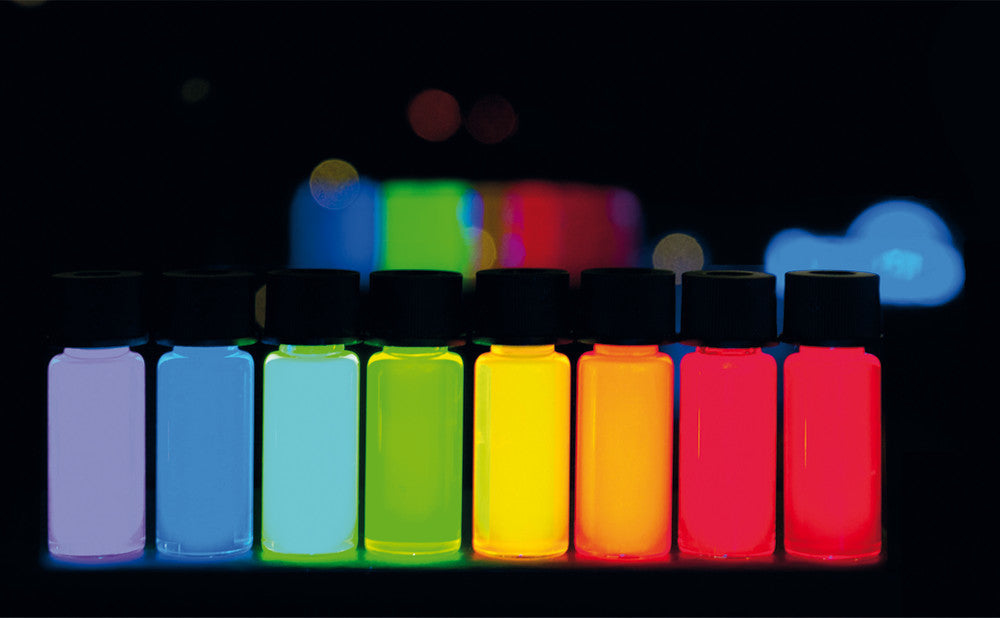


Description
CdSe/ZnS QD ROTI®nanoMETIC avec un maximum lambda de 560 ±5 nm sont des quantum dots cadmium selenide/zinc sulfide fournis pour un usage en laboratoire. Cette qualité est définie par une fenêtre d'émission optique spécifiée de 560 ±5 nm et appartient à la gamme ROTI®nanoMETIC du fabricant Carl ROTH. Le matériau est Poids de l'emballage est 0.016 kg. Les quantum dots CdSe/ZnS de ce type sont choisis lorsqu'une spécification lambda-max précise est requise pour des expériences optiques ou sur les matériaux. Le produit est associé au numéro UN 1759. Au sein de la série, l'option 560 ±5 nm fournit une cible de longueur d'onde distincte par rapport aux qualités lambda-max voisines. Les utilisateurs doivent consulter la fiche de données de sécurité avant la manipulation. La combinaison de la composition CdSe/ZnS, de la désignation ROTI®nanoMETIC et du maximum lambda étroitement spécifié rend ce conditionnement adapté aux flux de travail de laboratoire standardisés impliquant des réactifs à quantum dots et des travaux connexes sur des matériaux nanostructurés.
Cet article fait partie de Nanomatériaux & points quantiques, dans Produits chimiques inorganiques.
Caractéristiques
- Fluorescence λ max.: 555-565 nm
- Conditionnements: 5 mg, 10 mg
- Type de produit: Points quantiques CdSe/ZnS
- Ligne Brand: ROTI®nanoMETIC
- Lambda max.: 560 ±5 nm
- Poids de l'emballage: 0.016 kg
- Fiche technique:

- Fiche de données de sécurité:
Compliance & Safety Information


 Danger
Hazard Statements (H-Phrases)
Precautionary Statements (P-Phrases)
Récemment consulté
Vous aimerez peut-être aussi
Browse related categories
Category
Produits chimiques inorganiques
Sub-category
Nanomatériaux & points quantiques
Catalogue
Brand
Questions about CdSe/ZnS QD, ROTI®nanoMETIC Lambda max. 560 ±5 nm, 5 mg, verre
What is this article?
CdSe/ZnS QD, ROTI®nanoMETIC Lambda max. 560 ±5 nm, 5 mg, verre is the article on this page. Luminix Health distributes Carl Roth for laboratory use. It sits in Nanomatériaux & points quantiques, inside Produits chimiques inorganiques, in Produits chimiques.
A nanomaterial is defined by a particle size that changes how it behaves. A quantum dot's optical emission depends on that size. The stated diameter, the surface coating and the concentration are the specification. The bulk powder of the same composition is not this product.
An inorganic chemical is a salt, an acid or base in solid form, a metal, an oxide, or an element. The waters of hydration are part of the formula: a hydrate and an anhydrous salt are different masses for the same ion. Trace metals matter when the salt will be used in analysis. Nanomaterials add particle size to the specification. Look the substance up on PubChem. Hazard classes are on ECHA, under the CLP Regulation and REACH. Transport of the dangerous ones is explained by the UNECE.
Which category should I open next?
The category is Produits chimiques inorganiques. The sub-category is Nanomatériaux & points quantiques. The catalogue is Produits chimiques.
Shelves beside this one are Sels inorganiques and Métaux, éléments & oxydes.
What should I check before I order?
The technical information on this page is the manufacturer's sheet. Read that, not a rewritten specification.
When this page shows a safety data sheet, use that manufacturer file. Hazard text does not belong in the sales description. For a pack size, a grade or a certificate that is not on the page, send a quote request or contact the team.
How does ordering and shipping work?
Luminix Health distributes this article from the heart of Europe. Articles in stock ship within 2–5 business days. Standard delivery is free from €250 excl. VAT. Cold-chain goods and dangerous goods under ADR are never included in that free delivery. The terms are in the Shipping Policy. The full brand index is on shop by brand. Who we are is on about us.
Which other categories should I open?
The seven catalogues are Labware, Lab chemicals, Lab instruments, Lab consumables, Chromatography equipment, Lab safety equipment and Life Science & Microbiology.