
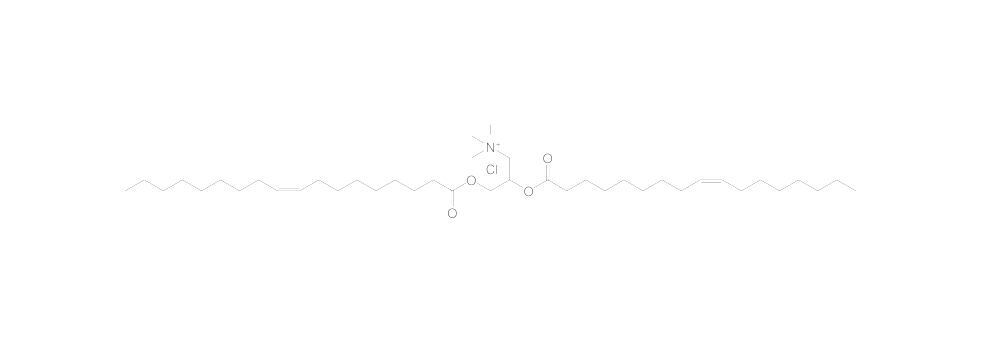


Description
Le chlorure de 1,2-dioléoyl-3-triméthylammonium-propane est un réactif lipidique cationique portant le numéro CAS 132172-61-3 et de formule brute C₄₂H₈₀ClNO₄. Ce composé possède une masse molaire de 698,54 g/mol et est utilisé dans la formulation de liposomes, la recherche sur la transfection et la préparation d'assemblages lipidiques chargés positivement. Ses doubles chaînes oléoyle et son groupement de tête ammonium quaternaire confèrent le caractère amphiphile nécessaire à la formation de bicouches et à la complexation électrostatique. Le produit est disponible auprès du fabricant Carl ROTH et est destiné aux environnements de recherche chimique et biochimique manipulant des lipides spécialisés. Les chercheurs bénéficient de la composition moléculaire définie pour optimiser les taux de formulation ou comparer les performances des lipides cationiques. Le conditionnement compact favorise une utilisation économique lors du développement de méthodes et du criblage. Convient aux laboratoires nécessitant une source fiable de ce lipide chlorure de triméthylammonium-propane pour des applications de formulation et biophysiques.
Cet article appartient à Sels inorganiques, dans Produits chimiques inorganiques.
Caractéristiques principales
- Couleur : blanc à jaune pâle
- Forme : semi-solide à solide
- Pureté (RMN) : ≥95 %
- Spectre RMN ¹H : conforme
- Numéro CAS : 132172-61-3
- Conditionnements : 100 mg, 250 mg, 500 mg, 1 g
- Formule brute : C₄₂H₈₀ClNO₄
- Masse molaire : 698,54 g/mol
- Température de stockage : -20 °C
- Fiche d'informations techniques :

- Fiche de données de sécurité :
Récemment consulté
Vous aimerez peut-être aussi
Browse related categories
Category
Sub-category
Catalogue
Produits chimiques de laboratoire et industriels
Brand
Questions about Chlorure de 1,2-dioléoyl-3-triméthylammonium-propane, 100 mg
What is this article?
Chlorure de 1,2-dioléoyl-3-triméthylammonium-propane, 100 mg is the article on this page. Luminix Health distributes Carl Roth for laboratory use. It sits in Inorganic salts, inside Inorganic chemicals, in Produits chimiques de laboratoire et industriels.
An inorganic salt is an ionic solid, a chloride, a sulfate, a nitrate, a phosphate. The degree of hydration changes the mass that contains one mole of the ion. Analytical grade limits the foreign ions. A hydrate and the anhydrous salt are not interchangeable by weight.
An inorganic chemical is a salt, an acid or base in solid form, a metal, an oxide, or an element. The waters of hydration are part of the formula: a hydrate and an anhydrous salt are different masses for the same ion. Trace metals matter when the salt will be used in analysis. Nanomaterials add particle size to the specification. Look the substance up on PubChem. Hazard classes are on ECHA, under the CLP Regulation and REACH. Transport of the dangerous ones is explained by the UNECE.
Which category should I open next?
The category is Inorganic chemicals. The sub-category is Inorganic salts. The catalogue is Produits chimiques de laboratoire et industriels.
Shelves beside this one are Metals, elements & oxides and Nanomaterials & quantum dots.
What should I check before I order?
When this page shows a safety data sheet, use that manufacturer file. Hazard text does not belong in the sales description. For a pack size, a grade or a certificate that is not on the page, send a quote request or contact the team.
How does ordering and shipping work?
Luminix Health distributes this article from the heart of Europe. Articles in stock ship within 2–5 business days. Standard delivery is free from €250 excl. VAT. Cold-chain goods and dangerous goods under ADR are never included in that free delivery. The terms are in the Shipping Policy. The full brand index is on shop by brand. Who we are is on about us.
Which other categories should I open?
The seven catalogues are Labware, Lab chemicals, Lab instruments, Lab consumables, Chromatography equipment, Lab safety equipment and Life Science & Microbiology.