


Description
Anti-Caspase-12 Antibody est un immunoréactif de laboratoire fourni dans une taille de conditionnement de 100 µl pour le travail de blotting et d'immunodétection. La densité est donnée comme 1 g/cm³, ce qui favorise une manipulation cohérente lorsque la préparation est appliquée dans des flux de travail de Western blot et d'ELISA. Les équipes qui étudient les voies apoptotiques et liées au stress peuvent intégrer cet anticorps dans des protocoles établis de blocage et d'immunodétection. Le produit est proposé du fabricant antibodies.com pour des environnements de laboratoire professionnels qui dépendent de la détection de protéines fondée sur les anticorps. Sa quantité unitaire compacte de 100 µl convient à la gestion des aliquotes sur plusieurs séries expérimentales et limite le volume inutile sur la paillasse. La densité indiquée aide à un pipetage et à une dilution fiables dans les systèmes de tampons couramment utilisés pour l'immunoblotting et les dosages immuno-enzymatiques. Chaque unité remplie pèse 0.006 kg, ce qui correspond à un format à l'échelle de la recherche. Le classement sous Western blot, ELISA, blocage et immunodétection indique un usage courant dans les flux de travail analytiques sur les protéines. Les laboratoires qui constituent ou mettent à jour des boîtes à outils d'anticorps pour des cibles de la famille des caspases et des cibles associées peuvent ajouter ce réactif dirigé contre Caspase-12 comme composant pratique des procédures quotidiennes de blotting et d'immunoessai sans volume excédentaire.
Cet article fait partie de Anticorps primaires, dans Anticorps & kits ELISA.
Caractéristiques
- Conditionnement: 100 µl
- Masse volumique: 1 g/cm³
- Température de stockage: +4 °C
- Poids: 0.006 kg
- Domaine d'application: Western blot et ELISA
- Fiche technique:

- Fiche de données de sécurité:
Compliance & Safety Information

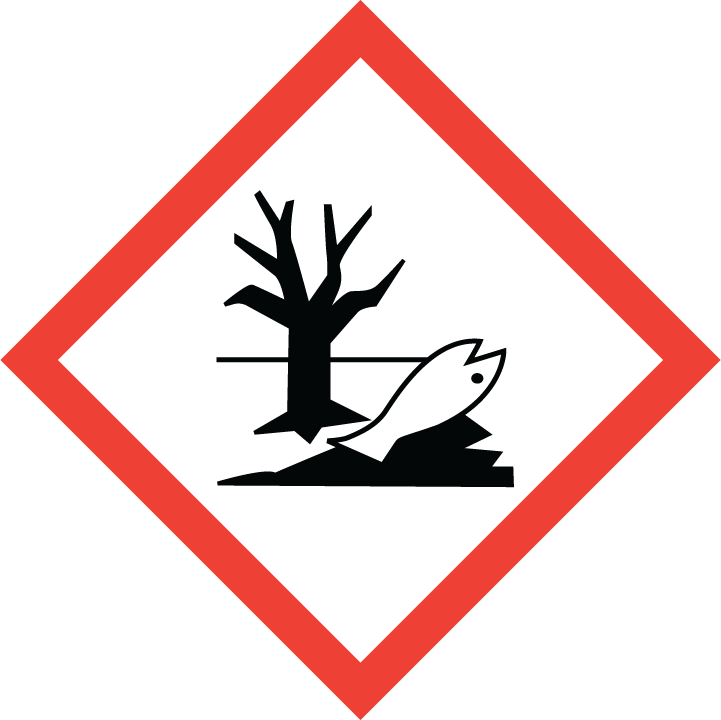 Avertissement
Hazard Statements (H-Phrases)
Récemment consulté
Vous aimerez peut-être aussi
Browse related categories
Category
Sub-category
Catalogue
Brand
Questions about Anti-Caspase-12 Antibody, 100 µl
What is this article?
Anti-Caspase-12 Antibody, 100 µl is the article on this page. Luminix Health distributes antibodies.com for laboratory use. It sits in Anticorps primaires, inside Anticorps & kits ELISA, in Milieux microbiologiques.
A primary antibody binds the target. Host species, clonality, clone name if monoclonal, the antigen, and the applications it was shown in, such as Western blot or immunohistochemistry, are the specification. A pretty band in the wrong application is not a promise.
An antibody binds one target. A primary antibody binds the molecule of interest. A secondary antibody binds the primary and usually carries the signal, an enzyme or a dye. An ELISA kit is that binding arranged in a well so the amount of target becomes a colour. The host species, the clone, the antigen and the stated application are the specification. A name alone is not. The literature is on PubMed. Sequences of the targets are on NCBI Nucleotide. Reference material is catalogued by ATCC.
Which category should I open next?
The category is Anticorps & kits ELISA. The sub-category is Anticorps primaires. The catalogue is Milieux microbiologiques.
Shelves beside this one are Kits ELISA, Protéines recombinantes & cytokines and Anticorps secondaires.
What should I check before I order?
The technical information on this page is the manufacturer's sheet. Read that, not a rewritten specification.
When this page shows a safety data sheet, use that manufacturer file. Hazard text does not belong in the sales description. For a pack size, a grade or a certificate that is not on the page, send a quote request or contact the team.
How does ordering and shipping work?
Luminix Health distributes this article from the heart of Europe. Articles in stock ship within 2–5 business days. Standard delivery is free from €250 excl. VAT. Cold-chain goods and dangerous goods under ADR are never included in that free delivery. The terms are in the Shipping Policy. The full brand index is on shop by brand. Who we are is on about us.
Which other categories should I open?
The seven catalogues are Labware, Lab chemicals, Lab instruments, Lab consumables, Chromatography equipment, Lab safety equipment and Life Science & Microbiology.