
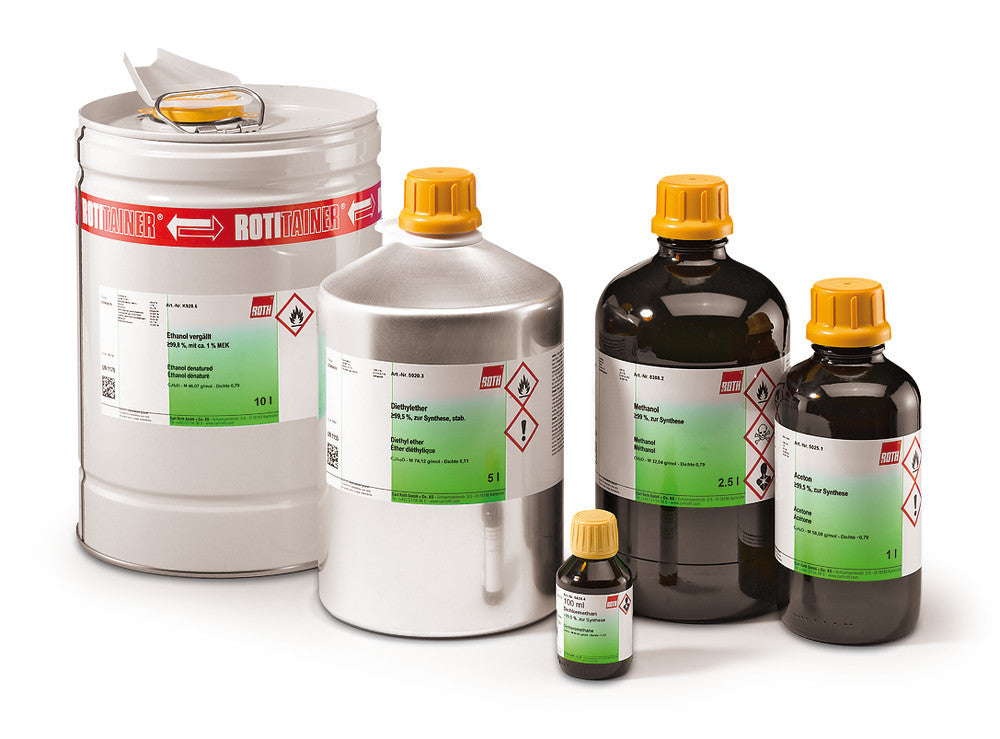


Description
Isooctane est un solvant hydrocarboné de haute pureté pour synthèse, spécifié à un minimum de 99.5 %. Il est identifié par le numéro CAS 540-84-1 et la formule empirique C₈H₁₈, avec une masse molaire de 114.23 g/mol et EG nr. 208-759-1. Les principales données physiques comprennent une densité de 0.69 g/cm³, un point d'ébullition de 99.2 °C et un point d'éclair de −12 °C ; le matériau est également associé au numéro UN 1262 pour la classification pour le transport. La combinaison de pureté, d'intervalle d'ébullition et de densité prend en charge des conditions de réaction et de traitement reproductibles. Proposé du fabricant Carl ROTH, isooctane pour synthèse fournit un conditionnement pratique d'un litre pour la synthèse organique, les étapes d'extraction et les applications associées où une spécification claire du solvant est essentielle. Les paramètres d'identité et pertinents pour la sécurité sont documentés pour faciliter la manipulation, la planification du stockage et l'intégration dans les systèmes d'achat de laboratoire.
Cet article fait partie de Solvants de qualité analytique (p.a.), dans Solvants.
Caractéristiques
- Dosage (GC): ≥99.5 %
- Densité (15 °C): 0.694-0.698
- Numéro CAS: 540-84-1
- Conditionnements: 1 l, 10 l, 200 l, 2.5 l, 5 l, 25 l
- N° CE: 208-759-1
- Pureté: min. 99.5 %, pour synthèse
- Masse molaire: 114.23 g/mol
- Masse volumique: 0.69 g/cm³
- Fiche technique:

- Fiche de données de sécurité:
Compliance & Safety Information


 Danger
Hazard Statements (H-Phrases)
Precautionary Statements (P-Phrases)
Récemment consulté
Vous aimerez peut-être aussi
Browse related categories
Category
Sub-category
Solvants de qualité analytique (p.a.)
Catalogue
Brand
Questions about Isooctane, min. 99.5 %, pour synthèse, 1 l, verre
What is this article?
Isooctane, min. 99.5 %, pour synthèse, 1 l, verre is the article on this page. Luminix Health distributes Carl Roth for laboratory use. It sits in Solvants de qualité analytique (p.a.), inside Solvants, in Produits chimiques.
An analytical-grade solvent, often marked p.a., has impurity limits tight enough for classical analysis and for preparing reagents. It is not automatically low enough in UV absorbance for HPLC, and it is not dry enough for a water-sensitive reaction. The grade is the purchase.
A solvent dissolves. The grade says which impurities are low enough for the method. Analytical grade is the ordinary pure solvent. HPLC and LC-MS grades limit the absorbance and the ions that would become peaks or background. A dry solvent has had water removed. A deuterated solvent is for NMR, where the hydrogen signal would otherwise drown the sample. Technical grade is for cleaning and for synthesis that does not need a chromatogram. Identity is on PubChem. Names follow IUPAC. Hazards follow ECHA, the CLP Regulation and REACH.
Which category should I open next?
The category is Solvants. The sub-category is Solvants de qualité analytique (p.a.). The catalogue is Produits chimiques.
Shelves beside this one are Solvants de qualité HPLC & LC-MS, Solvants secs & deutérés (NMR, synthèse), Solvants de qualité technique & synthèse and Solvants verts & alternatifs.
What should I check before I order?
When this page shows a safety data sheet, use that manufacturer file. Hazard text does not belong in the sales description. For a pack size, a grade or a certificate that is not on the page, send a quote request or contact the team.
How does ordering and shipping work?
Luminix Health distributes this article from the heart of Europe. Articles in stock ship within 2–5 business days. Standard delivery is free from €250 excl. VAT. Cold-chain goods and dangerous goods under ADR are never included in that free delivery. The terms are in the Shipping Policy. The full brand index is on shop by brand. Who we are is on about us.
Which other categories should I open?
The seven catalogues are Labware, Lab chemicals, Lab instruments, Lab consumables, Chromatography equipment, Lab safety equipment and Life Science & Microbiology.