
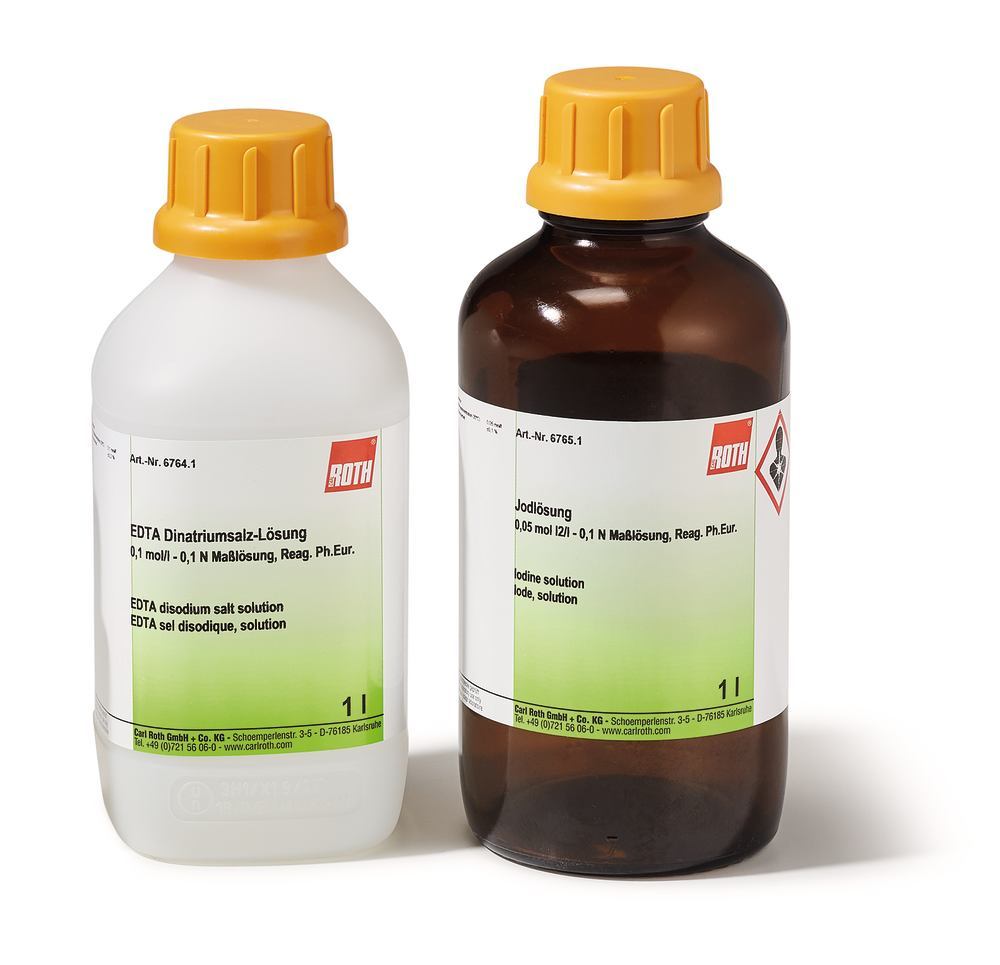


Description
La solution d'hydroxyde de potassium, Reag. Ph. Eur., est une solution titrée 0,1 mol/l (0,1 N) de KOH destinée aux travaux titrimétriques et analytiques exigeant des réactifs de qualité pharmacopée. Cette préparation correspond au numéro CAS 1310-58-3, de formule brute KOH, de masse molaire 56,11 g/mol, de densité 1,003 g/cm³ et de point d'ébullition 100 °C. Fournie en conditionnement de 1 litre, elle est conçue comme une solution titrée prête à l'emploi pour les titrages acide-base, les procédures de normalisation et les méthodes d'analyse inorganique connexes dans les laboratoires pharmaceutiques, chimiques et de contrôle qualité. Cette solution aqueuse d'hydroxyde de potassium du fabricant Carl ROTH répond à la désignation Reag. Ph. Eur. pour les solutions titrées et porte le numéro CE 215-181-3. La concentration définie permet un travail de titrage reproductible sans dilution sur site de base solide. Convient aux environnements de laboratoire de routine et réglementés qui spécifient une qualité de réactif Ph. Eur. pour les bases utilisées comme solutions titrées.
Cet article appartient aux catégories Bases et alcalis, dans Acides et bases.
Caractéristiques principales
- Concentration molaire (20 °C) : 0,099-0,109 mol/l
- Numéro CAS : 1310-58-3
- Conditionnement : 1 l
- Numéro CE : 215-181-3
- Formule brute : KOH
- Masse molaire : 56,11 g/mol
- Fiche technique :

- Fiche de données de sécurité :
Compliance & Safety Information
 Avertissement
Hazard Statements (H-Phrases)
Precautionary Statements (P-Phrases)
Récemment consulté
Vous aimerez peut-être aussi
Browse related categories
Category
Sub-category
Catalogue
Produits chimiques de laboratoire et industriels
Brand
Questions about Solution d'hydroxyde de potassium, réactif Ph. Eur.
What is this article?
Solution d'hydroxyde de potassium, réactif Ph. Eur. is the article on this page. Luminix Health distributes Carl Roth for laboratory use. It sits in Bases & alkalis, inside Acids & bases, in Produits chimiques de laboratoire et industriels.
A base or an alkali is sodium hydroxide, potassium hydroxide, ammonia and their relatives, as solid or as solution. The carbonate that a hydroxide picks up from the air changes a titre. Concentration and purity are the specification. Concentrated alkalis attack skin and aluminium.
An acid donates a proton. A base accepts one. In the bottle, the practical differences are the concentration, the purity and the anion or cation that comes along. Concentrated mineral acids are a different article from a dilute volumetric solution. The water in the acid, and the trace metals, decide whether it can be used for analysis. Check the substance on PubChem and the classification on ECHA CLP. Transport is the UNECE dangerous-goods framework. The legal texts are the CLP Regulation and REACH.
Which category should I open next?
The category is Acids & bases. The sub-category is Bases & alkalis. The catalogue is Produits chimiques de laboratoire et industriels.
Shelves beside this one are Acids.
What should I check before I order?
The technical information on this page is the manufacturer's sheet. Read that, not a rewritten specification.
When this page shows a safety data sheet, use that manufacturer file. Hazard text does not belong in the sales description. For a pack size, a grade or a certificate that is not on the page, send a quote request or contact the team.
How does ordering and shipping work?
Luminix Health distributes this article from the heart of Europe. Articles in stock ship within 2–5 business days. Standard delivery is free from €250 excl. VAT. Cold-chain goods and dangerous goods under ADR are never included in that free delivery. The terms are in the Shipping Policy. The full brand index is on shop by brand. Who we are is on about us.
Which other categories should I open?
The seven catalogues are Labware, Lab chemicals, Lab instruments, Lab consumables, Chromatography equipment, Lab safety equipment and Life Science & Microbiology.