
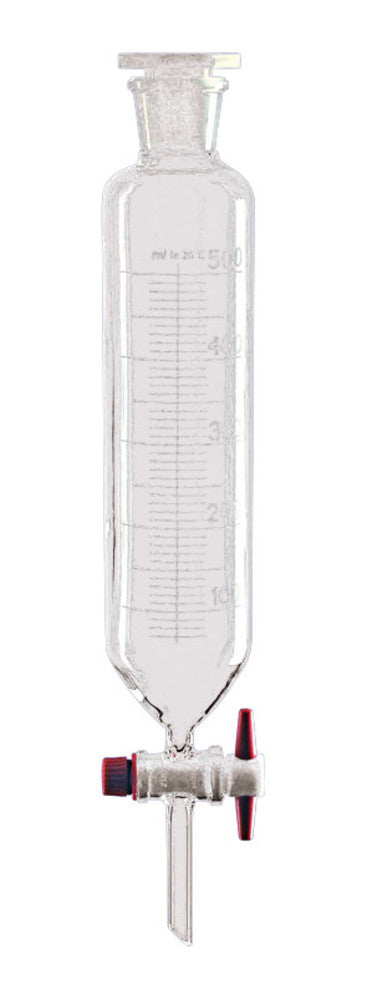



Description
Les ampoules à décanter, cylindriques, 1000 ml sont des ampoules de laboratoire graduées munies d'un bouchon en PTFE pour des séparations liquide–liquide de plus grand volume. Le corps cylindrique aide les opérateurs à suivre les interfaces de phases pendant les extractions de solvants, les lavages aqueux et les étapes d'isolement de produit courantes en synthèse organique et en préparation d'échantillons analytiques. Les marques de graduation aident à une évaluation approximative du remplissage, tandis que le bouchon en PTFE fournit un robinet chimiquement résistant pour une libération contrôlée de la couche inférieure. Cette capacité convient au travail préparatif lorsque des volumes de solvant plus élevés sont traités sur la paillasse. Fournies en un conditionnement de deux pièces du fabricant Lenz, les ampoules soutiennent les laboratoires qui ont besoin de verrerie appariée pour des séparations simultanées. Chaque ampoule pèse 1.076 kg, ce qui indique une construction solide en verre de laboratoire pour une manipulation régulière. Ensemble, la conception cylindrique, la graduation et le bouchon en PTFE répondent aux tâches de partage de routine à grand volume dans les environnements de recherche, d'enseignement et de contrôle qualité qui s'appuient sur des ampoules à décanter fiables.
Cet article fait partie de Ampoules à décanter, dans Entonnoirs.
Caractéristiques
- Conditionnement: 2 pièces
- Type: Ampoule à décanter, cylindrique
- Capacité: 1000 ml
- Robinet: Boisseau PTFE
- Graduation: Gradué
- Poids: 1.076 kg
Récemment consulté
Vous aimerez peut-être aussi
Browse related categories
Category
Sub-category
Catalogue
Brand
Questions about Ampoules à décanter, cylindriques, 1000 ml, graduées avec bouchon en PTFE, 2 pièces
What is this article?
Ampoules à décanter, cylindriques, 1000 ml, graduées avec bouchon en PTFE, 2 pièces is the article on this page. Luminix Health distributes Lenz for laboratory use. It sits in Ampoules à décanter, inside Entonnoirs, in Matériel de laboratoire.
A separating funnel lets two immiscible liquids settle into layers and then runs off the lower one through a stopcock. The shape, Squibb or pear, changes how sharp the interface is as the last millilitres leave. The stopper and the stopcock are both needed.
A funnel guides a liquid or a powder into a narrower mouth. A filter funnel holds a paper. A Büchner funnel is the flat perforated plate used with vacuum. A separating funnel has a stopcock so two liquid layers can be run off one at a time. A dropping funnel adds a reagent slowly into a reaction. The bore and the stopcock are the parts that matter. This glassware is listed under ISO laboratory glassware.
Which category should I open next?
The category is Entonnoirs. The sub-category is Ampoules à décanter. The catalogue is Matériel de laboratoire.
Shelves beside this one are Entonnoirs (plastique, verre & acier), Entonnoirs Büchner & filtrants, Entonnoirs à addition and Entonnoirs à poudre.
What should I check before I order?
The technical information on this page is the manufacturer's sheet. Read that, not a rewritten specification.
When this page shows a safety data sheet, use that manufacturer file. Hazard text does not belong in the sales description. For a pack size, a grade or a certificate that is not on the page, send a quote request or contact the team.
How does ordering and shipping work?
Luminix Health distributes this article from the heart of Europe. Articles in stock ship within 2–5 business days. Standard delivery is free from €250 excl. VAT. Cold-chain goods and dangerous goods under ADR are never included in that free delivery. The terms are in the Shipping Policy. The full brand index is on shop by brand. Who we are is on about us.
Which other categories should I open?
The seven catalogues are Labware, Lab chemicals, Lab instruments, Lab consumables, Chromatography equipment, Lab safety equipment and Life Science & Microbiology.