




Description
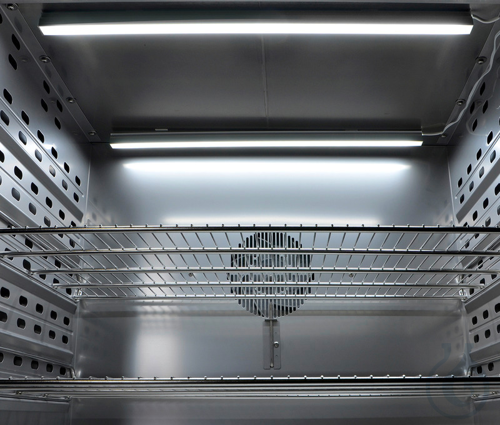
LED light bar extension set 900 is a laboratory lighting accessory for expanding an existing light-bar basic set. The set has a length of 90 cm and consists of two LED light bars supplied together with clip fastening material for secure mounting. It is intended specifically to extend the illuminated length of a compatible light-bar base installation in laboratory and technical workspaces. Offered as one complete unit from manufacturer Binder, the extension package supports modular layout of linear LED lighting along equipment or shelving zones where additional coverage is required. Net weight is 1 kg and gross weight is 3 kg, reflecting protective packing for transport and storage. The product originates from Germany, Baden-Württemberg, and belongs to standard laboratory material categories used with controlled-environment and general lab furniture systems. Clips included in the set simplify attachment and later repositioning during installation or reconfiguration. This extension option allows laboratories to scale lighting coverage as bench layouts change, without replacing the original basic light-bar set, while keeping mounting hardware consistent across the expanded run.
This article is part of Cold light sources & lighting, in Microscopy & histology.
Key features
- Pack size: 1 pc
- Product type: LED light bar extension set
- Designation: Extension set 900
- Length: 90 cm
- Set contents: 2 pieces
- Fastening material: Clips
- Data Sheet:

Recently viewed
You may also like
Browse related categories
Category
Sub-category
Catalogue
Brand
Questions about LED light bars
What is this article?
LED light bars is the article on this page. Luminix Health distributes Binder for laboratory use. It sits in Cold light sources & lighting, inside Microscopy & histology, in Lab instruments.
A cold light keeps the heat of the lamp away from a living or a melting specimen, usually by a fibre light guide. It is the illuminator for a stereo microscope. Colour temperature matters when the image is photographed. A hot lamp over a dissection dries the sample.
A light microscope forms an image with glass lenses and transmitted or reflected light. A stereo microscope is the lower-magnification instrument for dissecting and for looking at a surface. Fluorescence needs a light source and filters matched to the dye. Histology is the preparation that makes a tissue readable: fixation, a cassette, a section, a stain. The objective's magnification and numerical aperture decide the resolution. The slide and the cover glass decide whether the section sits in the focal plane. Stains and dyes as substances are identified on PubChem. Papers on the methods are on PubMed.
Which category should I open next?
The category is Microscopy & histology. The sub-category is Cold light sources & lighting. The catalogue is Lab instruments.
Shelves beside this one are Microscope slides & cover glasses, Microscope objectives, eyepieces & optics, Histology cassettes & moulds, Counting chambers & haemocytometers, Stereo microscopes, Light & fluorescence microscopes, Histology reagents & consumables, Microscopy accessories and Digital & USB microscopes.
What should I check before I order?
When this page shows a safety data sheet, use that manufacturer file. Hazard text does not belong in the sales description. For a pack size, a grade or a certificate that is not on the page, send a quote request or contact the team.
How does ordering and shipping work?
Luminix Health distributes this article from the heart of Europe. Articles in stock ship within 2–5 business days. Standard delivery is free from €250 excl. VAT. Cold-chain goods and dangerous goods under ADR are never included in that free delivery. The terms are in the Shipping Policy. The full brand index is on shop by brand. Who we are is on about us.
Which other categories should I open?
The seven catalogues are Labware, Lab chemicals, Lab instruments, Lab consumables, Chromatography equipment, Lab safety equipment and Life Science & Microbiology.