
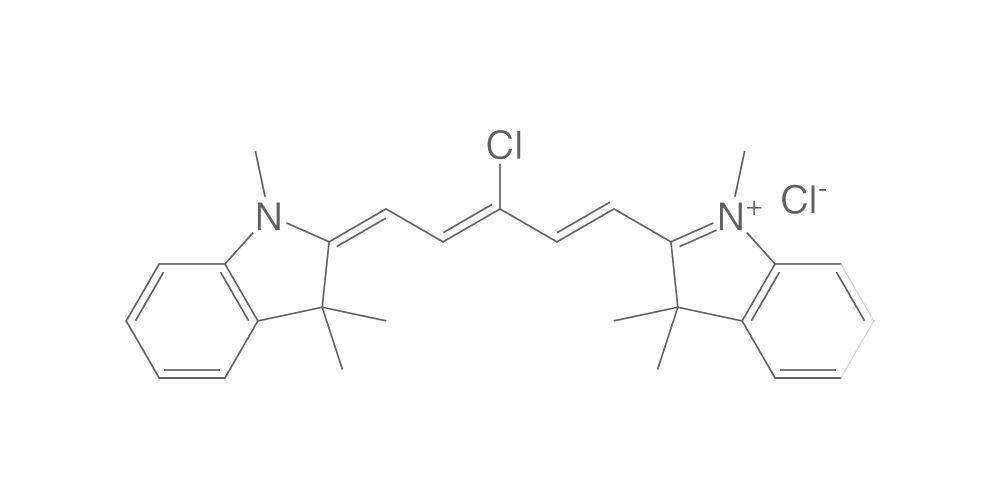


Beschreibung
Polymethine kleurstof met een absorptiemaximum (MeOH) = 639 nm is een gespecialiseerde laboratoriumkleurstof die wordt gekenmerkt door de empirische formule C₂₇H₃₀Cl₂N₂ en een molaire massa van 453,45 g/mol. Deze verbinding valt onder de categorie polymethine kleurstoffen en is bedoeld voor wetenschappelijk werk dat afhankelijk is van een gedefinieerd absorptieprofiel in het zichtbare bereik in methanol. Optische laboratoria en analytische groepen kunnen het vermelde absorptiemaximum van 639 nm gebruiken als een praktische referentiewaarde bij het uitlijnen van instrumenten of het evalueren van chromofoorgedrag onder methanolische omstandigheden. Fysieke hantering wordt ondersteund door een compacte glazen verpakking die helpt de integriteit van het monster te behouden tijdens opslag en dosering in gecontroleerde onderzoeksomgevingen. De kleurstof is verkrijgbaar bij fabrikant Carl ROTH en is geschikt voor toepassingen in workflows voor chemicaliën, kleurstoffen en pigmenten waar polymethinestructuren worden onderzocht. Onderzoekers die zich bezighouden met sensorchemie, karakterisering van optische materialen of demonstraties voor onderwijsdoeleinden profiteren van een duidelijk gespecificeerd absorptiemaximum dat documentatie, spectrale matching en reproduceerbare experimentele protocollen vereenvoudigt waarvoor kleine hoeveelheden van een goed beschreven polymethine kleurstof nodig zijn.
Dit artikel hoort bij Kleurstoffen & pigmenten, in Kleurstoffen, vloeistoffen & indicatoren.
Belangrijkste kenmerken
- Verpakkingsgroottes: 1 g, 5 g, 10 g
- Empirische formule: C₂₇H₃₀Cl₂N₂
- Absorptiemaximum (MeOH): 639 nm
- Veiligheidsinformatieblad:

Compliance & Safety Information

 Warnung
Hazard Statements (H-Phrases)
Recent bekeken
Misschien vind je dit ook leuk
Questions about Absorptiemaximum (MeOH) = 639 nm, 1 g, glas
What is this article?
Absorptiemaximum (MeOH) = 639 nm, 1 g, glas is the article on this page. Luminix Health distributes Carl Roth for laboratory use. It sits in Dyes & pigments, inside Dyes, stains & indicators, in Labor- und Industriechemikalien.
A dye dissolves. A pigment is a particle dispersed in a medium. On this shelf they are the colouring substances used as reagents or as markers, specified by Colour Index name or by structure where it is known. The same common name can hide two constitutions.
A dye or a stain binds, or changes colour, so that something invisible becomes visible. An indicator changes at a pH or a redox point. A fluorescent dye absorbs one wavelength and emits another, which is how a microscope or a plate reader picks it out. The excitation and emission, or the transition interval, are the specification. The colour name on the label is not. Structures are on PubChem under IUPAC names. Methods are in the PubMed literature.
Which category should I open next?
The category is Dyes, stains & indicators. The sub-category is Dyes & pigments. The catalogue is Labor- und Industriechemikalien.
Shelves beside this one are Fluorescent dyes & labels and Microscopy stains & staining solutions.
What should I check before I order?
When this page shows a safety data sheet, use that manufacturer file. Hazard text does not belong in the sales description. For a pack size, a grade or a certificate that is not on the page, send a quote request or contact the team.
How does ordering and shipping work?
Luminix Health distributes this article from the heart of Europe. Articles in stock ship within 2–5 business days. Standard delivery is free from €250 excl. VAT. Cold-chain goods and dangerous goods under ADR are never included in that free delivery. The terms are in the Shipping Policy. The full brand index is on shop by brand. Who we are is on about us.
Which other categories should I open?
The seven catalogues are Labware, Lab chemicals, Lab instruments, Lab consumables, Chromatography equipment, Lab safety equipment and Life Science & Microbiology.