


Description
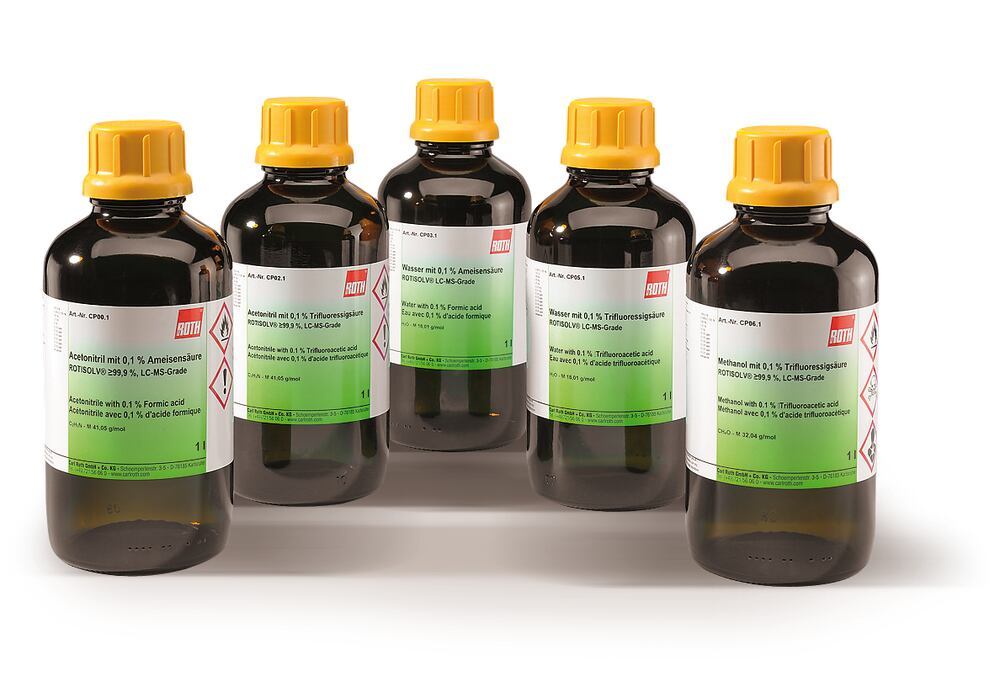
Acetonitrile with 0.1 % formic acid is a ROTISOLV® LC-MS-Grade solvent blend supplied at a minimum purity of 99,9 % for demanding chromatographic work. With the empirical formula C₂H₃N, a molar mass of 41,05 g/mol and a density of 0,79 g/cm³, it offers a defined physicochemical profile suited to sensitive LC-MS eluent systems. The boiling point is 81,65 °C and the flash point is 12,8 °C; the material is classified under UN number 1648. This ready-to-use acetonitrile–formic acid mixture supports reversed-phase separations and mass-spectrometric detection where a controlled acidic modifier improves peak shape and ionisation. Packaged in a 2,5 l unit, the solvent is practical for routine method development and high-throughput analysis. Available from manufacturer Carl ROTH within the ROTISOLV® range for solvents with eluent additives, it is intended for laboratories that require consistent LC-MS performance without on-site acid dosing.
This article is part of Microbial identification, hygiene monitoring & rapid tests, in Culture media & microbiology.
Key features
- Assay: ≥99.9 %
- Formic acid (v/v): 0.095-0.105 %
- Aluminium (Al): ≤0.05 ppm
- Calcium (Ca): ≤0.05 ppm
- Iron (Fe): ≤0.05 ppm
- Potassium (K): ≤0.05 ppm
- Magnesium (Mg): ≤0.05 ppm
- Sodium (Na): ≤0.05 ppm
- LC-MS suitability test: complies
- 254 nm: ≥90 %
- Pack size: 2,5 l
- Empirical formula: C₂H₃N
- Molar mass: 41,05 g/mol
- Density: 0,79 g/cm³
- Boiling point: 81,65 °C
- Technical Information Sheet:

- Safety Data Sheet:
Compliance & Safety Information
 Danger
Hazard Statements (H-Phrases)
Precautionary Statements (P-Phrases)
Recently viewed
You may also like
Browse related categories
Category
Sub-category
Microbial identification, hygiene monitoring & rapid tests
Catalogue
Brand
Questions about Acetonitrile with 0.1 % Formic acid, ROTISOLV® min. 99,9 %, LC-MS-Grade, 2.5 l
What is this article?
Acetonitrile with 0.1 % Formic acid, ROTISOLV® min. 99,9 %, LC-MS-Grade, 2.5 l is the article on this page. Luminix Health distributes Carl Roth for laboratory use. It sits in Microbial identification, hygiene monitoring & rapid tests, inside Culture media & microbiology, in Life Science & Microbiology.
These kits name an organism or detect a residue on a surface faster than a full culture. A swab, a lateral-flow strip or a chromogenic reaction are the forms. The organisms or the residues the kit claims, and the ones it misses, are in the pack insert. A negative is only as good as that list.
A culture medium is the food and the solid or liquid home of a microorganism. Dehydrated media are powders the laboratory dissolves and sterilises. Ready-to-use plates and tubes are already that. A Petri dish is the plate. Selective media let one kind of organism grow and hold another back. The formulation and the supplements, not the colour of the agar, are the specification. Reference strains are at ATCC. Methods are on PubMed. Biosafety practice is the WHO laboratory biosafety topic.
Which category should I open next?
The category is Culture media & microbiology. The sub-category is Microbial identification, hygiene monitoring & rapid tests. The catalogue is Life Science & Microbiology.
Shelves beside this one are Dehydrated culture media (agar & broth bases), Petri dishes, Ready-to-use culture media (plates, tubes, bottles), Microbiology (other) and Inoculation loops, spreaders & needles.
What should I check before I order?
When this page shows a safety data sheet, use that manufacturer file. Hazard text does not belong in the sales description. For a pack size, a grade or a certificate that is not on the page, send a quote request or contact the team.
How does ordering and shipping work?
Luminix Health distributes this article from the heart of Europe. Articles in stock ship within 2–5 business days. Standard delivery is free from €250 excl. VAT. Cold-chain goods and dangerous goods under ADR are never included in that free delivery. The terms are in the Shipping Policy. The full brand index is on shop by brand. Who we are is on about us.
Which other categories should I open?
The seven catalogues are Labware, Lab chemicals, Lab instruments, Lab consumables, Chromatography equipment, Lab safety equipment and Life Science & Microbiology.