


Description
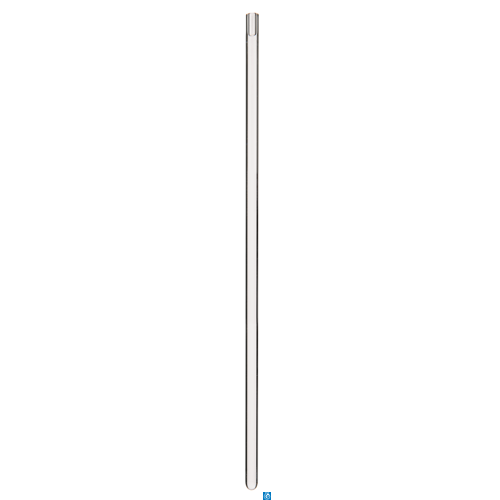
Boiling rod, Ø 6 mm, length approx. 220 mm is a laboratory boiling aid manufactured from borosilicate glass 3.3. This solid rod provides nucleation sites that promote even boiling and help prevent bumping or superheating of liquids during distillation, reflux and general heating procedures. With a diameter of 6 mm and an approximate length of 220 mm it fits readily into standard round-bottom flasks and other laboratory vessels. The borosilicate glass 3.3 construction offers the chemical resistance and thermal durability expected of laboratory glassware. Produced by manufacturer Rettberg, the rod is supplied as a single piece with a net weight of 0,014 kg and is intended for repeated use after cleaning. It supports controlled evaporation and heating workflows in analytical chemistry, organic synthesis and educational laboratories. Simple cylindrical geometry allows straightforward insertion and removal, making the boiling rod a practical accessory for routine and preparative work with aqueous or organic media under controlled thermal conditions.
This article is part of Organic building blocks & synthesis reagents, in Organic chemicals & synthesis reagents.
Key features
- Pack size: 1 pc
- Product type: Boiling rod
- Material: Borosilicate glass 3.3
- Diameter: 6 mm
- Length: approx. 220 mm
- Technical Information Sheet:

Recently viewed
You may also like
Browse related categories
Category
Organic chemicals & synthesis reagents
Sub-category
Organic building blocks & synthesis reagents
Catalogue
Brand
Questions about Boiling rod, Ø 6 mm, length approx. 220 mm
What is this article?
Boiling rod, Ø 6 mm, length approx. 220 mm is the article on this page. Luminix Health distributes Rettberg for laboratory use. It sits in Organic building blocks & synthesis reagents, inside Organic chemicals & synthesis reagents, in Lab chemicals.
A building block is an organic molecule bought to become part of a larger one. The structure, the CAS number and the purity decide it. A 95 percent reagent and a 99.9 percent reagent of the same name leave different impurities in the product. The functional groups are the reason it was chosen.
An organic chemical is built on carbon. In this category it is a building block or a reagent for making another molecule: a starting material, a coupling agent, a polymer, a PEG. Purity is a specification of which impurities remain. The structure, the CAS number and the grade decide whether two bottles are the same substance. Structures and properties are on PubChem. Nomenclature is IUPAC. Classification follows ECHA and the CLP Regulation.
Which category should I open next?
The category is Organic chemicals & synthesis reagents. The sub-category is Organic building blocks & synthesis reagents. The catalogue is Lab chemicals.
Shelves beside this one are Polymers, PEGs & silicones and Click chemistry, bioconjugation & synthesis reagents.
What should I check before I order?
When this page shows a safety data sheet, use that manufacturer file. Hazard text does not belong in the sales description. For a pack size, a grade or a certificate that is not on the page, send a quote request or contact the team.
How does ordering and shipping work?
Luminix Health distributes this article from the heart of Europe. Articles in stock ship within 2–5 business days. Standard delivery is free from €250 excl. VAT. Cold-chain goods and dangerous goods under ADR are never included in that free delivery. The terms are in the Shipping Policy. The full brand index is on shop by brand. Who we are is on about us.
Which other categories should I open?
The seven catalogues are Labware, Lab chemicals, Lab instruments, Lab consumables, Chromatography equipment, Lab safety equipment and Life Science & Microbiology.