
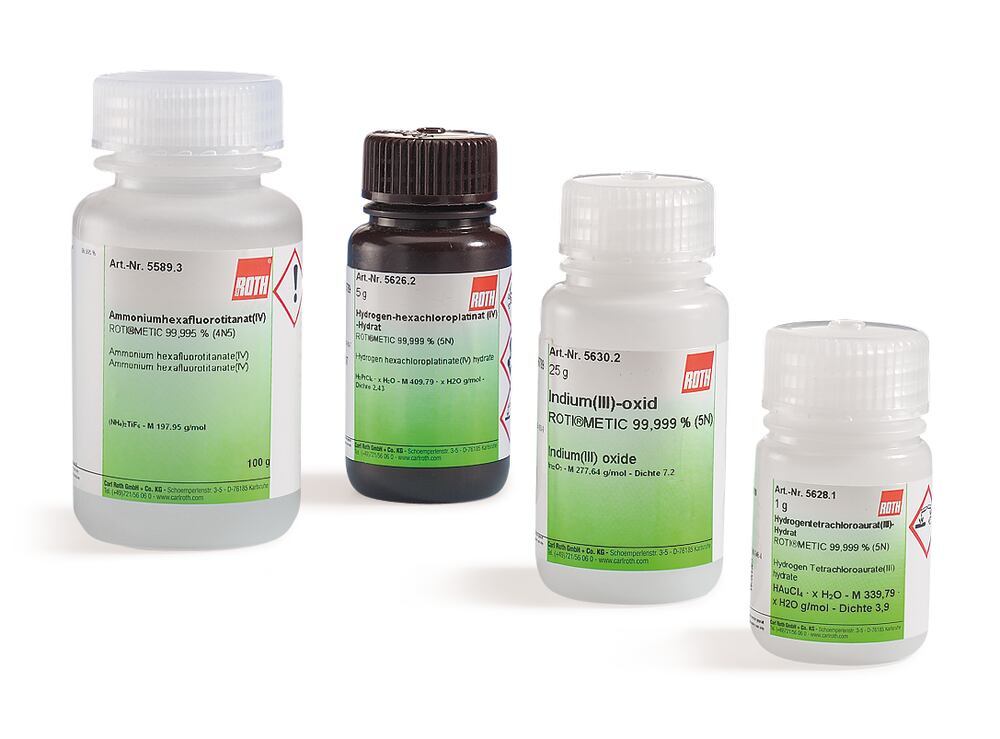


Description
Copper(II) oxide ROTI®METIC 99,999 % (5N) is a high-purity inorganic oxide for laboratory use, identified by CAS number 1317-38-0 and empirical formula CuO. It has a molar mass of 79,55 g/mol and a density of 6,31 g/cm³, matching the ROTI®METIC purity grade of 99,999 % (5N). The product is EG number 215-269-1 and UN number 3077 form part of the stated identity data. Documented molar mass, density and purity help laboratories plan formulations and maintain traceable reagent records. The HDPE bottle supports secure storage and handling of the solid, while size suits bench-scale use without large residual stock. With its defined CuO composition, CAS entry and ROTI®METIC 99,999 % (5N) specification, this copper(II) oxide grade is positioned for workflows that depend on high chemical purity and clearly reported physical constants.
This article is part of Metals, elements & oxides, in Inorganic chemicals.
Key features
- Assay (metals basis): 99.999 %
- CAS number: 1317-38-0
- Pack sizes: 5 g, 25 g
- EG nr.: 215-269-1
- Purity: 99,999 % (5N)
- Empirical formula: CuO
- Technical Information Sheet:

- Safety Data Sheet:
Compliance & Safety Information
 Warning
Hazard Statements (H-Phrases)
Precautionary Statements (P-Phrases)
Recently viewed
You may also like
Browse related categories
Category
Sub-category
Catalogue
Brand
Questions about Copper(II) oxide, ROTI®METIC 99,999 % (5N), 5 g, HDPE
What is this article?
Copper(II) oxide, ROTI®METIC 99,999 % (5N), 5 g, HDPE is the article on this page. Luminix Health distributes Carl Roth for laboratory use. It sits in Metals, elements & oxides, inside Inorganic chemicals, in Lab chemicals.
Metals, elements and oxides are the element itself or its oxide, sold as powder, shot, foil or wire. Purity and particle size are both the specification. A 99 percent powder and a 99.999 percent shot of the same element are different articles. Many are reactive to air or to water.
An inorganic chemical is a salt, an acid or base in solid form, a metal, an oxide, or an element. The waters of hydration are part of the formula: a hydrate and an anhydrous salt are different masses for the same ion. Trace metals matter when the salt will be used in analysis. Nanomaterials add particle size to the specification. Look the substance up on PubChem. Hazard classes are on ECHA, under the CLP Regulation and REACH. Transport of the dangerous ones is explained by the UNECE.
Which category should I open next?
The category is Inorganic chemicals. The sub-category is Metals, elements & oxides. The catalogue is Lab chemicals.
Shelves beside this one are Inorganic salts and Nanomaterials & quantum dots.
What should I check before I order?
The technical information on this page is the manufacturer's sheet. Read that, not a rewritten specification.
When this page shows a safety data sheet, use that manufacturer file. Hazard text does not belong in the sales description. For a pack size, a grade or a certificate that is not on the page, send a quote request or contact the team.
How does ordering and shipping work?
Luminix Health distributes this article from the heart of Europe. Articles in stock ship within 2–5 business days. Standard delivery is free from €250 excl. VAT. Cold-chain goods and dangerous goods under ADR are never included in that free delivery. The terms are in the Shipping Policy. The full brand index is on shop by brand. Who we are is on about us.
Which other categories should I open?
The seven catalogues are Labware, Lab chemicals, Lab instruments, Lab consumables, Chromatography equipment, Lab safety equipment and Life Science & Microbiology.