


Description
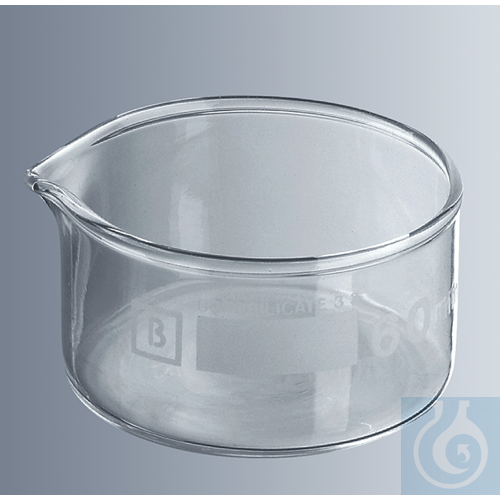
Crystallising dishes 80x45 mm (Ø x H), 90 ml are cylindrical laboratory vessels fabricated from borosilicate glass 3.3 for crystallisation, evaporation and related preparative procedures. Each dish features a flat bottom, an integrated spout and a nominal volume of 0,09 l, with a diameter of 80 mm and a height of 45 mm. The cylindrical shape together with the flat base ensures stable placement during solvent removal and crystal growth. Supplied in packs of 10 pieces from manufacturer Marienfeld, the dishes are intended for everyday use in analytical, synthetic and educational laboratories. The spout allows controlled decanting of supernatants or crystal suspensions, while borosilicate glass 3.3 provides the expected chemical resistance and thermal behaviour of this glass type. The 80 mm by 45 mm dimensions give a convenient surface-to-volume ratio for medium-scale crystallisations. These vessels integrate readily into standard laboratory routines involving heating, cooling and visual monitoring of solid formation.
This article is part of Watch glasses & crystallising dishes, in Dishes, crucibles & porcelain.
Key features
- Pack size: 10 pc(s)
- Material: Borosilicate glass 3.3
- Diameter: 80 mm
- Height: 45 mm
- Nominal volume: 0,09 l
- EAN: 4250317311368
Recently viewed
You may also like
Questions about Crystallizing dishes 80x45 mm (Ø x H), 90 ml
What is this article?
Crystallizing dishes 80x45 mm (Ø x H), 90 ml is the article on this page. Luminix Health distributes Marienfeld for laboratory use. It sits in Watch glasses & crystallising dishes, inside Dishes, crucibles & porcelain, in Labware.
A watch glass is a shallow curved cover or a dish for drying a few grams. A crystallising dish is the flatter, wider dish a solution is left in while a solid comes out. Neither is volumetric. Diameter is the specification.
A dish is an open vessel for drying, evaporating or holding a solid. Porcelain and glazed ceramic take a higher temperature than borosilicate glass, which is why a crucible, not a beaker, goes into a furnace. A watch glass covers, or holds a small amount for drying. A mortar is for grinding. The temperature and the chemical, not the shape alone, choose the material. Laboratory ware of this family is listed under ISO laboratory ware.
Which category should I open next?
The category is Dishes, crucibles & porcelain. The sub-category is Watch glasses & crystallising dishes. The catalogue is Labware.
Shelves beside this one are Crucibles, Trays, bowls & tubs, Mortars & pestles, Evaporating dishes and Dishes (other).
What should I check before I order?
When this page shows a safety data sheet, use that manufacturer file. Hazard text does not belong in the sales description. For a pack size, a grade or a certificate that is not on the page, send a quote request or contact the team.
How does ordering and shipping work?
Luminix Health distributes this article from the heart of Europe. Articles in stock ship within 2–5 business days. Standard delivery is free from €250 excl. VAT. Cold-chain goods and dangerous goods under ADR are never included in that free delivery. The terms are in the Shipping Policy. The full brand index is on shop by brand. Who we are is on about us.
Which other categories should I open?
The seven catalogues are Labware, Lab chemicals, Lab instruments, Lab consumables, Chromatography equipment, Lab safety equipment and Life Science & Microbiology.