DAB Metal Enhancer, ready-to-use, for immunochemistry, 100 ml, plastic

SKU: 9204.1

Volume: 100 ml
Value Packs: 1 piece
Price:
Sale price€131,70

Description

DAB Metal Enhancer, ready-to-use, for immunochemistry, Density (D) ~1 g/cm³, Boiling point (bp) 100 °C, Storage temp. +15 to +25 °C

DAB metal enhancer is used to enhance the signal strength in peroxidase (HRP) detections and to modify the signal colour from brown to purplish gray. Applications include all immunochemical assays like immunohistochemistry and -cytochemistry as well as Western blotting, but DAB metal enhancer may also well be used during in situ hybridization.

Mechanism

When the DAB metal enhancer is applied, the sensitivity of DAB staining is about two times higher than with DAB alone.

Figure: Immunohistochemical staining of mouse small intestines with an anti-PCNA antibody. Minuscules: pure DAB substrate, capitals: detection supplemented by DAB enhancer (A: NiCl2, B: DAB Metal Enhancer, Art. No. 9204).A/a: Basic method using 0.6 mg/ml DAB in Tris-buffer.B/b: Detection performed with the ROTI®DAB Kit.
Directions for use

For application, the DAB substrate components and buffer reagents (for instance ROTI®DAB-Kit, Art. No. 9202) are simply diluted in DAB metal enhancer instead of water. The purplish gray precipitate resulting from the staining reaction can be detected in visible light and does not bleach during long-term storage. Since it is insoluble in aqueous and organic solvents, slides may be permanently mounted in hydrophilic, or, after dehydration, in hydrophobic mounting medium.

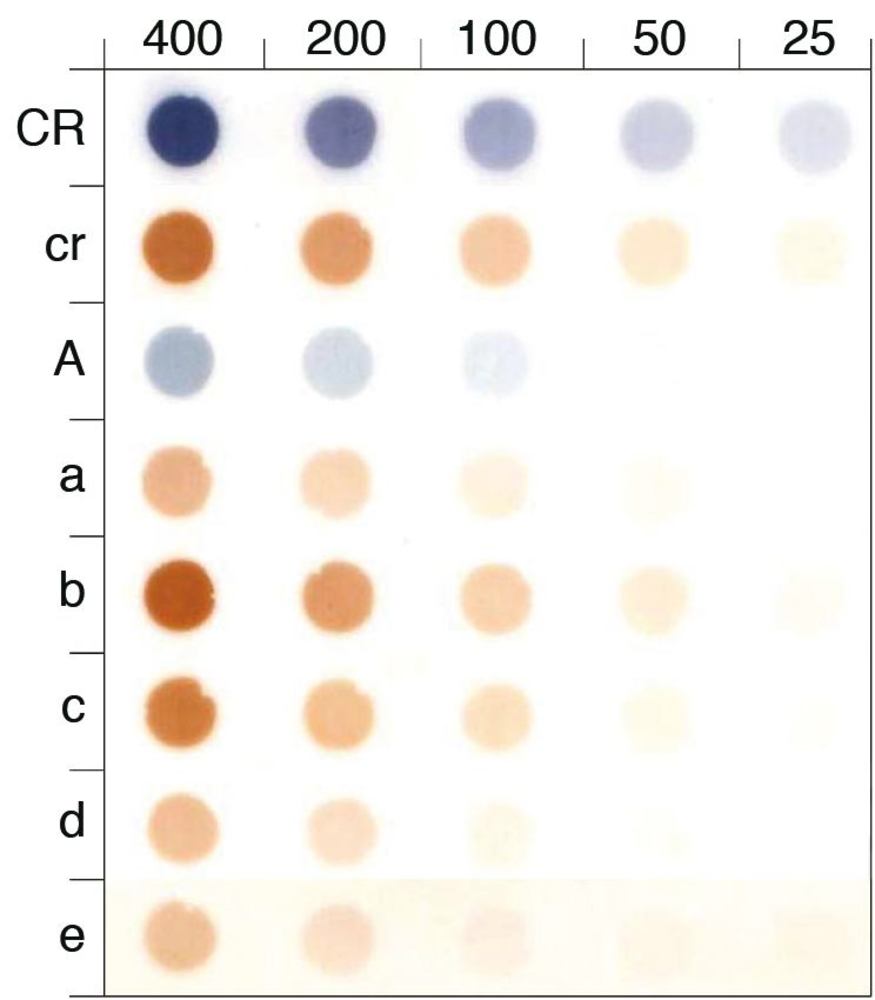
Figure 1: Dot blot of a HRP conjugated antibody (400, 200, 100, 50 and 25 pg).CR/cr: Detection using ROTI®DAB KitA-e: Detection using kits and DAB substrates from other suppliersCR: Detection under supplementation with DAB Metal EnhancerA: Detection under supplementation with NiCl2

Compliance & Safety Information

GHS08 Danger

Hazard Statements (H-Phrases)

H317 May cause an allergic skin reaction
H334 May cause allergy or asthma symptoms or breathing difficulties if inhaled
H341 Suspected of causing genetic defects
H350i H350i – No description available
H360D H360D – No description available
H372 Causes damage to organs through prolonged or repeated exposure
H412 Harmful to aquatic life with long lasting effects

Precautionary Statements (P-Phrases)

P273 P273 – No description available
P280 Wear protective gloves/protective clothing/eye protection/face protection.
P302+P352 IF ON SKIN: Wash with plenty of water.
P308+P313 IF exposed or concerned: Get medical advice/attention.

You may also like

Recently viewed