


Description
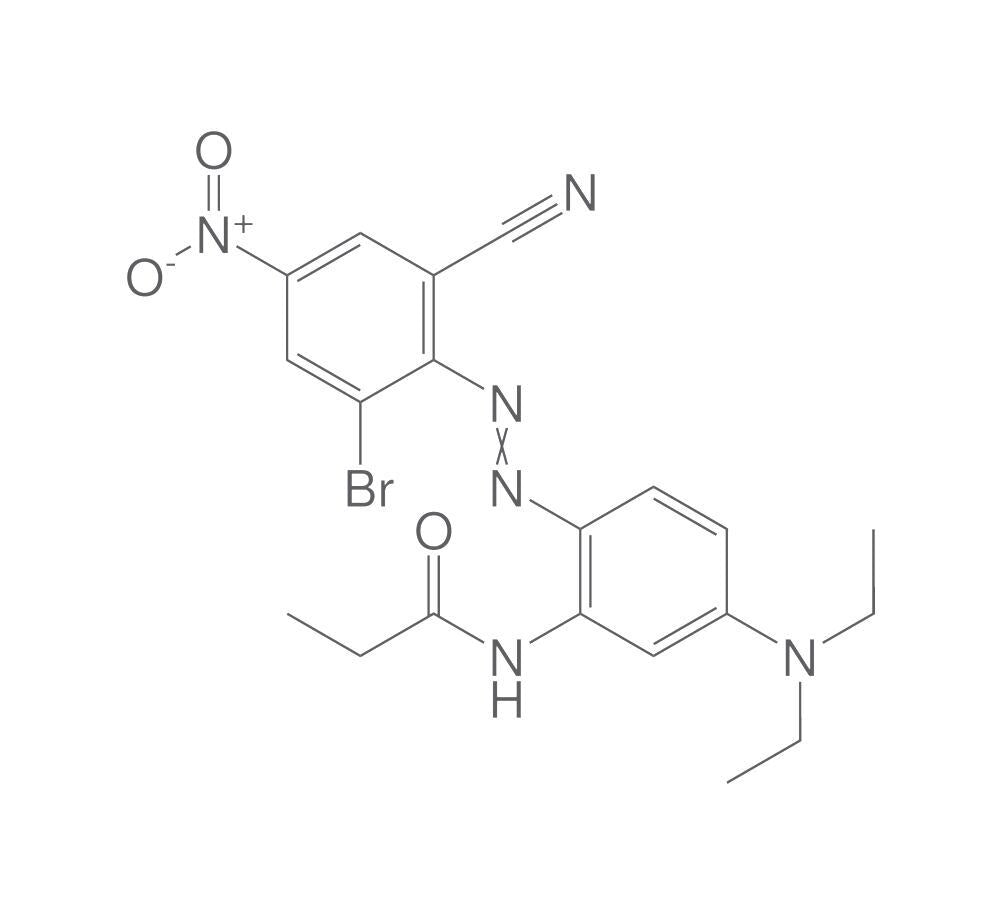
Disperse blue 183 is an organic colorant reagent supplied for laboratory chemical and biochemical applications. It is registered under CAS number 2309-94-6, with the empirical formula C₂₀H₂₁BrN₆O₃ and a molar mass of 473,32 g/mol. This listing provides, giving sufficient material for dyeing trials, analytical comparison, formulation screening, and educational or industrial laboratory work that requires a defined disperse blue dye. Physical identity is anchored by the stated molecular formula and molar mass, enabling accurate stoichiometric calculation and documentation in research notebooks and quality records. The product is offered from manufacturer Carl ROTH within its chemicals portfolio. Disperse dyes of this class are commonly employed when laboratories need reproducible coloration behaviour on hydrophobic substrates or when reference samples are prepared for spectroscopic and chromatographic methods. Consistent CAS and formula data support inventory control, safety assessment, and cross-site transfer of methods where the same dye identity must be maintained.
This article is part of Homogenisers & dispersers, in Stirring, shaking & mixing.
Key features
- Colour: blue to deep blue
- Form: powder
- Color intensity: 97-103 %
- CAS number: 2309-94-6
- Pack sizes: 250 g, 500 g, 1 kg
- Empirical formula: C₂₀H₂₁BrN₆O₃
- Molar mass: 473,32 g/mol
- Product type: Disperse blue dye
- Technical Information Sheet:

- Safety Data Sheet:
Recently viewed
You may also like
Browse related categories
Category
Sub-category
Catalogue
Brand
Questions about Disperse blue 183, 250 g
What is this article?
Disperse blue 183, 250 g is the article on this page. Luminix Health distributes Carl Roth for laboratory use. It sits in Homogenisers & dispersers, inside Stirring, shaking & mixing, in Lab instruments.
A homogeniser or disperser uses a rotor inside a stator to tear a sample and disperse it. Tip diameter and speed decide the particle size. A generator for 2 mL and a generator for 1 L are different tools on, sometimes, the same drive.
Stirring keeps a mixture uniform or helps a solid dissolve. A magnetic stirrer spins a bar inside a closed vessel. An overhead stirrer drives a shaft when the liquid is viscous or the volume is large. A vortex mixer agitates a tube. A shaker moves a whole rack or a plate. The shape of the impeller and the speed decide whether the liquid turns over or merely spins. The vessels being stirred are indexed under ISO laboratory glassware.
Which category should I open next?
The category is Stirring, shaking & mixing. The sub-category is Homogenisers & dispersers. The catalogue is Lab instruments.
Shelves beside this one are Magnetic stirring bars, Stirring shafts, propellers & impellers, Magnetic stirrers, Stirring & mixing accessories, Shakers, rockers & rotators, Overhead stirrers and Vortex mixers.
What should I check before I order?
When this page shows a safety data sheet, use that manufacturer file. Hazard text does not belong in the sales description. For a pack size, a grade or a certificate that is not on the page, send a quote request or contact the team.
How does ordering and shipping work?
Luminix Health distributes this article from the heart of Europe. Articles in stock ship within 2–5 business days. Standard delivery is free from €250 excl. VAT. Cold-chain goods and dangerous goods under ADR are never included in that free delivery. The terms are in the Shipping Policy. The full brand index is on shop by brand. Who we are is on about us.
Which other categories should I open?
The seven catalogues are Labware, Lab chemicals, Lab instruments, Lab consumables, Chromatography equipment, Lab safety equipment and Life Science & Microbiology.