
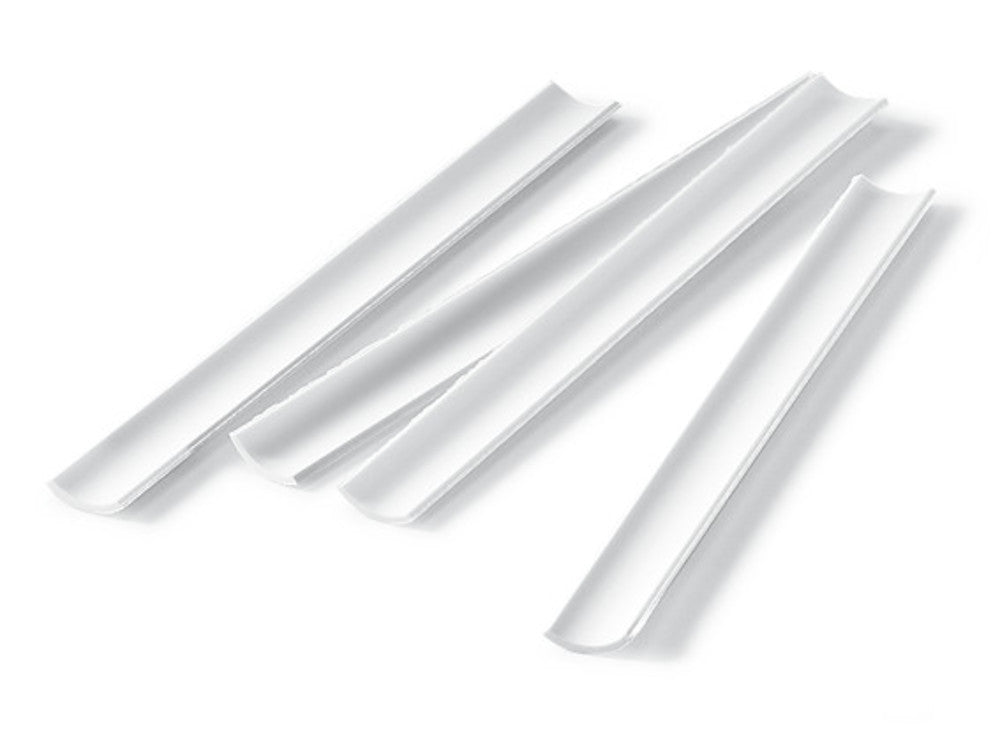


Description
Magnesia scoops are slender laboratory scoops measuring 9 mm in width and 100 mm in length, supplied for qualitative analytical work and cation detection routines. With a stated density of 3,58 g/cm³ and a boiling point of 3600 °C, the magnesia material withstands the high temperatures encountered in classic flame and bead tests. These scoops are used to introduce small solid samples into burner flames or to handle reagents during simple qualitative schemes in teaching and analytical laboratories. The pack contains 25 pieces and has a total weight of 0,065 kg, providing a practical stock for repeated classroom or routine bench use. Dimensions of 9 × 100 mm give a narrow profile that is convenient for precise sample placement. Magnesia scoops from manufacturer Carl ROTH belong to the range of qualitative detection aids employed alongside other cation-detection reagents and accessories. They support standardised handling of solids where thermal stability and a defined scoop geometry are required. Laboratories performing flame-based identification or related qualitative procedures can rely on this consistent format for day-to-day analytical preparation.
This article is part of Spatulas & spoons, in Tools & accessories.
Key features
- Pack sizes: 25 pc(s), 10 pc(s), 100 pc(s)
- Density: 3,58 g/cm³
- Boiling point: 3600 °C
- Product type: Magnesia scoops
- Dimensions: W 9 × L 100 mm
- Technical Information Sheet:

- Safety Data Sheet:
Recently viewed
You may also like
Browse related categories
Category
Sub-category
Catalogue
Brand
Questions about Magnesia scoops, W 9 x L 100 mm, 25 pieces
What is this article?
Magnesia scoops, W 9 x L 100 mm, 25 pieces is the article on this page. Luminix Health distributes Carl Roth for laboratory use. It sits in Spatulas & spoons, inside Tools & accessories, in Labware.
A spatula or spoon transfers a powder without pouring the whole bottle. The blade width and the material, steel or plastic or nickel, decide whether the tool contaminates the sample it touches.
The small tools of the bench are what the hand actually holds: a spatula for a powder, forceps for an object that must stay clean, a brush for a narrow neck, a desiccator when a dried sample must not take up water again. None of these reads a measurement. They keep the measurement possible. The apparatus around them is listed under ISO laboratory apparatus.
Which category should I open next?
The category is Tools & accessories. The sub-category is Spatulas & spoons. The catalogue is Labware.
Shelves beside this one are Other lab tools & accessories, Lab furniture, trolleys & storage, Tweezers & forceps, Scissors, scalpels & dissecting instruments, Weighing boats, dishes & paper, Desiccators & desiccant, Grease, boiling stones & sealants, Timers, stopwatches & calculators, Stationery, books & lab notebooks, Brushes & cleaning tools, Stirring rods, spreaders & glass tools, Cutting & sealing tools and Gas handling & burners accessories.
What should I check before I order?
The technical information on this page is the manufacturer's sheet. Read that, not a rewritten specification.
When this page shows a safety data sheet, use that manufacturer file. Hazard text does not belong in the sales description. For a pack size, a grade or a certificate that is not on the page, send a quote request or contact the team.
How does ordering and shipping work?
Luminix Health distributes this article from the heart of Europe. Articles in stock ship within 2–5 business days. Standard delivery is free from €250 excl. VAT. Cold-chain goods and dangerous goods under ADR are never included in that free delivery. The terms are in the Shipping Policy. The full brand index is on shop by brand. Who we are is on about us.
Which other categories should I open?
The seven catalogues are Labware, Lab chemicals, Lab instruments, Lab consumables, Chromatography equipment, Lab safety equipment and Life Science & Microbiology.