
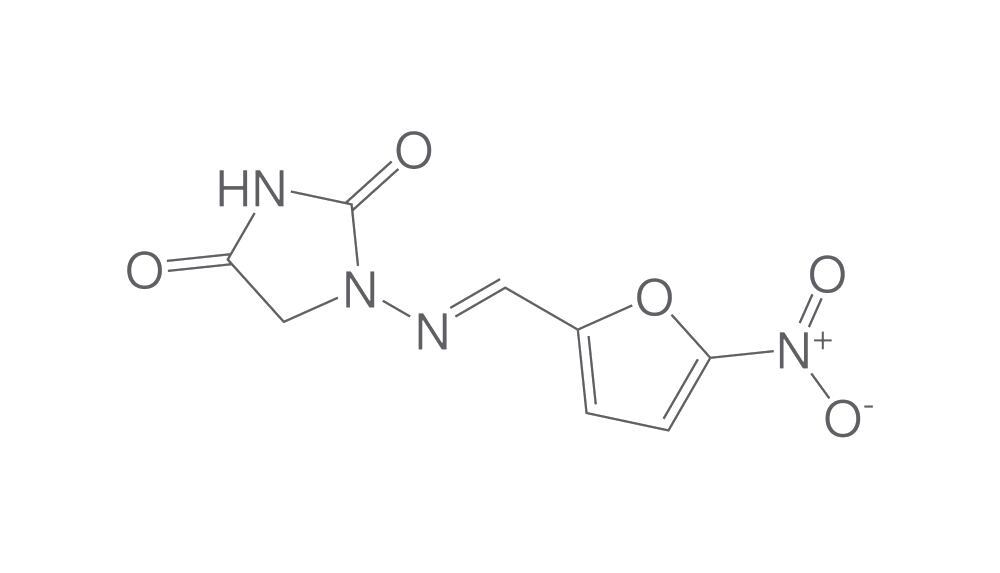


Description
Nitrofurantoin is a nitrofuran-class biochemical supplied at a minimum purity of 95 %, with CAS number 67-20-9 and empirical formula C₈H₆N₄O₅. Its molar mass is 238,16 g/mol, providing a defined molecular framework for research in medicinal chemistry, antimicrobial-related studies, and analytical method development. The product is Available from manufacturer Carl ROTH, this material supports synthetic elaboration, reference standard preparation, and biochemical screening workflows that require a nitrofurantoin scaffold of documented identity and assay. The larger unit quantity reduces reorder frequency while remaining practical for inventory control in academic, industrial, and contract research environments. Clear CAS designation and empirical formula facilitate regulatory documentation, safety assessment, and integration into electronic laboratory systems. Nitrofurantoin remains a relevant building block and study compound wherever nitrofuran chemistry intersects with life-science and fine-chemical research programmes.
This article belongs on Fluorescent dyes & labels, in Dyes, stains & indicators.
Key features
- Colour: yellow
- Form: powder to crystalline powder
- Purity (HPLC): ≥98 %
- CAS number: 67-20-9
- Pack sizes: 250 g, 500 g, 1 kg, 2 kg
- Purity: min. 95 %
- Empirical formula: C₈H₆N₄O₅
- Molar mass: 238,16 g/mol
- Storage temperature: +2 to +8 °C
- Technical Information Sheet:

- Safety Data Sheet:
Compliance & Safety Information
 Danger
Hazard Statements (H-Phrases)
Precautionary Statements (P-Phrases)
Recently viewed
You may also like
Browse related categories
Category
Sub-category
Catalogue
Brand
Questions about Nitrofurantoin, min. 95 %, 250 g
What is this article?
Nitrofurantoin, min. 95 %, 250 g is the article on this page. Luminix Health distributes Carl Roth for laboratory use. It sits in Fluorescent dyes & labels, inside Dyes, stains & indicators, in Lab chemicals.
A fluorescent dye absorbs at one wavelength and emits at a longer one. As a label it is attached to a protein, a nucleic acid or a cell. Excitation and emission maxima, and the reactive group if it must conjugate, are the specification. The colour name does not tell you the wavelengths.
A dye or a stain binds, or changes colour, so that something invisible becomes visible. An indicator changes at a pH or a redox point. A fluorescent dye absorbs one wavelength and emits another, which is how a microscope or a plate reader picks it out. The excitation and emission, or the transition interval, are the specification. The colour name on the label is not. Structures are on PubChem under IUPAC names. Methods are in the PubMed literature.
Which category should I open next?
The category is Dyes, stains & indicators. The sub-category is Fluorescent dyes & labels. The catalogue is Lab chemicals.
Shelves beside this one are Microscopy stains & staining solutions and Dyes & pigments.
What should I check before I order?
When this page shows a safety data sheet, use that manufacturer file. Hazard text does not belong in the sales description. For a pack size, a grade or a certificate that is not on the page, send a quote request or contact the team.
How does ordering and shipping work?
Luminix Health distributes this article from the heart of Europe. Articles in stock ship within 2–5 business days. Standard delivery is free from €250 excl. VAT. Cold-chain goods and dangerous goods under ADR are never included in that free delivery. The terms are in the Shipping Policy. The full brand index is on shop by brand. Who we are is on about us.
Which other categories should I open?
The seven catalogues are Labware, Lab chemicals, Lab instruments, Lab consumables, Chromatography equipment, Lab safety equipment and Life Science & Microbiology.