
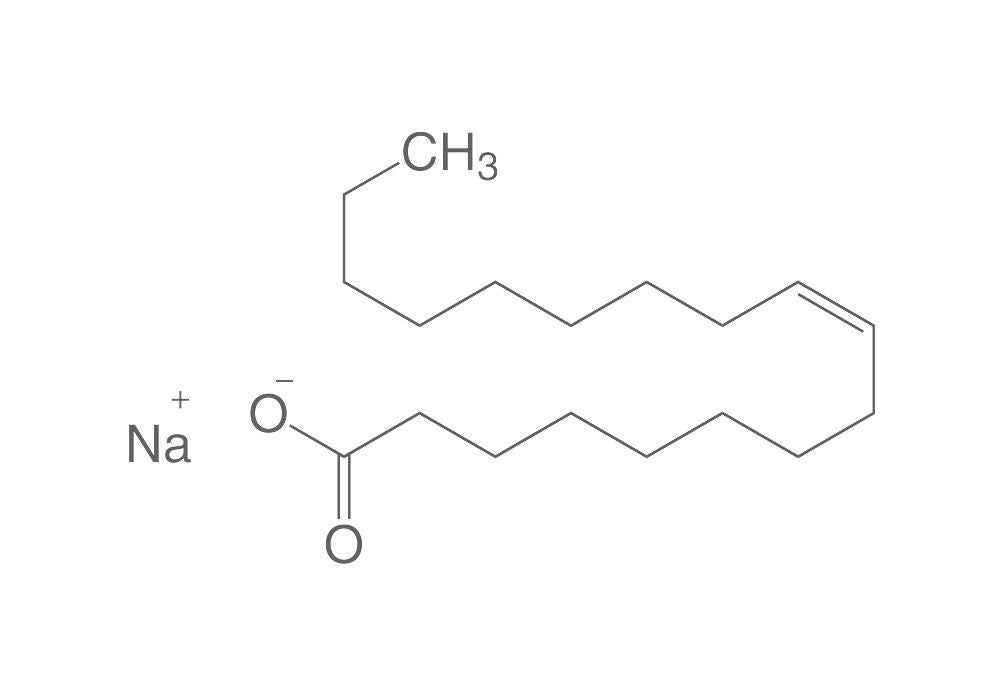


Description
Oleic acid sodium salt is a 90 % chemical reagent with CAS number 143-19-1 and empirical formula C₁₈H₃₃NaO₂. Key data include a molar mass of 304,47 g/mol, density of 1,02 g/cm³ and flash point of 220 °C, together with EG nr. 205-591-0. Offered in a 500 g plastic pack from manufacturer Carl ROTH, this sodium salt of oleic acid supports laboratory work where a defined fatty-acid salt is required. It is suitable for chemical synthesis, formulation studies and routine analytical or preparative tasks that specify sodium oleate. The stated physical properties aid weighing, dissolution and handling on the bench. A practical pack size suits research groups and process-development laboratories that need a reliable supply without excess bulk. Consistent composition helps maintain reproducibility when the salt is used as a reagent, intermediate or component in surfactant- and lipid-related preparations. Integrate it into established protocols wherever oleic acid sodium salt at this purity level is indicated.
This article is part of Lipids, steroids & fatty acids, in Biochemicals & reagents.
Key features
- Appearance: white to yellowish
- Total fatty acids: 88.0-92.0 %
- Moisture: 1.0-4.0 %
- Free NaOH: 0.2-0.6 %
- CAS number: 143-19-1
- Pack size: 500 g plastic
- EG nr.: 205-591-0
- Purity: 90 %
- Molar mass: 304,47 g/mol
- Density: 1,02 g/cm³
- Technical Information Sheet:

- Safety Data Sheet:
Recently viewed
You may also like
Questions about Oleic acid sodium salt, 90 %, 500 g, plastic
What is this article?
Oleic acid sodium salt, 90 %, 500 g, plastic is the article on this page. Luminix Health distributes Carl Roth for laboratory use. It sits in Lipids, steroids & fatty acids, inside Biochemicals & reagents, in Life Science & Microbiology.
A lipid, a steroid or a fatty acid is specified by chain length, saturation and purity. Esters and free acids are different compounds. Many are supplied in a small amount under inert gas because they oxidise. The physical form, oil or powder, follows from the structure.
A biochemical is a molecule of life, sold as a reagent: an amino acid, a sugar, a nucleotide, a lipid, an enzyme, an antibiotic. The difference from a bulk chemical is that the use is a biological one, and the impurities that matter are the ones that change that use. An enzyme is specified by activity, not only by mass. An antibiotic is specified by potency. Papers are on PubMed. Structures are on PubChem. Strains and lines that consume these reagents are at ATCC.
Which category should I open next?
The category is Biochemicals & reagents. The sub-category is Lipids, steroids & fatty acids. The catalogue is Life Science & Microbiology.
Shelves beside this one are Amino acids & peptides, Carbohydrates & sugars, Coenzymes, nucleotides & vitamins, Biochemicals (other), Enzymes & substrates, Antibiotics & antimycotics and Detergents & surfactants.
What should I check before I order?
When this page shows a safety data sheet, use that manufacturer file. Hazard text does not belong in the sales description. For a pack size, a grade or a certificate that is not on the page, send a quote request or contact the team.
How does ordering and shipping work?
Luminix Health distributes this article from the heart of Europe. Articles in stock ship within 2–5 business days. Standard delivery is free from €250 excl. VAT. Cold-chain goods and dangerous goods under ADR are never included in that free delivery. The terms are in the Shipping Policy. The full brand index is on shop by brand. Who we are is on about us.
Which other categories should I open?
The seven catalogues are Labware, Lab chemicals, Lab instruments, Lab consumables, Chromatography equipment, Lab safety equipment and Life Science & Microbiology.