



Description
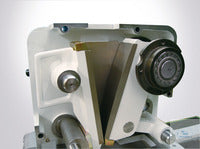
PULVERISETTE 1 classic line jaw crusher model 1 400 V/3~ 50 Hz is a laboratory jaw crusher for batchwise or continuous pre-crushing of coarse, hard to soft-brittle solid materials. Maximum feed size is 60 mm, continuous throughput reaches up to 140 kg/h, and final fineness is 1–15 mm depending on the gap setting. The unit works at 308 eccentric movements per minute, reducing the sample under high pressure between two crushing plates in a closed crushing chamber.
This article is part of Mills, grinders & homogenisers, in Test sieves & mills.
Fixed and movable crushing plates with lateral support walls in hardened steel form the standard equipment. Plates are available in five materials and can be exchanged easily; options include stainless steel, tungsten carbide hard metal, zirconia and manganese steel. The closed housing provides a dust-extraction connection and allows simple cleaning. The crusher can be combined with the PULVERISETTE 13 laboratory disc mill. Typical application fields are mining and metallurgy, chemistry, geology and mineralogy, glass, ceramics, and stones and earths. This model from manufacturer Fritsch operates on 400 V/3~ 50 Hz, carries CE marking and is supplied with a two-year warranty.
Key features
- Pack size: 1 pc
- EG nr.: centric movements: 308/min
- Power supply: 400 V/3~ 50 Hz
- Max. feed size: 60 mm
- Max. continuous throughput: 140 kg/h
- Final fineness: 1–15 mm
Recently viewed
You may also like
Questions about PULVERISETTE 1 classic line Jaw Crusher model 1 400 V/3~ 50 Hz
What is this article?
PULVERISETTE 1 classic line Jaw Crusher model 1 400 V/3~ 50 Hz is the article on this page. Luminix Health distributes Fritsch for laboratory use. It sits in Mills, grinders & homogenisers, inside Test sieves & mills, in Lab instruments.
A mill, grinder or homogeniser reduces particle size or breaks a tissue before an extraction. The rotor and the sieve insert decide the result. A knife mill and a bead mill are different machines. The sample has to tolerate the heat the motor puts into it.
A test sieve sorts particles by whether they pass an opening. Wire mesh and perforated plate are two ways of making that opening, and the nominal size is not a suggestion. A sieve shaker repeats the motion so the result does not depend on how hard someone shook by hand. A mill or grinder makes the particles smaller before they are sieved. The certificate of the sieve, and the opening size, are what an audit asks for. Measurement practice around mass and dimension sits with the BIPM, EURAMET and BELAC.
Which category should I open next?
The category is Test sieves & mills. The sub-category is Mills, grinders & homogenisers. The catalogue is Lab instruments.
Shelves beside this one are Test sieves (wire mesh), Test sieves (perforated plate), Sieve shakers and Sieve accessories (lids, pans, rings).
What should I check before I order?
When this page shows a safety data sheet, use that manufacturer file. Hazard text does not belong in the sales description. For a pack size, a grade or a certificate that is not on the page, send a quote request or contact the team.
How does ordering and shipping work?
Luminix Health distributes this article from the heart of Europe. Articles in stock ship within 2–5 business days. Standard delivery is free from €250 excl. VAT. Cold-chain goods and dangerous goods under ADR are never included in that free delivery. The terms are in the Shipping Policy. The full brand index is on shop by brand. Who we are is on about us.
Which other categories should I open?
The seven catalogues are Labware, Lab chemicals, Lab instruments, Lab consumables, Chromatography equipment, Lab safety equipment and Life Science & Microbiology.