
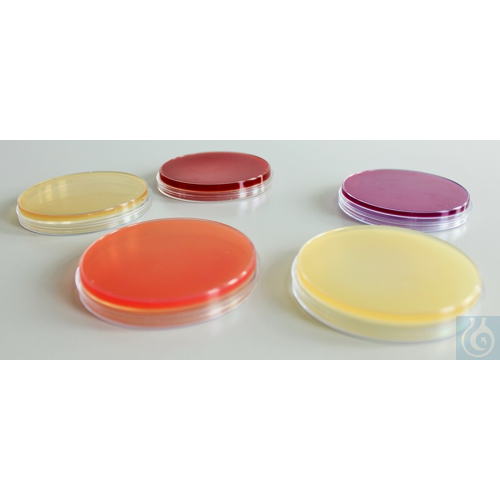


Description
Purple Lactose Agar Base, Modified is a dehydrated agar-base preparation for laboratory culture-media work involving lactose-containing solid media. The modified purple lactose agar base designation identifies a classic differential medium foundation used when laboratories prepare plates or slopes that incorporate lactose and a pH indicator system of the purple type. Supplied in a 5000 g pack, the product suits bulk media production in microbiology suites, quality-control laboratories, and teaching facilities that prepare larger volumes of solid media. Users reconstitute and complete the medium according to their validated recipes and autoclave procedures, retaining full control over final formulation and pouring. This agar base comes from manufacturer Dinkelberg and is classified among laboratory culture-media materials, with origin in Hungary. The generous pack quantity supports continuous media-kitchen schedules and helps limit order cycles for high-throughput environments. As a modified purple lactose agar base, it provides the foundational solids and nutrient matrix associated with this medium family. Handle the powder with standard precautions for dehydrated culture media and follow laboratory SOPs for weighing, dissolution, sterilisation, and plate preparation.
This article is part of Carbohydrates & sugars, in Biochemicals & reagents.
Key features
- Pack size: 5000 g
- Product type: Purple Lactose Agar Base, Modified
- Medium form: Agar base
- Format: Culture medium base
- Country of origin: Hungary
Recently viewed
You may also like
Browse related categories
Category
Sub-category
Catalogue
Brand
Questions about Purple Lactose Agar Base, Modified, 5000g
What is this article?
Purple Lactose Agar Base, Modified, 5000g is the article on this page. Luminix Health distributes Dinkelberg for laboratory use. It sits in Carbohydrates & sugars, inside Biochemicals & reagents, in Microbiology lab supplies.
A carbohydrate reagent is a sugar or a derivative, specified by identity, anomer where it matters, and purity. Hydrate and anhydrous forms change the mass. A culture-grade sugar and an analytical standard of the same name are different bottles.
A biochemical is a molecule of life, sold as a reagent: an amino acid, a sugar, a nucleotide, a lipid, an enzyme, an antibiotic. The difference from a bulk chemical is that the use is a biological one, and the impurities that matter are the ones that change that use. An enzyme is specified by activity, not only by mass. An antibiotic is specified by potency. Papers are on PubMed. Structures are on PubChem. Strains and lines that consume these reagents are at ATCC.
Which category should I open next?
The category is Biochemicals & reagents. The sub-category is Carbohydrates & sugars. The catalogue is Microbiology lab supplies.
Shelves beside this one are Amino acids & peptides, Coenzymes, nucleotides & vitamins, Biochemicals (other), Enzymes & substrates, Antibiotics & antimycotics, Lipids, steroids & fatty acids and Detergents & surfactants.
What should I check before I order?
When this page shows a safety data sheet, use that manufacturer file. Hazard text does not belong in the sales description. For a pack size, a grade or a certificate that is not on the page, send a quote request or contact the team.
How does ordering and shipping work?
Luminix Health distributes this article from the heart of Europe. Articles in stock ship within 2–5 business days. Standard delivery is free from €250 excl. VAT. Cold-chain goods and dangerous goods under ADR are never included in that free delivery. The terms are in the Shipping Policy. The full brand index is on shop by brand. Who we are is on about us.
Which other categories should I open?
The seven catalogues are Labware, Lab chemicals, Lab instruments, Lab consumables, Chromatography equipment, Lab safety equipment and Life Science & Microbiology.