
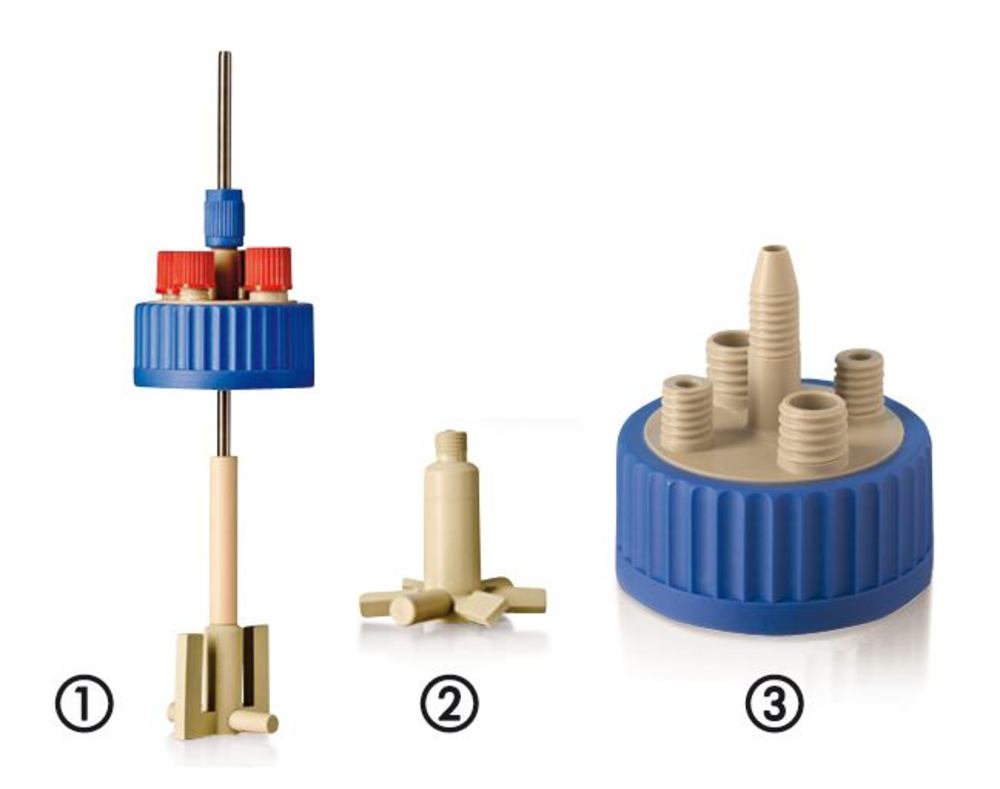



Description
Replacement shaft for GLS 80 stirrer reactor is a stainless-steel stirring shaft spare part intended for laboratory stirrer reactor systems fitted with a GLS 80 connection. The shaft is supplied complete with a PEEK screw joint, enabling secure mechanical coupling within the reactor assembly and reliable torque transmission during mixing. As a dedicated replacement component, it restores stirring function when the original shaft is bent, worn, or otherwise unsuitable for continued use. The unit is packed as 1 pc(s) and has a weight of 0,100 kg, making it a practical spare for maintenance inventories in synthesis, process chemistry, and general laboratory environments. Offered from manufacturer DWK Life Sciences, the shaft supports continued operation of GLS 80 stirrer reactors used with glass vessels, bottles, and related labware. Stainless steel construction provides mechanical strength for routine laboratory agitation tasks, while the included PEEK screw joint aids chemical compatibility at the fastening interface. Integrate this replacement shaft to maintain consistent mixing performance without replacing the full reactor setup, supporting efficient upkeep of multi-port stirred systems in research and teaching laboratories.
This article belongs on Reaction vessels & jacketed vessels, in Beakers & flasks.
Key features
- Pack size: 1 pc(s)
- Product type: Replacement stirrer shaft
- Compatibility: GLS 80 stirrer reactor
- Material: Stainless steel
- Joint: Incl. PEEK screw joint
- Weight: 0,100 kg
Recently viewed
You may also like
Questions about Replacement shaft, f. GLS 80 stirrer reactor, stainl. steel, 1 unit(s)
What is this article?
Replacement shaft, f. GLS 80 stirrer reactor, stainl. steel, 1 unit(s) is the article on this page. Luminix Health distributes DWK Life Sciences for laboratory use. It sits in Reaction vessels & jacketed vessels, inside Beakers & flasks, in Labware.
A reaction vessel is the flask a synthesis actually runs in, sometimes jacketed so a fluid can heat or cool the wall. The joints, the working volume and the jacket connections are the specification. It is not a storage bottle.
A beaker is an open working vessel: easy to pour, poor as a measure. An Erlenmeyer flask has a flat base and a conical wall so a liquid can be swirled without climbing out. A round-bottom flask is for heating under a condenser, because the heat meets a curved wall and the joint at the neck connects to the rest of the glassware. Borosilicate is the glass that survives the temperature change. These forms are listed under ISO laboratory glassware.
Which category should I open next?
The category is Beakers & flasks. The sub-category is Reaction vessels & jacketed vessels. The catalogue is Labware.
Shelves beside this one are Round-bottom flasks, Beakers, Erlenmeyer flasks, Flat-bottom flasks, Flasks (other) and Beaker & flask accessories.
What should I check before I order?
The technical information on this page is the manufacturer's sheet. Read that, not a rewritten specification.
When this page shows a safety data sheet, use that manufacturer file. Hazard text does not belong in the sales description. For a pack size, a grade or a certificate that is not on the page, send a quote request or contact the team.
How does ordering and shipping work?
Luminix Health distributes this article from the heart of Europe. Articles in stock ship within 2–5 business days. Standard delivery is free from €250 excl. VAT. Cold-chain goods and dangerous goods under ADR are never included in that free delivery. The terms are in the Shipping Policy. The full brand index is on shop by brand. Who we are is on about us.
Which other categories should I open?
The seven catalogues are Labware, Lab chemicals, Lab instruments, Lab consumables, Chromatography equipment, Lab safety equipment and Life Science & Microbiology.