
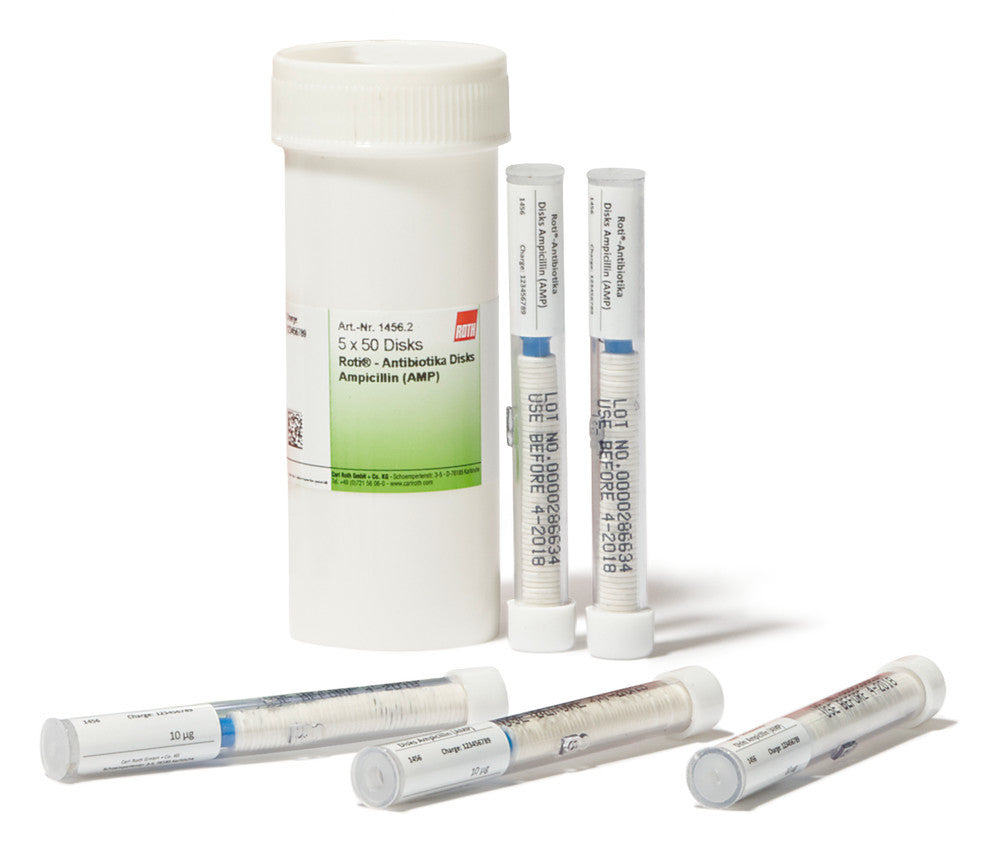


Description
ROTI®Antibiotic Discs Bacitracin (B) are ready-to-use discs impregnated with bacitracin at 10 units for microbiological antimicrobial susceptibility testing. They are intended for agar diffusion workflows in which laboratories evaluate bacterial sensitivity to this polypeptide antibiotic under controlled culture conditions. The discs form part of the ROTI® Antibiotics Disks line from manufacturer Carl ROTH and are designated for microbiology applications. A fixed 10-unit potency helps maintain comparable inhibition-zone results across experiments when standard diffusion procedures are followed. The unit quantity weighs 0,052 kg, offering a compact format that integrates easily with other antibiotic and antimycotic disc stocks. These bacitracin discs suit research, educational, and diagnostic-support laboratories seeking consistent, pre-loaded reference material for susceptibility work.
This article belongs on Antibiotics & antimycotics, in Biochemicals & reagents.
Key features
- Activity: 10 U
- Staphylococcus aureus ATCC 25923: 12-22 mm
- Pack sizes: 250 pc(s), 50 pc(s)
- Product type: Antibiotic discs for microbiology
- Active agent: Bacitracin (B)
- Potency: 10 units
- Technical Information Sheet:

- Safety Data Sheet:
Recently viewed
You may also like
Browse related categories
Category
Sub-category
Catalogue
Brand
Questions about ROTI®Antibiotic Discs Bacitracin (B), 10 units, for microbiology, 50 unit(s)
What is this article?
ROTI®Antibiotic Discs Bacitracin (B), 10 units, for microbiology, 50 unit(s) is the article on this page. Luminix Health distributes Carl Roth for laboratory use. It sits in Antibiotics & antimycotics, inside Biochemicals & reagents, in Life Science & Microbiology.
An antibiotic or an antimycotic for laboratory use is specified by potency, often micrograms per milligram, and by the spectrum it is used for in media. A hydrate and a free base differ in mass. Sterile solutions ready for culture and the dry powder are different articles. This is not a medicine for a patient.
A biochemical is a molecule of life, sold as a reagent: an amino acid, a sugar, a nucleotide, a lipid, an enzyme, an antibiotic. The difference from a bulk chemical is that the use is a biological one, and the impurities that matter are the ones that change that use. An enzyme is specified by activity, not only by mass. An antibiotic is specified by potency. Papers are on PubMed. Structures are on PubChem. Strains and lines that consume these reagents are at ATCC.
Which category should I open next?
The category is Biochemicals & reagents. The sub-category is Antibiotics & antimycotics. The catalogue is Life Science & Microbiology.
Shelves beside this one are Amino acids & peptides, Carbohydrates & sugars, Coenzymes, nucleotides & vitamins, Biochemicals (other), Enzymes & substrates, Lipids, steroids & fatty acids and Detergents & surfactants.
What should I check before I order?
When this page shows a safety data sheet, use that manufacturer file. Hazard text does not belong in the sales description. For a pack size, a grade or a certificate that is not on the page, send a quote request or contact the team.
How does ordering and shipping work?
Luminix Health distributes this article from the heart of Europe. Articles in stock ship within 2–5 business days. Standard delivery is free from €250 excl. VAT. Cold-chain goods and dangerous goods under ADR are never included in that free delivery. The terms are in the Shipping Policy. The full brand index is on shop by brand. Who we are is on about us.
Which other categories should I open?
The seven catalogues are Labware, Lab chemicals, Lab instruments, Lab consumables, Chromatography equipment, Lab safety equipment and Life Science & Microbiology.