


Description
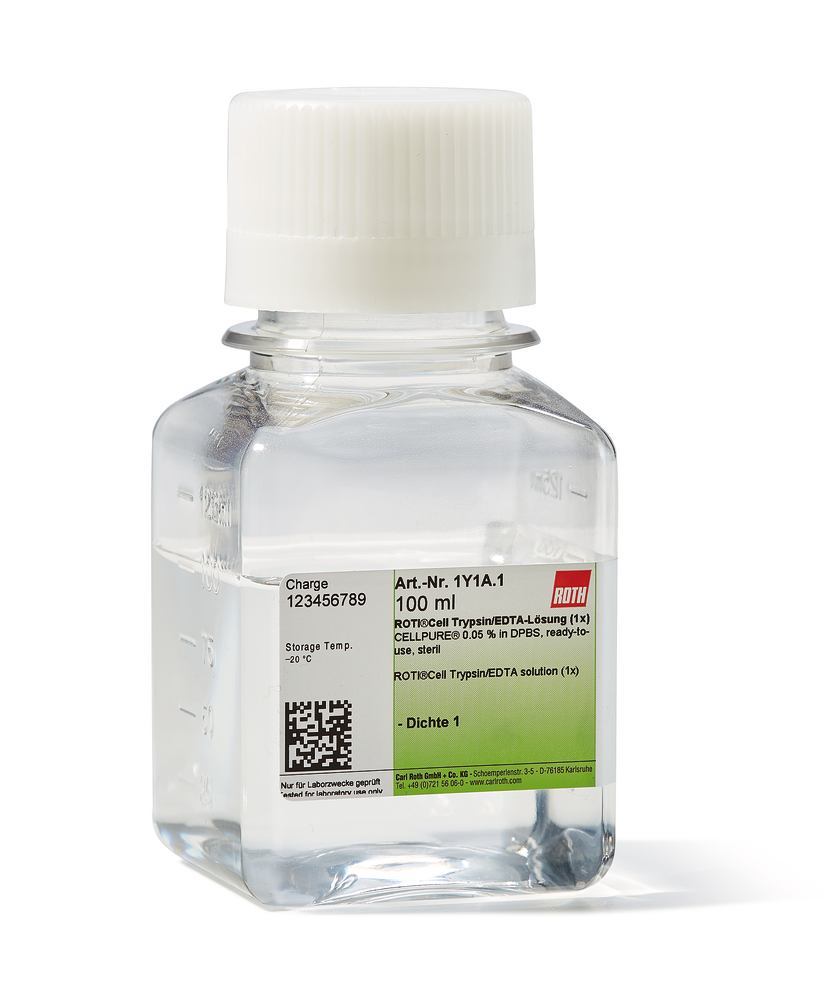
ROTI®Cell Trypsin/EDTA solution (1x), sterile, 1x, CELLPURE®, Density (D) 1 g/cm³, Storage temp. -20 °C
Trypsin is a protein-cleaving digestive enzyme of the pancreas belonging to the serine proteases, which cleaves lysine and arginine at the C-terminus. Trypsin solutions are used for the separation of cells from tissue or cell monolayers. Thus, they are essential for routine applications in cell culture passaging, for cell culture experiments to obtain an adequate number of cells or for dissociation of primary tissue.As an alternative to Trypsin, the morecell-protective solution ROTI®Cell Accutase solution can be used, which is free of mammalian components.
This trypsin solution contains EDTA. EDTA is a chelating agent and enhances the ability of trypsin to detach adherent cells. EDTA binds calcium and magnesium, which additionally weakens cell contacts. This favors the hydrolysis of specific peptide bonds by trypsin.
The required trypsin concentration depends primarily on the cell type and the age of the cell culture. For orientation, you will find a complete protocol in the technical info brochure.
After cell dissociation, trypsin should be inhibited. This can be done either by using FCS or trypsin inhibitors.
| Enzyme | Trypsin from porcine pancreas |
| Alternative name | Cell dissociation reagents |
| Use | Cell dissociation |
| Instructions for use, addition | Preparation of aliquots recommended to avoid repeated freeze-thaw cycles. |
Recently viewed
You may also like
Browse related categories
Category
Sub-category
Catalogue
Brand
Questions about ROTI®Cell Trypsin/EDTA solution (1x), sterile, 1x, CELLPURE®, 100 ml, plastic
What is this article?
ROTI®Cell Trypsin/EDTA solution (1x), sterile, 1x, CELLPURE®, 100 ml, plastic is the article on this page. Luminix Health distributes Carl Roth for laboratory use. It sits in Enzymes & substrates, inside Biochemicals & reagents, in Life Science & Microbiology.
An enzyme is sold by activity, in units defined by a stated reaction, not only by milligrams. Source and specific activity are the specification. A substrate is the molecule that enzyme converts, often a chromogenic one so the reaction can be seen. Units from two suppliers are comparable only when the definition matches.
A biochemical is a molecule of life, sold as a reagent: an amino acid, a sugar, a nucleotide, a lipid, an enzyme, an antibiotic. The difference from a bulk chemical is that the use is a biological one, and the impurities that matter are the ones that change that use. An enzyme is specified by activity, not only by mass. An antibiotic is specified by potency. Papers are on PubMed. Structures are on PubChem. Strains and lines that consume these reagents are at ATCC.
Which category should I open next?
The category is Biochemicals & reagents. The sub-category is Enzymes & substrates. The catalogue is Life Science & Microbiology.
Shelves beside this one are Amino acids & peptides, Carbohydrates & sugars, Coenzymes, nucleotides & vitamins, Biochemicals (other), Antibiotics & antimycotics, Lipids, steroids & fatty acids and Detergents & surfactants.
What should I check before I order?
The technical information on this page is the manufacturer's sheet. Read that, not a rewritten specification.
When this page shows a safety data sheet, use that manufacturer file. Hazard text does not belong in the sales description. For a pack size, a grade or a certificate that is not on the page, send a quote request or contact the team.
How does ordering and shipping work?
Luminix Health distributes this article from the heart of Europe. Articles in stock ship within 2–5 business days. Standard delivery is free from €250 excl. VAT. Cold-chain goods and dangerous goods under ADR are never included in that free delivery. The terms are in the Shipping Policy. The full brand index is on shop by brand. Who we are is on about us.
Which other categories should I open?
The seven catalogues are Labware, Lab chemicals, Lab instruments, Lab consumables, Chromatography equipment, Lab safety equipment and Life Science & Microbiology.