



Description
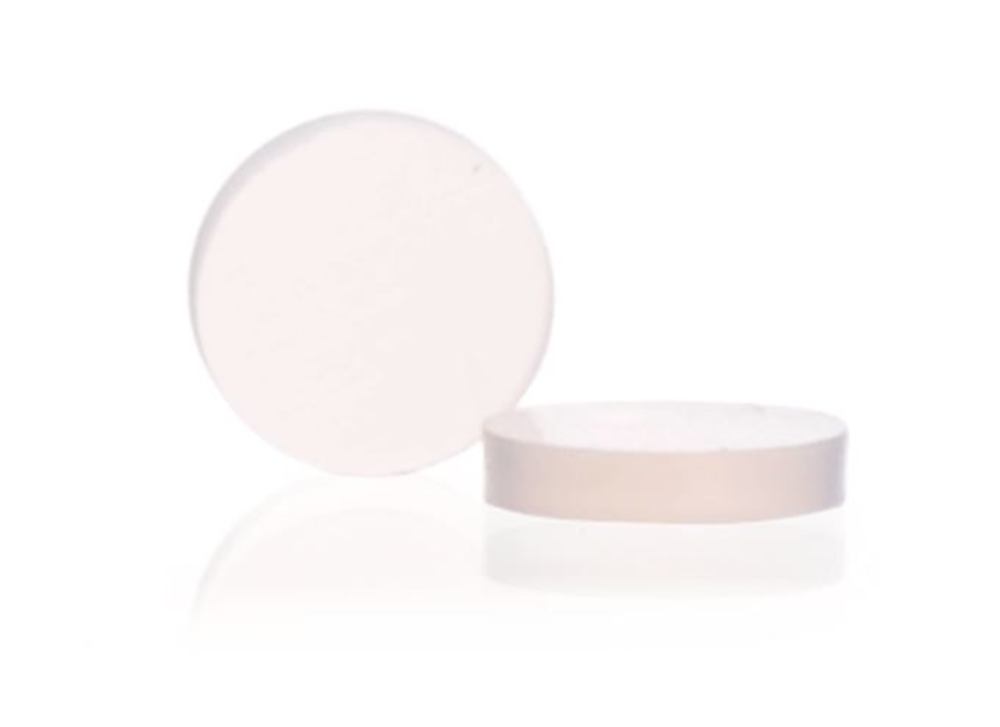
Silicone rubber septa for GL 14 closures provide a resilient sealing disc for laboratory bottles, vessels and related consumable assemblies. Each septum measures 12 mm in diameter with a thickness of 2 mm, matching common GL 14 screw-cap geometries used in seals, hose connectors and accessory work. The silicone rubber construction supports repeated needle or connector access where a soft, elastic barrier is required between the exterior and the vessel interior. Packaged as 20 pieces with a unit weight of 0,001 kg, the set is practical for routine restocking of laboratory glassware and plasticware stations. These septa fit within the broader category of containers, bottles, tins and canisters accessories, where dependable disc seals maintain closure integrity during storage, sampling or transfer steps. Offered from manufacturer DWK Life Sciences, they are specified purely by material, GL size, diameter and thickness, without added sterility or purity grades. Use them wherever GL 14 silicone septa of 12 mm diameter and 2 mm thickness are called for in standard lab sealing applications.
This article is part of Polymers, PEGs & silicones, in Organic chemicals & synthesis reagents.
Key features
- Pack size: 20 pc(s)
- Material: Silicone rubber
- Thread compatibility: GL 14
- Diameter: 12 mm
- Thickness: 2 mm
- Product type: Septum / sealing disc
Recently viewed
You may also like
Browse related categories
Category
Organic chemicals & synthesis reagents
Sub-category
Catalogue
Brand
Questions about Septa, made of silicone rubber, GL 14, Ø 12 mm, thickness 2 mm, 20 unit(s)
What is this article?
Septa, made of silicone rubber, GL 14, Ø 12 mm, thickness 2 mm, 20 unit(s) is the article on this page. Luminix Health distributes DWK Life Sciences for laboratory use. It sits in Polymers, PEGs & silicones, inside Organic chemicals & synthesis reagents, in Lab chemicals.
A polymer, a PEG or a silicone is sold by molecular weight, or by viscosity, as much as by name. PEG 400 and PEG 4000 are different liquids and solids. A silicone oil's viscosity grades are the product range. The average molecular weight is the specification.
An organic chemical is built on carbon. In this category it is a building block or a reagent for making another molecule: a starting material, a coupling agent, a polymer, a PEG. Purity is a specification of which impurities remain. The structure, the CAS number and the grade decide whether two bottles are the same substance. Structures and properties are on PubChem. Nomenclature is IUPAC. Classification follows ECHA and the CLP Regulation.
Which category should I open next?
The category is Organic chemicals & synthesis reagents. The sub-category is Polymers, PEGs & silicones. The catalogue is Lab chemicals.
Shelves beside this one are Organic building blocks & synthesis reagents and Click chemistry, bioconjugation & synthesis reagents.
What should I check before I order?
The technical information on this page is the manufacturer's sheet. Read that, not a rewritten specification.
When this page shows a safety data sheet, use that manufacturer file. Hazard text does not belong in the sales description. For a pack size, a grade or a certificate that is not on the page, send a quote request or contact the team.
How does ordering and shipping work?
Luminix Health distributes this article from the heart of Europe. Articles in stock ship within 2–5 business days. Standard delivery is free from €250 excl. VAT. Cold-chain goods and dangerous goods under ADR are never included in that free delivery. The terms are in the Shipping Policy. The full brand index is on shop by brand. Who we are is on about us.
Which other categories should I open?
The seven catalogues are Labware, Lab chemicals, Lab instruments, Lab consumables, Chromatography equipment, Lab safety equipment and Life Science & Microbiology.