


Description
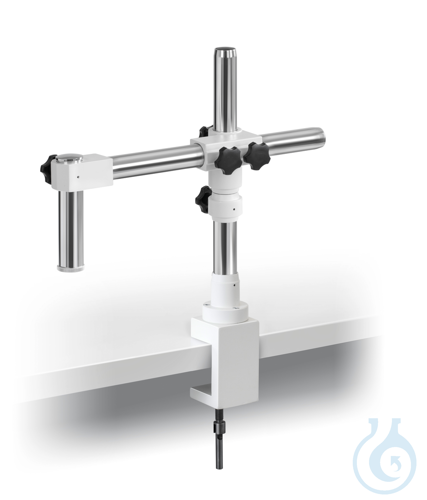
Stereo microscope stand KERN OZB-A1211 belongs to the ECO universal stand family and enables individual, modular configuration of stereo microscopes. Together with compatible base stands, microscope heads and external illumination units, the stand lets users assemble a system tailored to their preferred working style and application requirements. Flexible, adjustable universal stands support optimal handling of diverse samples in many laboratory disciplines. The smaller universal stands are supplied as stand-base variants and may optionally be equipped with a table clamp for attachment to the edge of a desk or workbench. Model-dependent arm options include a telescopic arm or a ball-bearing double-arm universal stand, both intended to improve reach and positioning comfort during routine microscopy. This single-piece unit from manufacturer Kern has a net weight of 10 kg and a gross weight of 12 kg. Packaging occupies 0,059682 m³ with height 0,29 m, width 0,49 m and depth 0,42 m, making the stand practical to store and ship while remaining ready for integration into stereo microscope workstations used in inspection, education and analytical settings.
This article is part of Stereo microscopes, in Microscopy & histology.
Key features
- Pack size: 1 pc
- Product type: Stereo microscope stand
- Series: ECO universal stand
- EAN: 4045761218307
- Technical Information Sheet:

Recently viewed
You may also like
Browse related categories
Category
Sub-category
Catalogue
Brand
Questions about Stereomicroscope Stands KERN OZB-A1211
What is this article?
Stereomicroscope Stands KERN OZB-A1211 is the article on this page. Luminix Health distributes Kern for laboratory use. It sits in Stereo microscopes, inside Microscopy & histology, in Lab instruments.
A stereo microscope gives a low-magnification, upright, three-dimensional view for dissecting, for sorting and for inspecting a surface. It is not the instrument for a stained section at high power. Working distance and zoom range are the choices.
A light microscope forms an image with glass lenses and transmitted or reflected light. A stereo microscope is the lower-magnification instrument for dissecting and for looking at a surface. Fluorescence needs a light source and filters matched to the dye. Histology is the preparation that makes a tissue readable: fixation, a cassette, a section, a stain. The objective's magnification and numerical aperture decide the resolution. The slide and the cover glass decide whether the section sits in the focal plane. Stains and dyes as substances are identified on PubChem. Papers on the methods are on PubMed.
Which category should I open next?
The category is Microscopy & histology. The sub-category is Stereo microscopes. The catalogue is Lab instruments.
Shelves beside this one are Microscope slides & cover glasses, Microscope objectives, eyepieces & optics, Histology cassettes & moulds, Counting chambers & haemocytometers, Light & fluorescence microscopes, Histology reagents & consumables, Microscopy accessories, Cold light sources & lighting and Digital & USB microscopes.
What should I check before I order?
When this page shows a safety data sheet, use that manufacturer file. Hazard text does not belong in the sales description. For a pack size, a grade or a certificate that is not on the page, send a quote request or contact the team.
How does ordering and shipping work?
Luminix Health distributes this article from the heart of Europe. Articles in stock ship within 2–5 business days. Standard delivery is free from €250 excl. VAT. Cold-chain goods and dangerous goods under ADR are never included in that free delivery. The terms are in the Shipping Policy. The full brand index is on shop by brand. Who we are is on about us.
Which other categories should I open?
The seven catalogues are Labware, Lab chemicals, Lab instruments, Lab consumables, Chromatography equipment, Lab safety equipment and Life Science & Microbiology.