
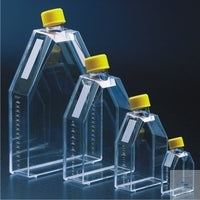


Description
Tissue culture flasks 75 cm² are polystyrene (PS) vessels designed for cell and tissue culture applications that need a larger growth surface than small flasks. The stated growth area of 75 cm² supports scale-up of adherent cultures while remaining convenient for standard laboratory incubators and handling routines. Clear polystyrene allows straightforward visual monitoring of culture status during incubation and media changes. These flasks are supplied in packs of 100 pieces, which is practical for laboratories running multiple parallel cultures or regular passage schedules. The 75 cm² format is a common intermediate size between compact starter flasks and large production vessels, helping match culture area to experimental needs and media volumes. Tissue culture flasks from manufacturer Witeg are positioned for routine cell culture, tissue culture and related laboratory workflows. Pack net weight is 0,249 kg. Polystyrene remains a widely used material for disposable culture ware thanks to its clarity and handling properties. Origin is Germany. Users select this size when a 75 cm² growth surface offers the right balance of capacity and footprint for expansion of cell lines, primary cultures or other adherent systems. No additional purity, sterility or surface-treatment claims are stated beyond the manufacturer data on material, growth area and pack quantity.
This article belongs on Cell culture flasks, in Cell culture.
Key features
- Pack size: 100 pc(s)
- Growth area: 75 cm²
- Material: Polystyrene (PS)
- Country of origin: Germany
- Region of origin: Bavaria
Recently viewed
You may also like
Browse related categories
Category
Sub-category
Catalogue
Brand
Questions about Tissue culture flasks polystyrene growth area 75 c
What is this article?
Tissue culture flasks polystyrene growth area 75 c is the article on this page. Luminix Health distributes Witeg for laboratory use. It sits in Cell culture flasks, inside Cell culture, in Life Science & Microbiology.
A culture flask is a flat vessel with a cap, treated so adherent cells attach, or untreated for suspension cells. Growth area in square centimetres, the cap filter or a plug seal, and the treatment are the specification. A filter cap allows gas exchange. A plug seal does not.
Cell culture grows cells outside the body. The medium, often with serum, supplies what the flask does not. A flask or a dish is the vessel, treated so the cells attach or left untreated so they float. Contamination by microbes, or by another cell line, is the ordinary failure. Cold-chain articles in this work, including serum, are never part of free standard delivery. Lines are catalogued by ATCC. Papers are on PubMed. Practice is summarised by the WHO laboratory biosafety topic.
Which category should I open next?
The category is Cell culture. The sub-category is Cell culture flasks. The catalogue is Life Science & Microbiology.
Shelves beside this one are Cell culture media & sera, Cell culture accessories, Cell culture plates & dishes and Cell strainers, inserts & scrapers.
What should I check before I order?
When this page shows a safety data sheet, use that manufacturer file. Hazard text does not belong in the sales description. For a pack size, a grade or a certificate that is not on the page, send a quote request or contact the team.
How does ordering and shipping work?
Luminix Health distributes this article from the heart of Europe. Articles in stock ship within 2–5 business days. Standard delivery is free from €250 excl. VAT. Cold-chain goods and dangerous goods under ADR are never included in that free delivery. The terms are in the Shipping Policy. The full brand index is on shop by brand. Who we are is on about us.
Which other categories should I open?
The seven catalogues are Labware, Lab chemicals, Lab instruments, Lab consumables, Chromatography equipment, Lab safety equipment and Life Science & Microbiology.