



Description
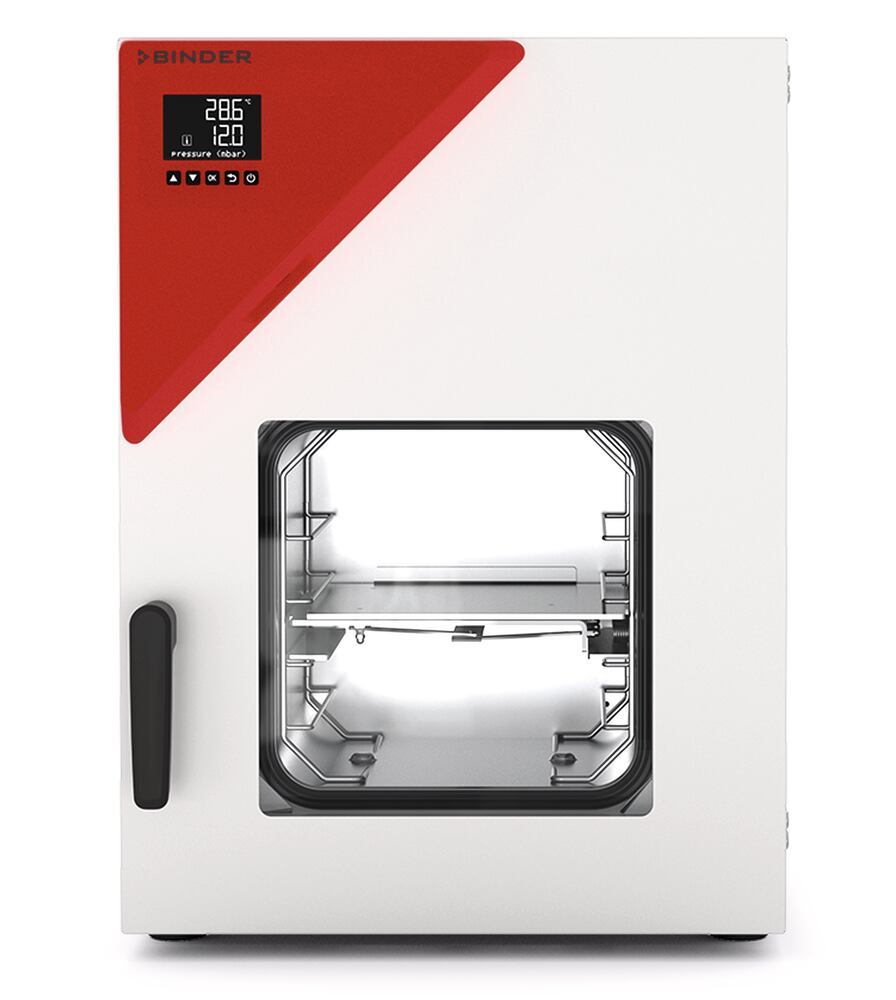
VD 23 vacuum drying cabinet is a compact laboratory vacuum drying unit for controlled drying under reduced pressure. It offers a usable chamber volume of 24 l and an operating temperature range from RT +10 to +220 °C, supporting gentle moisture removal from heat-sensitive samples, components and materials. An inert gas connection allows processing under protective atmosphere when oxidation-sensitive substances must be handled. One aluminium insert/expansion rack is included to organise loads inside the chamber and improve airflow around the samples. Supplied as a single complete unit with a net weight of 73,000 kg, this vacuum drying cabinet from manufacturer Binder is suited to research, quality-control and production laboratories that need reproducible vacuum drying conditions. The 24 l interior fits routine drying tasks, solvent removal and sample-preparation workflows where stable temperature control under vacuum is essential. Defined thermal limits and robust construction help maintain consistent process parameters across successive runs in chemistry, materials science and pharmaceutical environments.
This article belongs on Drying ovens & climate chambers, in Heating, drying & cooling.
Key features
- Pack size: 1 pc
- Chamber volume: 24 l
- Temperature range: RT +10 to +220 °C
- Inert gas connection: yes
- Includes: 1 aluminium insert/expansion rack
- Weight: 73,000 kg
Recently viewed
You may also like
Questions about VD 23 vacuum drying cabinets, with inert conn. 24 l, RT +10 - +220°C, 1 unit(s)
What is this article?
VD 23 vacuum drying cabinets, with inert conn. 24 l, RT +10 - +220°C, 1 unit(s) is the article on this page. Luminix Health distributes Binder for laboratory use. It sits in Drying ovens & climate chambers, inside Heating, drying & cooling, in Lab instruments.
A drying oven holds a temperature above ambient to drive off water or to condition a sample. A climate chamber also holds humidity. Uniformity across the chamber, not only the set point, decides whether two samples on different shelves saw the same conditions.
Temperature equipment either holds a set point or drives a sample toward one. An oven dries. A furnace reaches the temperatures of ashing and melting. A bath surrounds a vessel with water or oil. A circulator moves that fluid. An incubator holds the mild warmth of a culture. An autoclave uses steam under pressure to sterilise. The number that matters is the temperature the article actually reaches, not the number painted on the dial. Temperature is part of the international system kept by the BIPM and compared by EURAMET.
Which category should I open next?
The category is Heating, drying & cooling. The sub-category is Drying ovens & climate chambers. The catalogue is Lab instruments.
Shelves beside this one are Muffle & tube furnaces, Heating mantles, Circulators, chillers & thermostats, Water & oil baths, Hot plates & heating blocks, Incubators, Heating & cooling (other), Temperature control accessories, Laboratory refrigerators & freezers, Autoclaves & sterilisers, Bunsen & gas burners and Heating tapes, cables & plates.
What should I check before I order?
The technical information on this page is the manufacturer's sheet. Read that, not a rewritten specification.
When this page shows a safety data sheet, use that manufacturer file. Hazard text does not belong in the sales description. For a pack size, a grade or a certificate that is not on the page, send a quote request or contact the team.
How does ordering and shipping work?
Luminix Health distributes this article from the heart of Europe. Articles in stock ship within 2–5 business days. Standard delivery is free from €250 excl. VAT. Cold-chain goods and dangerous goods under ADR are never included in that free delivery. The terms are in the Shipping Policy. The full brand index is on shop by brand. Who we are is on about us.
Which other categories should I open?
The seven catalogues are Labware, Lab chemicals, Lab instruments, Lab consumables, Chromatography equipment, Lab safety equipment and Life Science & Microbiology.