
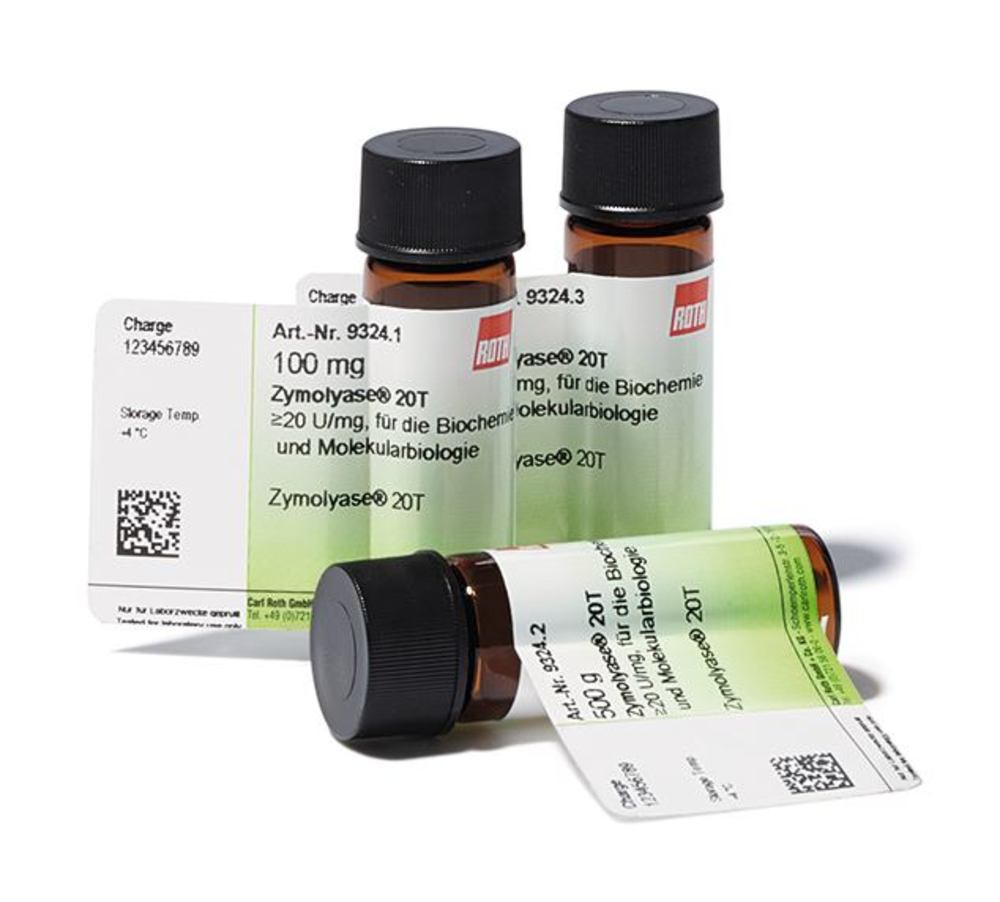


Description
Zymolyase® 20T, min. 20 U/mg, for biochemistry and molecular biology, Storage temp. +4 °C, CAS No. 37340-57-1
This article belongs on Biochemicals (other), in Biochemicals & reagents.
Zymolyase®, produced by a submerged culture of Oerskovia xanthineolytica, has strong lytic activity against living cell walls of various strains of yeast cells. Hence, it is frequently used in order to produce protoplasts or spheroplasts. The essential enzyme for the lytic activity of Zymolyase® is β-1,3-glucan laminaripentaohydrolase. It hydrolyzes linear glucose polymers with β-1,3-linkages and releases specifically laminaripentaose as the main and minimum product unit.
Other confirmed side activities: β-1,3-glucanase, protease, mannanase; occasionally traces of other hydrolytic activities (e.g. amylase, phosphatase).Stability: At 30 °C 70 % of the lytic activity is lost after 3 months. Optimum temperature and pH: at pH 7,5 - 35 °C for lysis of viable yeast cells, at pH 6,5 - 45 °C for hydrolysis of yeast glucan.
One unit of lytic activity is defined as the enzyme amount causing a decrease of 30 % in absorbance at 800 nm using 6 mg Brewer’s yeast as substrate in Phosphate buffer (pH 7,5) at 25 °C. Lytic activity varies depending on the particular yeast strain, the growth stage of the yeast, and cultural conditions.
Zymolyase® 20T is prepared by ammonium sulfate precipitatation.
| Additional info | Source: Arthrobacter luteus |
Recently viewed
You may also like
Browse related categories
Category
Sub-category
Catalogue
Brand
Questions about Zymolyase® 20T, min. 20 U/mg, for biochemistry and molecular biology, 100 mg
What is this article?
Zymolyase® 20T, min. 20 U/mg, for biochemistry and molecular biology, 100 mg is the article on this page. Luminix Health distributes Carl Roth for laboratory use. It sits in Biochemicals (other), inside Biochemicals & reagents, in Life Science & Microbiology.
These are the biochemical reagents that are not an amino acid, a sugar, a lipid, an enzyme or an antibiotic. Identity and purity still decide the bottle. If the compound is light-sensitive or hygroscopic, the handling on the label is part of the specification.
A biochemical is a molecule of life, sold as a reagent: an amino acid, a sugar, a nucleotide, a lipid, an enzyme, an antibiotic. The difference from a bulk chemical is that the use is a biological one, and the impurities that matter are the ones that change that use. An enzyme is specified by activity, not only by mass. An antibiotic is specified by potency. Papers are on PubMed. Structures are on PubChem. Strains and lines that consume these reagents are at ATCC.
Which category should I open next?
The category is Biochemicals & reagents. The sub-category is Biochemicals (other). The catalogue is Life Science & Microbiology.
Shelves beside this one are Amino acids & peptides, Carbohydrates & sugars, Coenzymes, nucleotides & vitamins, Enzymes & substrates, Antibiotics & antimycotics, Lipids, steroids & fatty acids and Detergents & surfactants.
What should I check before I order?
The technical information on this page is the manufacturer's sheet. Read that, not a rewritten specification.
When this page shows a safety data sheet, use that manufacturer file. Hazard text does not belong in the sales description. For a pack size, a grade or a certificate that is not on the page, send a quote request or contact the team.
How does ordering and shipping work?
Luminix Health distributes this article from the heart of Europe. Articles in stock ship within 2–5 business days. Standard delivery is free from €250 excl. VAT. Cold-chain goods and dangerous goods under ADR are never included in that free delivery. The terms are in the Shipping Policy. The full brand index is on shop by brand. Who we are is on about us.
Which other categories should I open?
The seven catalogues are Labware, Lab chemicals, Lab instruments, Lab consumables, Chromatography equipment, Lab safety equipment and Life Science & Microbiology.