
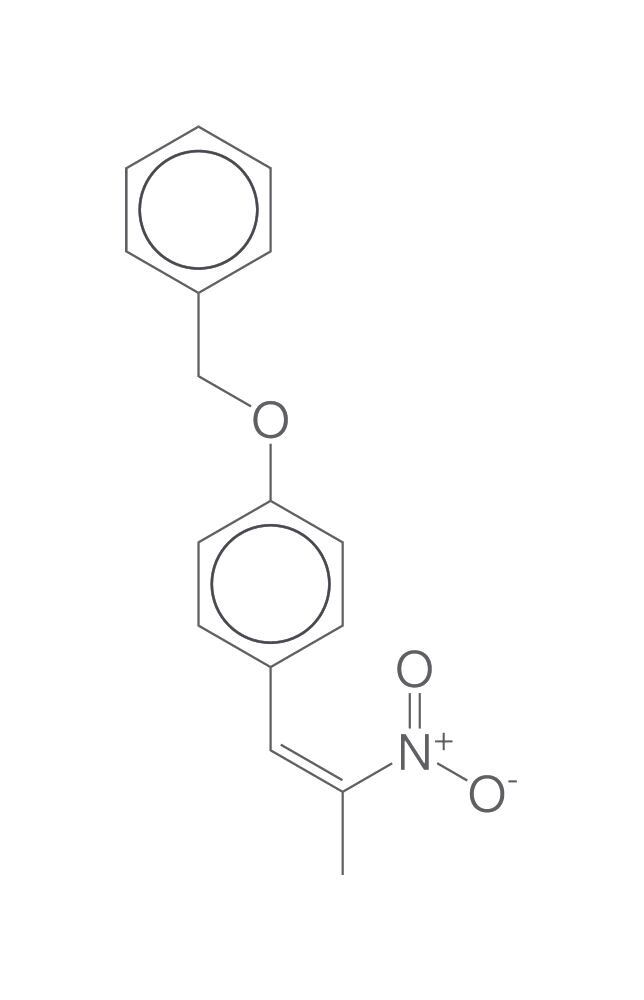


Description
Le 1-(4-benzyloxyphényl)-2-nitropropène est un bloc de construction nitroalcène proposé avec une pureté minimale de 95 % pour la chimie de laboratoire et la synthèse. Il est caractérisé par la formule brute C₁₆H₁₅NO₃, une masse molaire de 269,3 g/mol et le numéro CAS 7176-38-7, présentant un cycle aromatique substitué par un groupement benzyloxy conjugué à une unité nitropropène. Cette structure permet des additions conjuguées, des réductions et d'autres interconversions de groupes fonctionnels utilisés dans la construction d'intermédiaires azotés plus complexes. Les données fiables sur la masse molaire facilitent les calculs stoechiométriques précis lors des séquences multi-étapes. Disponible auprès du fabricant Carl ROTH, ce composé est destiné aux groupes de recherche en chimie médicinale et en chimie fine ayant besoin de nitroalcènes aromatiques définis. Il figure parmi les produits biochimiques et les nouveautés pour les laboratoires à la recherche de réactifs spécialisés polyvalents. Les précautions de laboratoire habituelles pour les composés nitrés doivent être respectées lors de sa manipulation et de son utilisation.
Cet article appartient à la catégorie Blocs de construction organiques & réactifs de synthèse, dans Produits chimiques organiques & réactifs de synthèse.
Caractéristiques principales
- Numéro CAS : 7176-38-7
- Conditionnements : 250 mg, 500 mg, 1 g, 2 g, 5 g
- Pureté : min. 95 %
- Formule brute : C₁₆H₁₅NO₃
- Masse molaire : 269,3 g/mol
- Poids : 0,001 kg
- Fiche technique :

Récemment consulté
Vous aimerez peut-être aussi
Browse related categories
Category
Organic chemicals & synthesis reagents
Sub-category
Organic building blocks & synthesis reagents
Catalogue
Brand
Questions about 1-(4-benzyloxyphenyl)-2-nitropropène, min. 95 %, 250 mg
What is this article?
1-(4-benzyloxyphenyl)-2-nitropropène, min. 95 %, 250 mg is the article on this page. Luminix Health distributes Carl Roth for laboratory use. It sits in Organic building blocks & synthesis reagents, inside Organic chemicals & synthesis reagents, in Produits chimiques.
A building block is an organic molecule bought to become part of a larger one. The structure, the CAS number and the purity decide it. A 95 percent reagent and a 99.9 percent reagent of the same name leave different impurities in the product. The functional groups are the reason it was chosen.
An organic chemical is built on carbon. In this category it is a building block or a reagent for making another molecule: a starting material, a coupling agent, a polymer, a PEG. Purity is a specification of which impurities remain. The structure, the CAS number and the grade decide whether two bottles are the same substance. Structures and properties are on PubChem. Nomenclature is IUPAC. Classification follows ECHA and the CLP Regulation.
Which category should I open next?
The category is Organic chemicals & synthesis reagents. The sub-category is Organic building blocks & synthesis reagents. The catalogue is Produits chimiques.
Shelves beside this one are Polymers, PEGs & silicones and Click chemistry, bioconjugation & synthesis reagents.
What should I check before I order?
When this page shows a safety data sheet, use that manufacturer file. Hazard text does not belong in the sales description. For a pack size, a grade or a certificate that is not on the page, send a quote request or contact the team.
How does ordering and shipping work?
Luminix Health distributes this article from the heart of Europe. Articles in stock ship within 2–5 business days. Standard delivery is free from €250 excl. VAT. Cold-chain goods and dangerous goods under ADR are never included in that free delivery. The terms are in the Shipping Policy. The full brand index is on shop by brand. Who we are is on about us.
Which other categories should I open?
The seven catalogues are Labware, Lab chemicals, Lab instruments, Lab consumables, Chromatography equipment, Lab safety equipment and Life Science & Microbiology.