
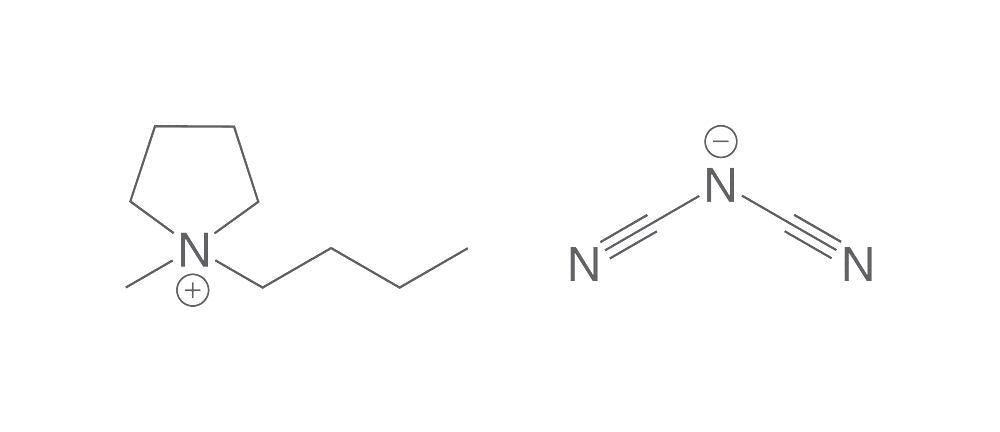


Description
Le dicyanamide de 1-butyl-1-méthylpyrrolidinium est un liquide ionique proposé avec une pureté minimale de 98 % pour les solvants de laboratoire et les travaux de chimie verte. Il possède la formule brute C₁₁H₂₀N₄, une masse molaire de 208,31 g/mol et une densité de 1,02 g/cm³, identifié par le numéro CAS 370865-80-8. Ce produit du fabricant Carl ROTH fournit un sel de dicyanamide de pyrrolidinium défini avec une composition et des propriétés physiques indiquées pour une utilisation reproductible en laboratoire. Il est classé parmi les solvants de substitution écologiques, les liquides ioniques étant évalués pour leur faible volatilité et leur polarité ajustable. Les données documentées de formule, masse molaire, densité et numéro CAS facilitent la rédaction des méthodes, l'évaluation de la sécurité et le contrôle des stocks. Il convient au criblage, au développement de procédés et aux essais analytiques dans les laboratoires académiques et industriels explorant des systèmes de solvants avancés basés sur les liquides ioniques de type dicyanamide.
Cet article fait partie de Solvants techniques et de synthèse, dans Solvants.
Caractéristiques principales
- Aspect : liquide jaune à brun
- Teneur : ≥98 %
- Eau (KF) : ≤0,2 %
- Halogènes : ≤2,0 %
- Numéro CAS : 370865-80-8
- Conditionnements : 25 g, 100 g
- Pureté : min. 98 %
- Formule brute : C₁₁H₂₀N₄
- Masse molaire : 208,31 g/mol
- Fiche technique :

- Fiche de données de sécurité :
Compliance & Safety Information
 Avertissement
Hazard Statements (H-Phrases)
Precautionary Statements (P-Phrases)
Récemment consulté
Vous aimerez peut-être aussi
Questions about 1-butyl-1-méthylpyrrolidinium, dicyanamide, min. 98 %, 25 g, verre
What is this article?
1-butyl-1-méthylpyrrolidinium, dicyanamide, min. 98 %, 25 g, verre is the article on this page. Luminix Health distributes Carl Roth for laboratory use. It sits in Technical & synthesis grade solvents, inside Solvents, in Produits chimiques.
Technical and synthesis grades are for cleaning, for a coarse extraction and for chemistry that does not end in a chromatogram. They cost less because more impurity is allowed. They are the wrong bottle to make a mobile phase or a volumetric standard.
A solvent dissolves. The grade says which impurities are low enough for the method. Analytical grade is the ordinary pure solvent. HPLC and LC-MS grades limit the absorbance and the ions that would become peaks or background. A dry solvent has had water removed. A deuterated solvent is for NMR, where the hydrogen signal would otherwise drown the sample. Technical grade is for cleaning and for synthesis that does not need a chromatogram. Identity is on PubChem. Names follow IUPAC. Hazards follow ECHA, the CLP Regulation and REACH.
Which category should I open next?
The category is Solvents. The sub-category is Technical & synthesis grade solvents. The catalogue is Produits chimiques.
Shelves beside this one are Analytical grade solvents (p.a.), HPLC & LC-MS grade solvents, Dry & deuterated solvents (NMR, synthesis) and Green & alternative solvents.
What should I check before I order?
The technical information on this page is the manufacturer's sheet. Read that, not a rewritten specification.
When this page shows a safety data sheet, use that manufacturer file. Hazard text does not belong in the sales description. For a pack size, a grade or a certificate that is not on the page, send a quote request or contact the team.
How does ordering and shipping work?
Luminix Health distributes this article from the heart of Europe. Articles in stock ship within 2–5 business days. Standard delivery is free from €250 excl. VAT. Cold-chain goods and dangerous goods under ADR are never included in that free delivery. The terms are in the Shipping Policy. The full brand index is on shop by brand. Who we are is on about us.
Which other categories should I open?
The seven catalogues are Labware, Lab chemicals, Lab instruments, Lab consumables, Chromatography equipment, Lab safety equipment and Life Science & Microbiology.