
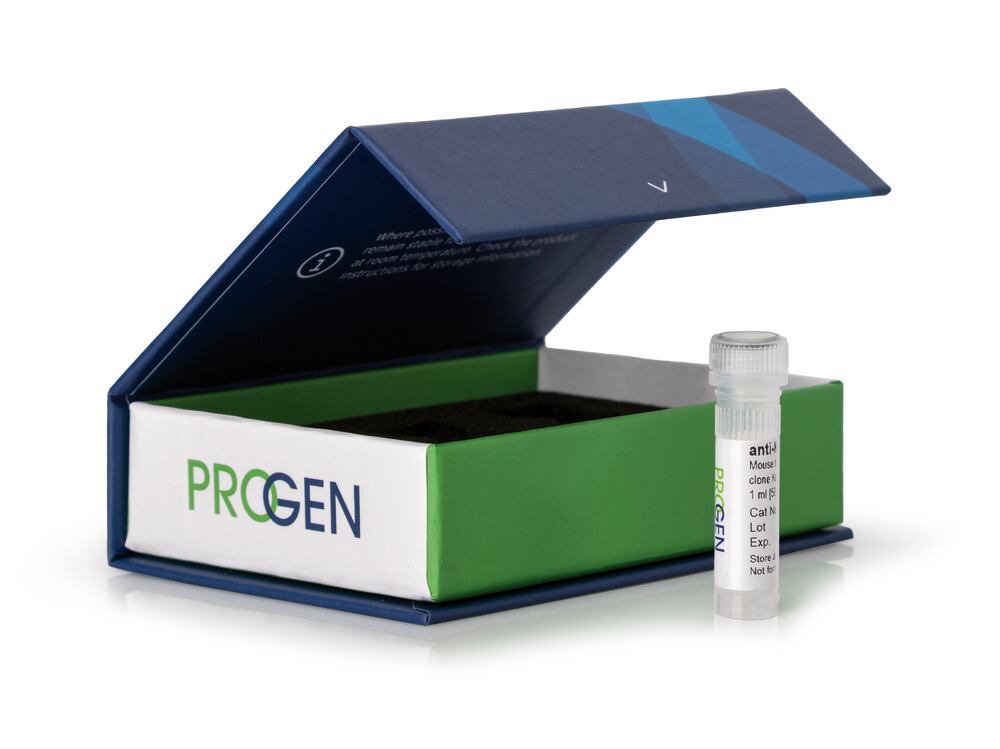


Description
anticorps monoclonal de souris anti-vimentine, VIM 3B44, 50 µg/ml, purifié par affinité (fabriqué par PROGEN), Densité (D) ~1 g/cm³, Point d'ébullition (pb) ~100 °C, Température de stockage +4 °C
Ce portefeuille d'anticorps comprend une large gamme d'anticorps primaires spécifiques aux tissus et aux tumeurs pour la recherche fondamentale, le développement de produits et l'analyse de diverses questions biologiques. Les anticorps monoclonaux sont parfaitement applicables à toutes les études de biologie cellulaire ou tissulaire et à l'analyse de marqueurs prédictifs en recherche.
- Haute affinité épitopique
- Détection hautement spécifique de la protéine cible
- Non conjugué
- Convient par exemple pour le western blot, l'immunoprécipitation, l'ELISA et l'immunofluorescence
L'anticorps est hautement spécifique de la protéine de filament intermédiaire vimentine, présente dans toutes les cellules d'origine mésenchymateuse. VIM 3B4 s'est avéré être le mab le plus avid pour la vimentine. Polypeptide réagissant : protéine de filament intermédiaire de 57 kDa (vimentine) des cellules mésenchymateuses. Tumeurs spécifiquement détectées : sarcome (y compris myosarcome), lymphome, mélanome. La région de liaison de l'anticorps monoclonal VIM3B4 a été caractérisée par Bohn et al. (1992). Selon ces auteurs, l'épitope a été localisé sur la partie alpha-hélicoïdale de la vimentine (domaine en bâtonnet, bobine 2). En raison d'une substitution d'acides aminés à la position 353 de la vimentine murine (qui pourrait expliquer la faible réaction croisée de l'anticorps avec la vimentine murine), ils ont pu affiner la région de liaison autour de la position 353. Ces résultats ont été confirmés par des expériences de mutagénèse par délétion utilisant la vimentine humaine (Rogers et al., 1995). Lignes cellulaires cultivées testées : fibroblastes (SV-80).
Immunocytochimie (ICC) : dépend de l'essai. Immunohistochimie (IHC) - congelée : 1:100-1:200 (250-500 ng/ml)
| Application | ICC/IF IHC WB |
| Espèce hôte | Souris |
| Clonalité | Monoclonal |
| Anticorps de réactivité | Amphibiens |
| Purification | Chromatographie d'affinité |
| Conjugué | Non conjugué |
| Concentration | 50 µg/ml |
| Isotype | IgG2a |
| ID Uniprot AK | P48616 (bovin), P09654 (poulet), P08670 (humain) |
| Clone | VIM 3B4 |
| Cible | Vimentine |
Récemment consulté
Vous aimerez peut-être aussi
Browse related categories
Category
Sub-category
Catalogue
Brand
Questions about anticorps monoclonal de souris anti-vimentine, VIM 3B4, 0,2 ml, plastique
What is this article?
anticorps monoclonal de souris anti-vimentine, VIM 3B4, 0,2 ml, plastique is the article on this page. Luminix Health distributes PROGEN for laboratory use. It sits in Primary antibodies, inside Antibodies & ELISA kits, in Milieux microbiologiques.
A primary antibody binds the target. Host species, clonality, clone name if monoclonal, the antigen, and the applications it was shown in, such as Western blot or immunohistochemistry, are the specification. A pretty band in the wrong application is not a promise.
An antibody binds one target. A primary antibody binds the molecule of interest. A secondary antibody binds the primary and usually carries the signal, an enzyme or a dye. An ELISA kit is that binding arranged in a well so the amount of target becomes a colour. The host species, the clone, the antigen and the stated application are the specification. A name alone is not. The literature is on PubMed. Sequences of the targets are on NCBI Nucleotide. Reference material is catalogued by ATCC.
Which category should I open next?
The category is Antibodies & ELISA kits. The sub-category is Primary antibodies. The catalogue is Milieux microbiologiques.
Shelves beside this one are ELISA kits, Recombinant proteins & cytokines and Secondary antibodies.
What should I check before I order?
The technical information on this page is the manufacturer's sheet. Read that, not a rewritten specification.
When this page shows a safety data sheet, use that manufacturer file. Hazard text does not belong in the sales description. For a pack size, a grade or a certificate that is not on the page, send a quote request or contact the team.
How does ordering and shipping work?
Luminix Health distributes this article from the heart of Europe. Articles in stock ship within 2–5 business days. Standard delivery is free from €250 excl. VAT. Cold-chain goods and dangerous goods under ADR are never included in that free delivery. The terms are in the Shipping Policy. The full brand index is on shop by brand. Who we are is on about us.
Which other categories should I open?
The seven catalogues are Labware, Lab chemicals, Lab instruments, Lab consumables, Chromatography equipment, Lab safety equipment and Life Science & Microbiology.