



Description
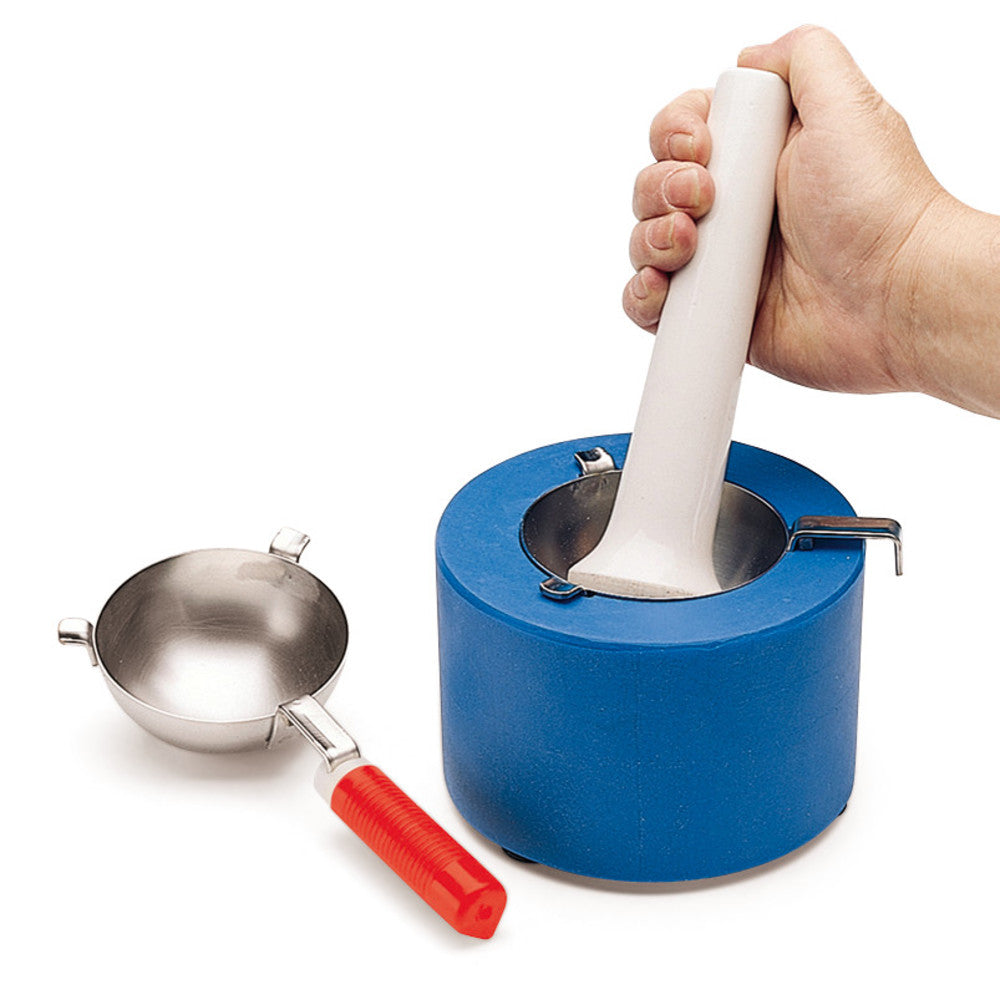
Le mortier cryo est un mortier de laboratoire destiné à la préparation et au broyage d'échantillons froids au sein du groupe plus large des coupelles, coupelles d'évaporation, mortiers et coupelles de broyage. L'unité est fournie comme une pièce et a un poids de 0.897 kg, ce qui en fait un outil de paillasse substantiel pour les flux de travail qui exigent un mortier cryo dédié plutôt qu'un mortier standard à température ambiante. Répertorié dans les catégories verre de laboratoire, récipients et consommables pour mortiers et coupelles de broyage, il prend en charge les étapes de réduction et d'homogénéisation d'échantillons réalisées dans des conditions cryogéniques ou à basse température, comme l'implique sa désignation cryo. Ce mortier cryo du fabricant Bel-Art Products est proposé comme une unité complète pour les laboratoires qui conservent des accessoires de broyage spécialisés aux côtés du matériel de laboratoire général. Utilisez-le lorsque les protocoles spécifient un mortier cryo pour la manipulation de matériaux réfrigérés ou congelés avant une analyse ou un traitement ultérieur. Le conditionnement simple en une unité simplifie la commande et le réapprovisionnement de remplacement. Avec un poids enregistré de 0.897 kg et une classification parmi les mortiers et coupelles de broyage, le produit est facile à placer dans les systèmes d'inventaire et à associer à des pilons complémentaires ou à des accessoires de manipulation à froid déjà utilisés sur la paillasse de laboratoire.
Cet article fait partie de Mortiers & pilons, dans Coupelles, creusets & porcelaine.
Caractéristiques
- Conditionnement: 1 pièce
- Type de produit: Mortier cryo
- Poids: 0.897 kg
- Domaine d'application: Broyage d'échantillons de laboratoire
Récemment consulté
Vous aimerez peut-être aussi
Questions about Mortier cryo, 1 unité
What is this article?
Mortier cryo, 1 unité is the article on this page. Luminix Health distributes Bel-Art Products for laboratory use. It sits in Mortiers & pilons, inside Coupelles, creusets & porcelaine, in Matériel de laboratoire.
A mortar and pestle grind a solid by hand. Porcelain is the ordinary laboratory set. Agate and glass are chosen when the sample must not pick up porcelain dust. The unglazed grinding surface, not the glossy outside, does the work.
A dish is an open vessel for drying, evaporating or holding a solid. Porcelain and glazed ceramic take a higher temperature than borosilicate glass, which is why a crucible, not a beaker, goes into a furnace. A watch glass covers, or holds a small amount for drying. A mortar is for grinding. The temperature and the chemical, not the shape alone, choose the material. Laboratory ware of this family is listed under ISO laboratory ware.
Which category should I open next?
The category is Coupelles, creusets & porcelaine. The sub-category is Mortiers & pilons. The catalogue is Matériel de laboratoire.
Shelves beside this one are Creusets, Plateaux, bols & bacs, Verres de montre & coupelles de cristallisation, Capsules à évaporation and Coupelles (autres).
What should I check before I order?
The technical information on this page is the manufacturer's sheet. Read that, not a rewritten specification.
When this page shows a safety data sheet, use that manufacturer file. Hazard text does not belong in the sales description. For a pack size, a grade or a certificate that is not on the page, send a quote request or contact the team.
How does ordering and shipping work?
Luminix Health distributes this article from the heart of Europe. Articles in stock ship within 2–5 business days. Standard delivery is free from €250 excl. VAT. Cold-chain goods and dangerous goods under ADR are never included in that free delivery. The terms are in the Shipping Policy. The full brand index is on shop by brand. Who we are is on about us.
Which other categories should I open?
The seven catalogues are Labware, Lab chemicals, Lab instruments, Lab consumables, Chromatography equipment, Lab safety equipment and Life Science & Microbiology.