


Description
DEGRAD INX X100, kit, pour lithographie multiphoton (MPL), densité (D) ~1 g/cm³, point d’éclair (flp) -17 °C, point d'ébullition (bp) 56,05 °C, température de stockage +2 à +8 °C, n° UN 3316
La technologie CURASOL© résout certaines des limites de traitement liées aux polymères photodurcissables traditionnels en offrant une excellente fidélité d'impression grâce à une impression à l'état fondu, associée à une réticulation efficace. Grâce à la technologie CURASOL©, la réticulation des encres induite par UV à l'état solide est 5 fois plus rapide par rapport aux encres à l'état fondu, ce qui permet de réduire les temps d'irradiation. Les structures imprimées offrent des plateformes stables ou biodégradables pour l'ensemencement cellulaire, utilisables pour les tissus plus durs (par ex. le cartilage).
DEGRAD INX© X100 est une résine synthétique à base de polyester pour des applications d'impression 3D par lithographie multiphoton. C'est la toute première encre biodégradable qui combine les avantages de biocompatibilité, de flexibilité et de facilité de traitement, aboutissant à des résolutions élevées (<500 nm). Les formulations prêtes à l'emploi DEGRAD INX© X100 peuvent être traitées via une imprimante basée sur la lithographie multiphoton après un court processus de préchauffage. La résine peut être traitée à des vitesses de balayage élevées (jusqu'à 100 mm/s), ce qui est favorable pour réduire les temps de fabrication.
- Upnano NanoOne
- Upnano NanoOneBio
- Nanoscribe Photonic Professional GT2
- Autres sur demande
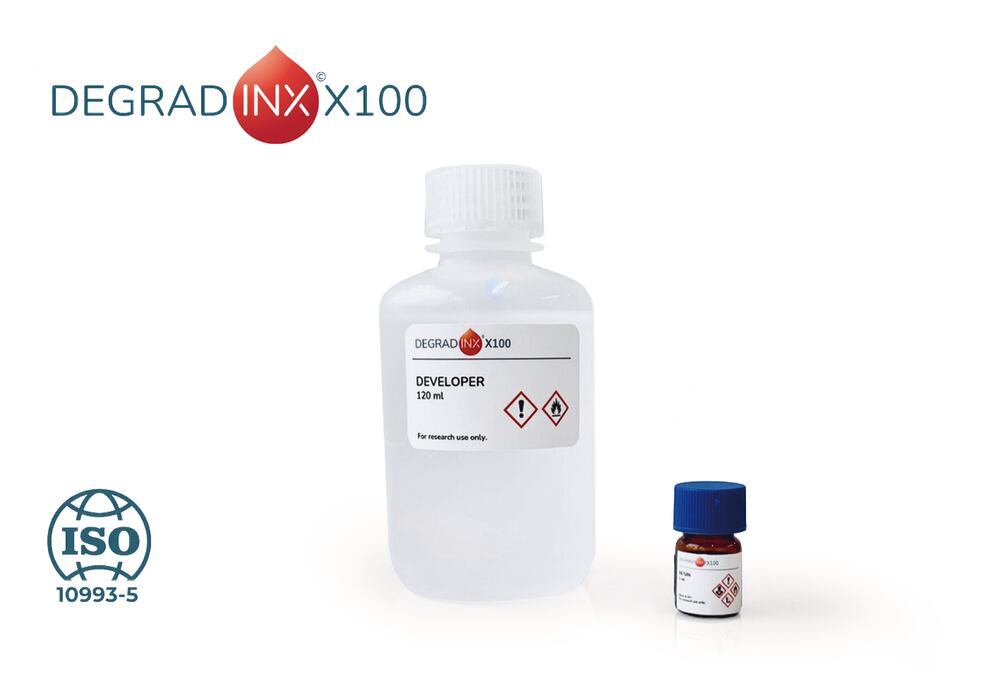
- Flacon de résine (1 ml)
- Grand flacon de développeur (120 ml)
- Floater BIO INX sur mesure
Kopinski-Grünwald O. et al., 2024, Scaffolded spheroids as building blocks for bottom-up cartilage tissue engineering show enhanced bioassembly dynamics, Acta Biomaterialia Zhang M. et al., 2023, Hydrogel muscles powering reconfigurable micro-metastructures with wide-spectrum programmability, Nature Materials Guillaume O. et al., 2022, Hybrid Spheroid Microscaffolds as Modular Tissue Units to Build Macro, Tissue Assemblies for Tissue Engineering, Acta Biomaterialia Gréant C. et al., 2023, Multiphoton Lithography as a Promising Tool for Biomedical Applications, Advanced Functional Materials
- Polyester biodégradable
- Résolution maximale (<500 nm)
- Très robuste et flexible
- Facile à traiter (CURASOL©)
| Technologie d'impression | Lithographie multiphoton (MPL) |
| Apparence | Liquide jaune-orange |
| Matériau | synthétique |
| Indice de réfraction | 1,46 - 1,48 |
| Viscosité | 0,5 - 3 Pa·s |
| Module de Young | 50 - 60 MPa |
| Résistance à la traction | 5 - 10 MPa |
| Allongement à la rupture | 20 - 30 % |
| Qté emb. | 1 kit |
| Application | Pas d'interaction cellulaire |
| Biocompatibilité | ISO 10993-5 |
Compliance & Safety Information


 Danger
Hazard Statements (H-Phrases)
Precautionary Statements (P-Phrases)
Récemment consulté
Vous aimerez peut-être aussi
Browse related categories
Category
Sub-category
3D printers, accessories & spare parts
Catalogue
Brand
Questions about DEGRAD INX X100, Kit, pour lithographie multiphotonique (MPL), 1 kit, carton
What is this article?
DEGRAD INX X100, Kit, pour lithographie multiphotonique (MPL), 1 kit, carton is the article on this page. Luminix Health distributes BIO INX© for laboratory use. It sits in 3D printers, accessories & spare parts, inside 3D printing & bioprinting, in Instruments de précision.
These are the printers themselves and the nozzles, beds and build plates that wear out. Nozzle diameter decides detail against speed. A spare nozzle for a different extruder thread does not fit. The printer's build volume is the largest object it can make.
A laboratory 3D printer builds a solid from a filament or a resin, layer by layer, when a shape is needed and a catalogue part does not exist. Bioprinting uses a bioink that contains, or will contain, living cells. The material decides the chemistry of the object and whether a cell will tolerate it. A filament that is only described as plastic is not a specification. Cell work around bioinks is discussed in the WHO biosafety topic and the papers are on PubMed.
Which category should I open next?
The category is 3D printing & bioprinting. The sub-category is 3D printers, accessories & spare parts. The catalogue is Instruments de précision.
Shelves beside this one are 3D printer filaments & resins and Bioinks & bioprinting materials.
What should I check before I order?
The technical information on this page is the manufacturer's sheet. Read that, not a rewritten specification.
When this page shows a safety data sheet, use that manufacturer file. Hazard text does not belong in the sales description. For a pack size, a grade or a certificate that is not on the page, send a quote request or contact the team.
How does ordering and shipping work?
Luminix Health distributes this article from the heart of Europe. Articles in stock ship within 2–5 business days. Standard delivery is free from €250 excl. VAT. Cold-chain goods and dangerous goods under ADR are never included in that free delivery. The terms are in the Shipping Policy. The full brand index is on shop by brand. Who we are is on about us.
Which other categories should I open?
The seven catalogues are Labware, Lab chemicals, Lab instruments, Lab consumables, Chromatography equipment, Lab safety equipment and Life Science & Microbiology.