


Description
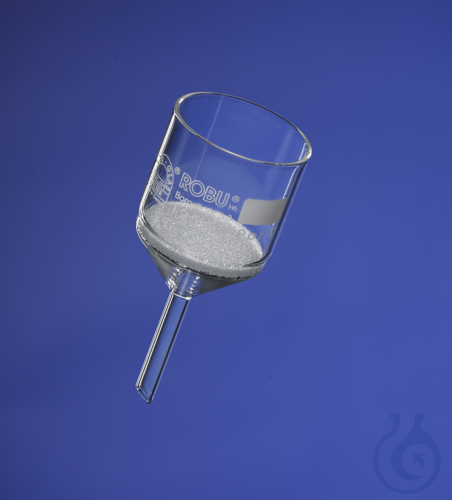
L'entonnoir filtrant 125 ml, porosité 5 est un entonnoir de filtration de laboratoire fabriqué en verre borosilicaté 3.3 et équipé d'une plaque filtrante VitraPOR® de 60 mm de diamètre. La hauteur au-dessus de la plaque filtrante est de 56 mm, offrant un volume utile pratique pour la filtration sous vide d'échantillons de petite à moyenne taille. Le grade de porosité 5 fournit une structure de fritté plus fine adaptée aux séparations solide-liquide fines en chimie analytique, en préparation d'échantillons et en travaux généraux de laboratoire. Cet entonnoir nutsche de type Büchner permet le recueil de précipités fins, le lavage de solides et la clarification de suspensions sans toujours nécessiter de papier filtre supplémentaire. La construction en borosilicate chimiquement résistante assure la durabilité dans les conditions typiques de laboratoire. Fourni comme une seule pièce du fabricant ROBU - Stereon, l'entonnoir associe des caractéristiques de pores fiables à une manipulation simple sur la paillasse. Sa capacité compacte de 125 ml le rend pratique pour la recherche de routine, le contrôle qualité et les applications d'enseignement où des performances de filtration fine constantes sont requises.
Cet article fait partie de Plaques filtrantes en verre fritté & disques, dans Filtration.
Caractéristiques
- Conditionnement: 1 pièce
- Matériau: Borosilicate 3.3
- Capacité: 125 ml
- Diamètre de plaque filtrante: 60 mm
- Porosité: 5
- Hauteur au-dessus de la plaque filtrante: 56 mm
Récemment consulté
Vous aimerez peut-être aussi
Browse related categories
Category
Sub-category
Plaques filtrantes en verre fritté & disques
Catalogue
Brand
Questions about Entonnoir filtrant, 125 ml, Por. 5
What is this article?
Entonnoir filtrant, 125 ml, Por. 5 is the article on this page. Luminix Health distributes ROBU - Stereon for laboratory use. It sits in Plaques filtrantes en verre fritté & disques, inside Filtration, in Consommables.
A sintered glass filter is a disc of fused glass particles with a porosity grade, often 0 to 5, from coarse to fine. It is cleaned and reused. The porosity number, not a micrometre guess, is the specification. Hydrofluoric acid and strong alkali attack the glass.
Filtration holds back what is larger than the pores and lets the rest through. Paper is the ordinary laboratory filter. A membrane has a stated pore size and a polymer that must survive the solvent. A syringe filter is that membrane in a housing on a syringe. Glass fibre takes a higher dirt load. Ultrafiltration holds back macromolecules and passes salts. The pore size, the chemical compatibility and the volume are the three choices. Laboratory apparatus around filtration is indexed under ISO laboratory apparatus.
Which category should I open next?
The category is Filtration. The sub-category is Plaques filtrantes en verre fritté & disques. The catalogue is Consommables.
Shelves beside this one are Papier filtre, Filtres seringue, Cartouches filtrantes & capsules, Filtres à membrane, Filtres en fibres de verre & de quartz, Unités de filtration sur flacon & sous vide, Ultrafiltration & concentrateurs, Accessoires de filtration, Cartouches d'extraction and Tubes de dialyse & dispositifs.
What should I check before I order?
When this page shows a safety data sheet, use that manufacturer file. Hazard text does not belong in the sales description. For a pack size, a grade or a certificate that is not on the page, send a quote request or contact the team.
How does ordering and shipping work?
Luminix Health distributes this article from the heart of Europe. Articles in stock ship within 2–5 business days. Standard delivery is free from €250 excl. VAT. Cold-chain goods and dangerous goods under ADR are never included in that free delivery. The terms are in the Shipping Policy. The full brand index is on shop by brand. Who we are is on about us.
Which other categories should I open?
The seven catalogues are Labware, Lab chemicals, Lab instruments, Lab consumables, Chromatography equipment, Lab safety equipment and Life Science & Microbiology.