
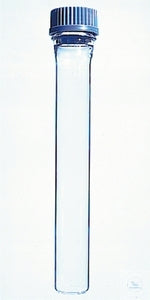


Description
Hybridisation bottles 38 x 300 mm are specialised laboratory vessels intended for hybridisation procedures in molecular biology and related life-science workflows. Fabricated from borosilicate glass 3.3, they combine chemical resistance with thermal stability needed for temperature-controlled incubations. Each bottle is fitted with a GL 45 cap and seal that provides a secure closure during rotation or static use. The 38 mm diameter by 300 mm length geometry supplies a practical working volume and surface area suited to roller-bottle systems and hybridisation ovens. Supplied as a single piece with a net weight of 0,226 kg, these bottles from manufacturer Witeg integrate readily into standard laboratory protocols. The robust glass construction tolerates repeated thermal cycling and exposure to common hybridisation buffers while retaining optical clarity for visual sample checks. Uniform wall thickness supports even heat transfer and mixing, which is advantageous for nucleic-acid hybridisation, blotting steps and similar techniques that demand consistent conditions. Their durable design reduces breakage risk and ensures compatibility with common laboratory rotators and temperature-control equipment.
This article is part of PCR, qPCR & nucleic acid analysis reagents, in Molecular biology.
Key features
- Pack size: 1 pc
- Material: Borosilicate glass 3.3
- Dimensions: 38 x 300 mm
- Cap type: GL 45 with seal
Récemment consulté
Vous aimerez peut-être aussi
Browse related categories
Category
Sub-category
PCR, qPCR & nucleic acid analysis reagents
Catalogue
Brand
Questions about Hybridization bottle 38 x 300 mm, with G
What is this article?
Hybridization bottle 38 x 300 mm, with G is the article on this page. Luminix Health distributes Witeg for laboratory use. It sits in PCR, qPCR & nucleic acid analysis reagents, inside Molecular biology, in Microbiologie.
PCR and qPCR reagents are the polymerase, the nucleotides, the buffer and often a ready master mix, plus the dyes a real-time instrument reads. Hot-start enzymes and proofreading enzymes are different tools. A master mix already contains nucleotides. Adding them again is a failed reaction.
Molecular biology here is the handling of DNA and RNA. Extraction kits break the cell and then separate the nucleic acid from protein and from the other nucleic acid. PCR and qPCR reagents copy a chosen sequence so it can be seen. The enzymes and the nucleotides are what the copy depends on. Nuclease contamination destroys the sample before the kit can save it. Sequences are on NCBI Nucleotide. Papers are on PubMed.
Which category should I open next?
The category is Molecular biology. The sub-category is PCR, qPCR & nucleic acid analysis reagents. The catalogue is Microbiologie.
Shelves beside this one are DNA & RNA extraction kits and Molecular biology reagents (other).
What should I check before I order?
When this page shows a safety data sheet, use that manufacturer file. Hazard text does not belong in the sales description. For a pack size, a grade or a certificate that is not on the page, send a quote request or contact the team.
How does ordering and shipping work?
Luminix Health distributes this article from the heart of Europe. Articles in stock ship within 2–5 business days. Standard delivery is free from €250 excl. VAT. Cold-chain goods and dangerous goods under ADR are never included in that free delivery. The terms are in the Shipping Policy. The full brand index is on shop by brand. Who we are is on about us.
Which other categories should I open?
The seven catalogues are Labware, Lab chemicals, Lab instruments, Lab consumables, Chromatography equipment, Lab safety equipment and Life Science & Microbiology.