


Description
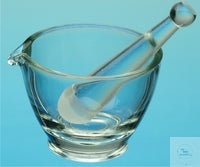
Le mortier Ø 150 mm, hauteur 110 mm est un bol de broyage de laboratoire destiné à concasser, mélanger et homogénéiser des échantillons solides plus importants. Fabriqué en verre borosilicaté 3.3, il offre la résistance chimique et la stabilité thermique attendues dans les environnements analytiques et de recherche de routine. Un pied stable maintient le récipient en sécurité sur la paillasse, tandis qu'un bec intégré permet le transfert contrôlé de poudres ou de pâtes après broyage. Un pilon assorti est inclus, de sorte que l'ensemble arrive prêt à l'emploi. Avec un diamètre extérieur de 150 mm et une hauteur de 110 mm, le mortier offre un volume de travail généreux pour la préparation d'échantillons dans les laboratoires de chimie, de pharmacie et de matériaux. La construction en verre clair facilite le contrôle visuel pendant le traitement et un nettoyage approfondi entre les séries. Ce mortier avec pied, bec et pilon du fabricant Witeg est fourni en une pièce et convient aux applications qui exigent de la verrerie de laboratoire durable et transparente. Le poids net est de 1.352 kg. Il convient bien à la pulvérisation de réactifs, à la préparation de mélanges homogènes et au travail général de broyage avec un ensemble robuste de mortier et de pilon en verre borosilicaté.
Cet article fait partie de Mortiers & pilons, dans Coupelles, creusets & porcelaine.
Caractéristiques
- Conditionnement: 1 pièce
- Matériau: Borosilicate glass 3.3
- Diamètre: 150 mm
- Hauteur: 110 mm
- Exécution: Avec pied, bec et pilon
Récemment consulté
Vous aimerez peut-être aussi
Questions about Mortier Ø:150 mm hauteur 110 mm
What is this article?
Mortier Ø:150 mm hauteur 110 mm is the article on this page. Luminix Health distributes Witeg for laboratory use. It sits in Mortiers & pilons, inside Coupelles, creusets & porcelaine, in Matériel de laboratoire.
A mortar and pestle grind a solid by hand. Porcelain is the ordinary laboratory set. Agate and glass are chosen when the sample must not pick up porcelain dust. The unglazed grinding surface, not the glossy outside, does the work.
A dish is an open vessel for drying, evaporating or holding a solid. Porcelain and glazed ceramic take a higher temperature than borosilicate glass, which is why a crucible, not a beaker, goes into a furnace. A watch glass covers, or holds a small amount for drying. A mortar is for grinding. The temperature and the chemical, not the shape alone, choose the material. Laboratory ware of this family is listed under ISO laboratory ware.
Which category should I open next?
The category is Coupelles, creusets & porcelaine. The sub-category is Mortiers & pilons. The catalogue is Matériel de laboratoire.
Shelves beside this one are Creusets, Plateaux, bols & bacs, Verres de montre & coupelles de cristallisation, Capsules à évaporation and Coupelles (autres).
What should I check before I order?
When this page shows a safety data sheet, use that manufacturer file. Hazard text does not belong in the sales description. For a pack size, a grade or a certificate that is not on the page, send a quote request or contact the team.
How does ordering and shipping work?
Luminix Health distributes this article from the heart of Europe. Articles in stock ship within 2–5 business days. Standard delivery is free from €250 excl. VAT. Cold-chain goods and dangerous goods under ADR are never included in that free delivery. The terms are in the Shipping Policy. The full brand index is on shop by brand. Who we are is on about us.
Which other categories should I open?
The seven catalogues are Labware, Lab chemicals, Lab instruments, Lab consumables, Chromatography equipment, Lab safety equipment and Life Science & Microbiology.