
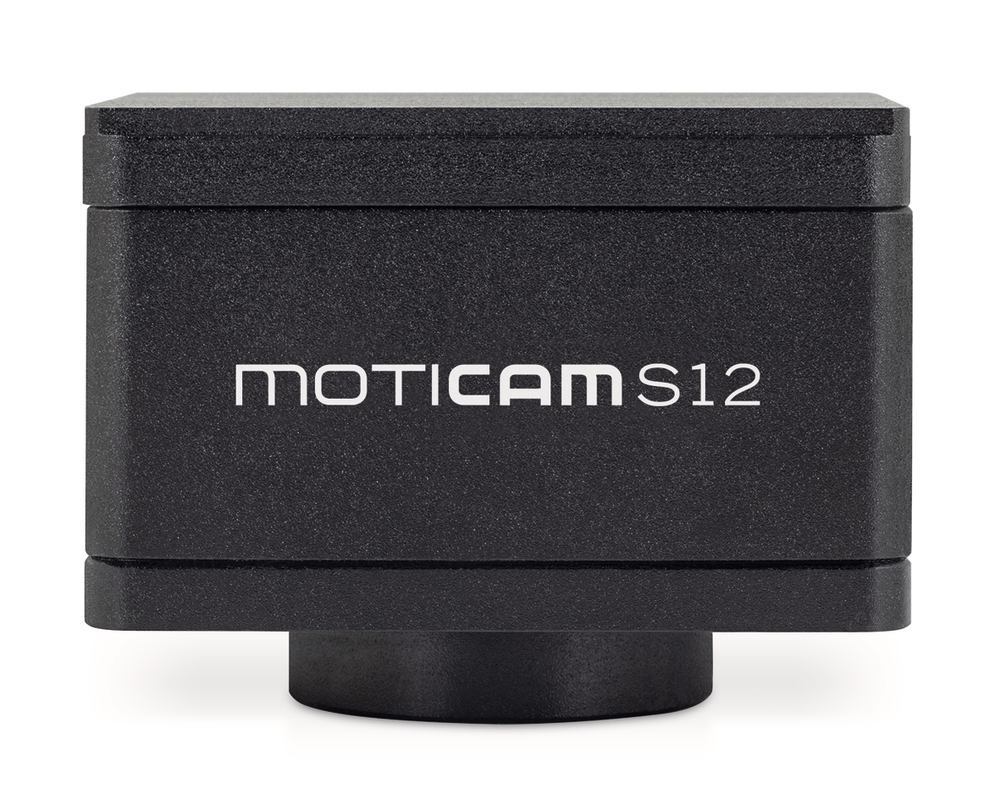


Description
La caméra de microscope Moticam S12 est une caméra numérique de laboratoire configurée pour l'imagerie microscopique, la documentation et la mesure étalonnée. L'unité est livrée avec un CS-Ring et un câble USB 3.1, permettant une intégration simple avec des configurations de microscope compatibles et des ordinateurs hôtes. L'étalonnage Motic 4 points et le logiciel Motic Images Plus 3 sont inclus, prenant en charge une mise à l'échelle précise et le traitement d'images pour les dossiers scientifiques, l'enseignement et l'analyse de routine. Conditionnée en 1 pièce avec un poids de 0.75 kg, la caméra convient aux postes fixes ou aux bancs d'instruments optiques partagés. Disponible du fabricant Motic, elle appartient à la catégorie des caméras de microscope utilisées avec les instruments optiques et le matériel de laboratoire associé. Les laboratoires qui recherchent un ensemble d'imagerie prêt à l'emploi bénéficient des accessoires matériels combinés, des outils d'étalonnage et du logiciel dédié, ce qui aide à standardiser la capture numérique d'échantillons microscopiques dans les environnements de recherche, de contrôle qualité et d'enseignement sans ajouter de composants superflus.
Cet article fait partie de Objectifs, oculaires & optiques de microscope, dans Microscopie et histologie.
Caractéristiques
- Conditionnement: 1 pièce
- Type de produit: Caméra de microscope
- Poids: 0.75 kg
- Accessoires inclus: CS-Ring, câble USB 3.1
- Étalonnage: Étalonnage Motic 4 points
- Logiciel: Motic Images Plus 3
- Technical Information Sheet:

Récemment consulté
Vous aimerez peut-être aussi
Browse related categories
Category
Sub-category
Objectifs, oculaires & optiques de microscope
Catalogue
Brand
Questions about Caméra de microscope Moticam S12, incl. CS-Ring, câble USB 3.1,, 1 unité
What is this article?
Caméra de microscope Moticam S12, incl. CS-Ring, câble USB 3.1,, 1 unité is the article on this page. Luminix Health distributes Motic for laboratory use. It sits in Objectifs, oculaires & optiques de microscope, inside Microscopie et histologie, in Instruments de laboratoire.
An objective makes the resolution. Magnification and numerical aperture are the two numbers, and the tube length or the infinity correction has to match the microscope. An eyepiece mostly enlarges the image the objective already resolved. A mismatched objective does not become sharper by zooming.
A light microscope forms an image with glass lenses and transmitted or reflected light. A stereo microscope is the lower-magnification instrument for dissecting and for looking at a surface. Fluorescence needs a light source and filters matched to the dye. Histology is the preparation that makes a tissue readable: fixation, a cassette, a section, a stain. The objective's magnification and numerical aperture decide the resolution. The slide and the cover glass decide whether the section sits in the focal plane. Stains and dyes as substances are identified on PubChem. Papers on the methods are on PubMed.
Which category should I open next?
The category is Microscopie et histologie. The sub-category is Objectifs, oculaires & optiques de microscope. The catalogue is Instruments de laboratoire.
Shelves beside this one are Lames de microscope & lamelles couvre-objet, Cassettes & moules d'histologie, Chambres de comptage & hémocytomètres, Stéréomicroscopes, Microscopes optiques & à fluorescence, Réactifs & consommables d'histologie, Accessoires de microscopie, Sources de lumière froide & éclairage and Microscopes numériques & USB.
What should I check before I order?
The technical information on this page is the manufacturer's sheet. Read that, not a rewritten specification.
When this page shows a safety data sheet, use that manufacturer file. Hazard text does not belong in the sales description. For a pack size, a grade or a certificate that is not on the page, send a quote request or contact the team.
How does ordering and shipping work?
Luminix Health distributes this article from the heart of Europe. Articles in stock ship within 2–5 business days. Standard delivery is free from €250 excl. VAT. Cold-chain goods and dangerous goods under ADR are never included in that free delivery. The terms are in the Shipping Policy. The full brand index is on shop by brand. Who we are is on about us.
Which other categories should I open?
The seven catalogues are Labware, Lab chemicals, Lab instruments, Lab consumables, Chromatography equipment, Lab safety equipment and Life Science & Microbiology.