


Description
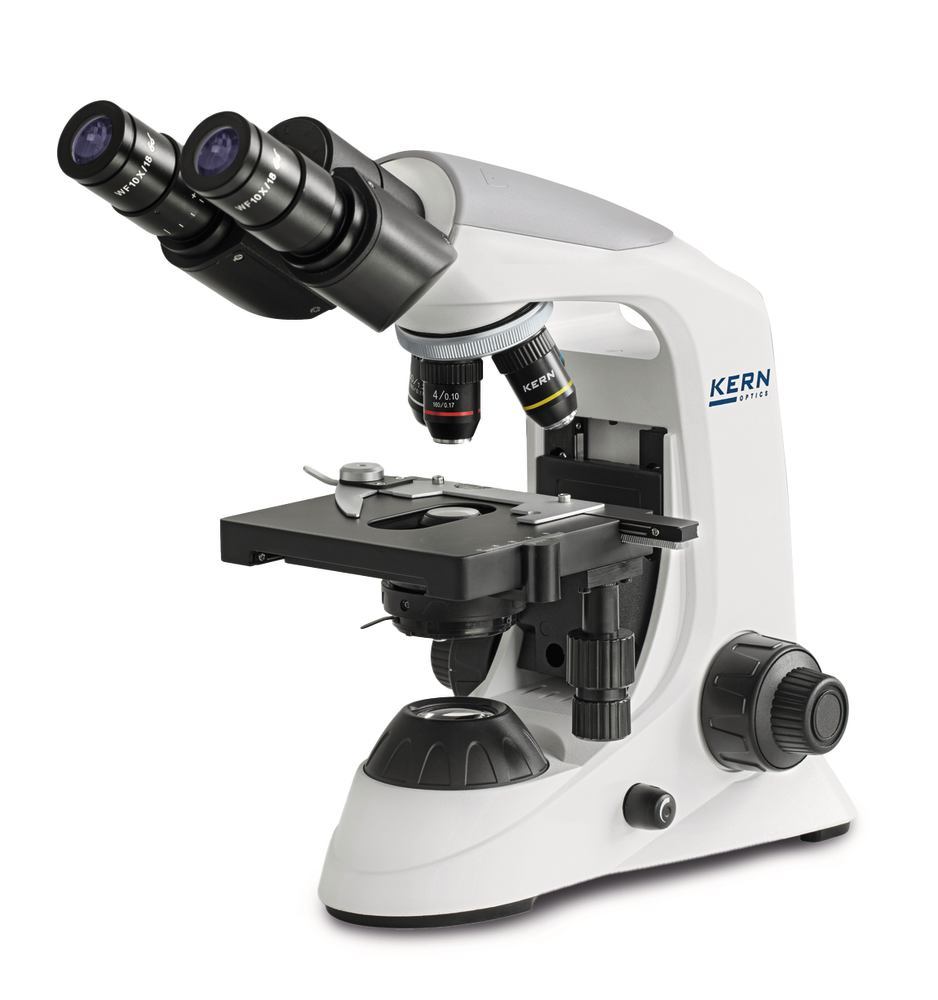
Microscope à lumière transmise OBE 132, binoculaire, incluant œilletons et housse de protection contre la poussière
Educational Line. High-quality, fully equipped transmitted light microscope (bright-field) for training, laboratory and medical use. For translucent and thin, high-contrast, less challenging specimens (e. g. plant tissues, stained cells/parasites). Particularly suitable for blood analysis and urine sediments.
- Le top tube papillon
- Grâce au côté pratique du compartiment de rangement à l'arrière de l'appareil, le câble d'alimentation peut être rangé rapidement pour un gain de place optimal
- L'alimentation électrique, par exemple via une batterie externe, est possible grâce au Technologie de connexion USB
- Le revolver porte-objectifs à quatre emplacements est entièrement équipé de quatre objectifs achromatiques standards (4x/10x/40x/100x), qui sont idéalement adaptés à toutes les applications d'analyse en fond clair
- The 1.25 Abbe condenser with aperture cover, with its height-adjustable focus, permet une concentration idéale de la lumière et une illumination optimale de l'échantillon
- table en croix mécanique garantit un travail et un positionnement rapides de l'échantillon. Il est doté d'un système de mise au point coaxiale macro et micrométrique équipé de chaque côté pour régler la hauteur et faire la mise au point sur l'échantillon
- Avec un puissant éclairage par lumière transmise à LED de 3 W, à intensité réglable en continu
- Par rapport à la série OBS, celle-ci offre une gamme diversifiée options d'extension
- Utilisation en champ sombre pour les objectifs 4x à 40x ; pour augmenter le contraste des petites structures non colorées
- Objectif 100x (planachromatique, à ressort) avec immersion à l'eau
| Type | OBE 132 |
| Tube | jumelles |
| Grossissement total | 40x, 100x, 400x, 1000x |
| Type de grossissement | tourelle |
| Grossissement oculaire | grand champ 10x |
| Lentilles | achromatique |
| Configuration des lentilles | 4 directions, incliné vers l'avant |
| Grossissement de l'objectif | - 4x/N.A. 0.10, W.D. 18.6 mm- 10x/N.A. 0.25, W.D. 6.5 mm- 40x (spring)/N.A. 0.65, W.D. 0.47 mm- 100x (spring, oil)/N.A. 1.25, W.D. 0.07 mm |
| Champ de vision | 18 mm |
| Compensation dioptrique | d'un côté |
| Observation angulaire | 30 ° |
| Head | peut pivoter à 360° |
| Écart pupillaire | 48-75 mm |
| Condenseur | Abbe O.N. 1,25 avec diaphragme |
| Éclairage de Köhler | non |
| Source lumineuse | LED |
| Type d'éclairage | lumière transmise |
| Mise au point de l'image | mise au point coaxiale macro et micrométrique avec échelle : 2 µm |
| Optique | fini |
| Platine de microscope | zone de 125 x 115 mmplage de déplacement coaxial x/y de 50 x 70 mm |
| Alimentation électrique | alimenté par secteur |
| Branchement secteur | 100-240 V, 50/60 Hz |
Récemment consulté
Vous aimerez peut-être aussi
Browse related categories
Category
Sub-category
Catalogue
Brand
Questions about Microscope optique à transmission OBE 132, Binoculaire, 1 unité(s)
What is this article?
Microscope optique à transmission OBE 132, Binoculaire, 1 unité(s) is the article on this page. Luminix Health distributes KERN for laboratory use. It sits in Digital & USB microscopes, inside Microscopy & histology, in Instruments de précision.
A digital or USB microscope is a camera with optics, useful for inspection and for a quick shared image. It does not replace a compound microscope when the method needs a stated numerical aperture and a fluorescence filter. Magnification claims on these are often a screen magnification, not an optical one.
A light microscope forms an image with glass lenses and transmitted or reflected light. A stereo microscope is the lower-magnification instrument for dissecting and for looking at a surface. Fluorescence needs a light source and filters matched to the dye. Histology is the preparation that makes a tissue readable: fixation, a cassette, a section, a stain. The objective's magnification and numerical aperture decide the resolution. The slide and the cover glass decide whether the section sits in the focal plane. Stains and dyes as substances are identified on PubChem. Papers on the methods are on PubMed.
Which category should I open next?
The category is Microscopy & histology. The sub-category is Digital & USB microscopes. The catalogue is Instruments de précision.
Shelves beside this one are Microscope slides & cover glasses, Microscope objectives, eyepieces & optics, Histology cassettes & moulds, Counting chambers & haemocytometers, Stereo microscopes, Light & fluorescence microscopes, Histology reagents & consumables, Microscopy accessories and Cold light sources & lighting.
What should I check before I order?
The technical information on this page is the manufacturer's sheet. Read that, not a rewritten specification.
When this page shows a safety data sheet, use that manufacturer file. Hazard text does not belong in the sales description. For a pack size, a grade or a certificate that is not on the page, send a quote request or contact the team.
How does ordering and shipping work?
Luminix Health distributes this article from the heart of Europe. Articles in stock ship within 2–5 business days. Standard delivery is free from €250 excl. VAT. Cold-chain goods and dangerous goods under ADR are never included in that free delivery. The terms are in the Shipping Policy. The full brand index is on shop by brand. Who we are is on about us.
Which other categories should I open?
The seven catalogues are Labware, Lab chemicals, Lab instruments, Lab consumables, Chromatography equipment, Lab safety equipment and Life Science & Microbiology.