


Description
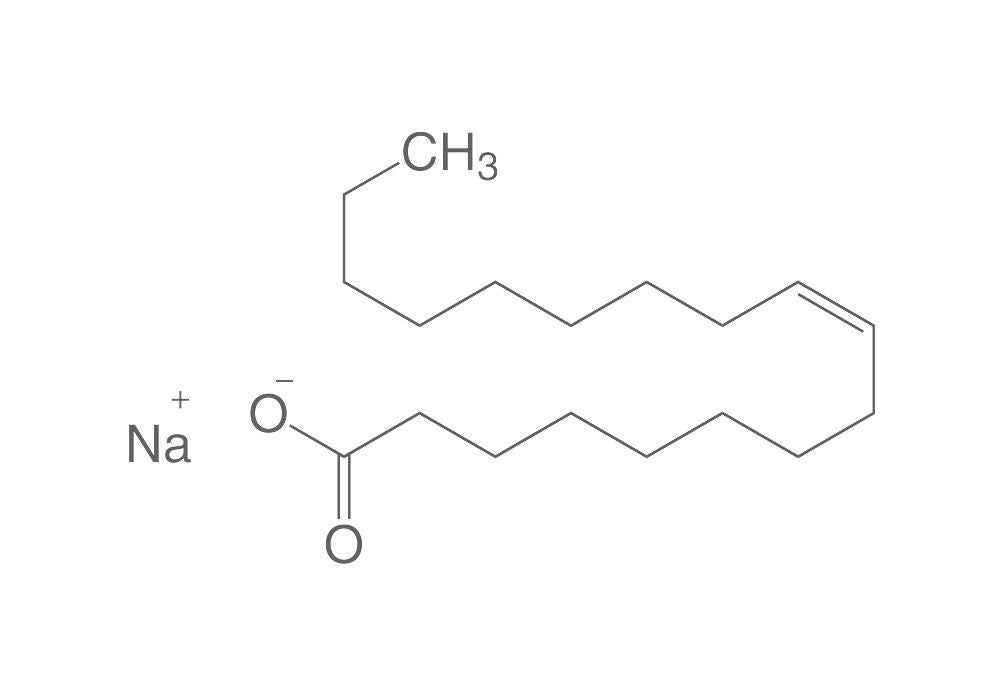
Le sel de sodium d'acide oléique est un réactif chimique à 90 % portant le numéro CAS 143-19-1 et la formule empirique C₁₈H₃₃NaO₂. Les données clés comprennent une masse molaire de 304,47 g/mol, une densité de 1,02 g/cm³ et un point d'éclair de 220 °C, ainsi que le numéro EG 205-591-0. Proposé dans un emballage plastique de 500 g par le fabricant Carl ROTH, ce sel de sodium de l'acide oléique soutient les travaux de laboratoire nécessitant un sel d'acide gras défini. Il convient à la synthèse chimique, aux études de formulation et aux tâches analytiques ou préparatives courantes spécifiant l'oléate de sodium. Les propriétés physiques indiquées facilitent la pesée, la dissolution et la manipulation sur la paillasse. Un conditionnement pratique convient aux groupes de recherche et aux laboratoires de développement de procédés ayant besoin d'un approvisionnement fiable sans encombrement excessif. Une composition constante aide à maintenir la reproductibilité lorsque le sel est utilisé comme réactif, intermédiaire ou composant dans des préparations liées aux tensioactifs et aux lipides. Intégrez-le dans vos protocoles établis partout où le sel de sodium d'acide oléique à ce niveau de pureté est indiqué.
Cet article appartient à la catégorie Lipides, stéroïdes et acides gras, dans Produits biochimiques et réactifs.
Caractéristiques principales
- Aspect : blanc à jaunâtre
- Acides gras totaux : 88,0-92,0 %
- Humidité : 1,0-4,0 %
- NaOH libre : 0,2-0,6 %
- Numéro CAS : 143-19-1
- Conditionnement : 500 g plastique
- N° EG : 205-591-0
- Pureté : 90 %
- Masse molaire : 304,47 g/mol
- Densité : 1,02 g/cm³
- Fiche technique :

- Fiche de données de sécurité :
Récemment consulté
Vous aimerez peut-être aussi
Questions about Sel de sodium de l'acide oléique, 90 %, 500 g, plastique
What is this article?
Sel de sodium de l'acide oléique, 90 %, 500 g, plastique is the article on this page. Luminix Health distributes Carl Roth for laboratory use. It sits in Lipids, steroids & fatty acids, inside Biochemicals & reagents, in Microbiologie.
A lipid, a steroid or a fatty acid is specified by chain length, saturation and purity. Esters and free acids are different compounds. Many are supplied in a small amount under inert gas because they oxidise. The physical form, oil or powder, follows from the structure.
A biochemical is a molecule of life, sold as a reagent: an amino acid, a sugar, a nucleotide, a lipid, an enzyme, an antibiotic. The difference from a bulk chemical is that the use is a biological one, and the impurities that matter are the ones that change that use. An enzyme is specified by activity, not only by mass. An antibiotic is specified by potency. Papers are on PubMed. Structures are on PubChem. Strains and lines that consume these reagents are at ATCC.
Which category should I open next?
The category is Biochemicals & reagents. The sub-category is Lipids, steroids & fatty acids. The catalogue is Microbiologie.
Shelves beside this one are Amino acids & peptides, Carbohydrates & sugars, Coenzymes, nucleotides & vitamins, Biochemicals (other), Enzymes & substrates, Antibiotics & antimycotics and Detergents & surfactants.
What should I check before I order?
When this page shows a safety data sheet, use that manufacturer file. Hazard text does not belong in the sales description. For a pack size, a grade or a certificate that is not on the page, send a quote request or contact the team.
How does ordering and shipping work?
Luminix Health distributes this article from the heart of Europe. Articles in stock ship within 2–5 business days. Standard delivery is free from €250 excl. VAT. Cold-chain goods and dangerous goods under ADR are never included in that free delivery. The terms are in the Shipping Policy. The full brand index is on shop by brand. Who we are is on about us.
Which other categories should I open?
The seven catalogues are Labware, Lab chemicals, Lab instruments, Lab consumables, Chromatography equipment, Lab safety equipment and Life Science & Microbiology.