




Description
Protino 96 Ni-IDA (4×96) est un kit de biochromatographie à plusieurs plaques pour la purification de protéines His-tag au moyen de la chimie Nickel–iminodiacetic acid (Ni-IDA) au format 96 puits. Le conditionnement contient du matériel pour 4 × 96 préparations, comprenant des plaques Protino Ni-IDA et les tampons associés requis pour le flux de purification. Le traitement parallèle des plaques prend en charge un débit d'échantillons plus élevé lorsque plusieurs constructions d'expression, conditions de culture ou lots de purification doivent être traités selon des protocoles alignés. La liaison sélective de polyhistidine-tagged recombinant proteins facilite des étapes de capture et d'élution efficaces, typiques de la chromatographie d'affinité sur métal immobilisé en contexte de recherche. Proposé par le fabricant Macherey-Nagel au sein de la famille de produits Protino, cette configuration à quatre plaques s'adresse aux laboratoires qui purifient régulièrement des cibles His-tag et préfèrent un système plaque-et-tampon assorti plutôt que de préparer séparément des résines et des solutions. Il convient à la biologie moléculaire, à la biochimie des protéines et aux environnements de criblage dans lesquels une isolation His-tag reproductible sur plusieurs séries en 96 puits est requise. La taille de conditionnement plus grande réduit la fréquence de réapprovisionnement pour les flux de purification chargés.
Cet article fait partie de Sorbants, gel de silice & échangeurs d'ions, dans SPE & préparation d'échantillons.
Caractéristiques
- Conditionnement: 4 × 96 préparations
- Température de stockage: 18–25 °C
- Format: Plaques 96 puits Protino Ni-IDA
- Contenu: Plaques Protino Ni-IDA et tampons
- EAN: 4046681153228
- Fiche technique:

- Fiche de données de sécurité:
Compliance & Safety Information
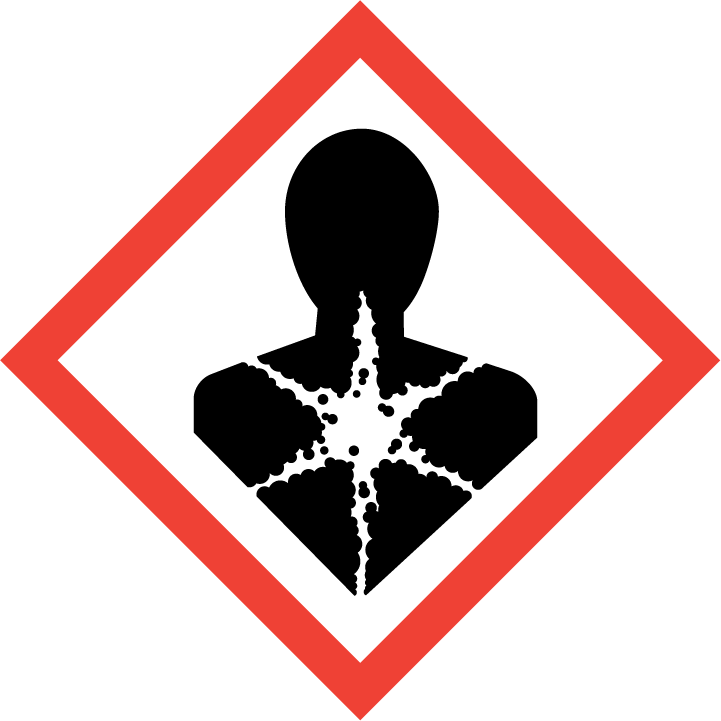 Danger
Récemment consulté
Vous aimerez peut-être aussi
Browse related categories
Category
SPE & préparation d'échantillons
Sub-category
Sorbants, gel de silice & échangeurs d'ions
Catalogue
Brand
Questions about Protino Ni-IDA (4x96)
What is this article?
Protino Ni-IDA (4x96) is the article on this page. Luminix Health distributes Macherey-Nagel for laboratory use. It sits in Sorbants, gel de silice & échangeurs d'ions, inside SPE & préparation d'échantillons, in Chromatographie.
Loose sorbent, silica gel and ion-exchange resin are the phases bought in bulk to pack a column or to stir into a solution. Particle size and activity, or the ion-exchange capacity, are the specification. A TLC silica and a flash silica of different particle sizes are not the same separation.
Solid-phase extraction holds a compound on a sorbent while the rest of the sample is washed away, then releases it in a small volume. The sorbent, the bed mass and the solvents are the method. Silica, ion exchangers and polymer phases do different jobs. A flash column is the same idea scaled toward purification rather than trace cleanup. The molecules are on PubChem, named by IUPAC.
Which category should I open next?
The category is SPE & préparation d'échantillons. The sub-category is Sorbants, gel de silice & échangeurs d'ions. The catalogue is Chromatographie.
Shelves beside this one are Cartouches & colonnes SPE and Colonnes de chromatographie flash, vides & en verre.
What should I check before I order?
When this page shows a safety data sheet, use that manufacturer file. Hazard text does not belong in the sales description. For a pack size, a grade or a certificate that is not on the page, send a quote request or contact the team.
How does ordering and shipping work?
Luminix Health distributes this article from the heart of Europe. Articles in stock ship within 2–5 business days. Standard delivery is free from €250 excl. VAT. Cold-chain goods and dangerous goods under ADR are never included in that free delivery. The terms are in the Shipping Policy. The full brand index is on shop by brand. Who we are is on about us.
Which other categories should I open?
The seven catalogues are Labware, Lab chemicals, Lab instruments, Lab consumables, Chromatography equipment, Lab safety equipment and Life Science & Microbiology.