


Description
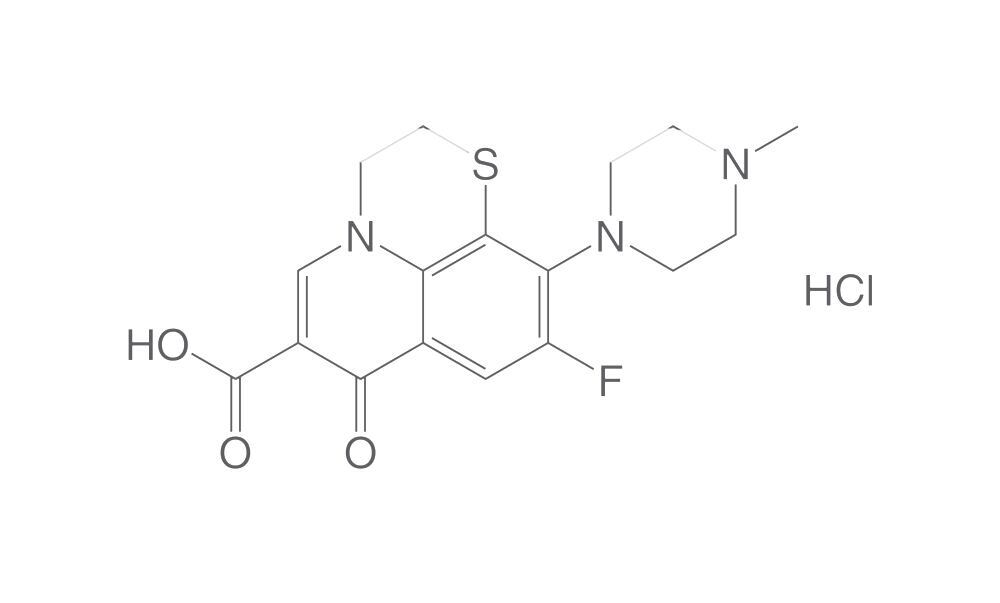
Le chlorhydrate de rufloxacine est un composé biochimique identifié par le numéro CAS 106017-08-7 et la formule brute C₁₇H₁₈FN₃O₃SHCl. Il présente une masse molaire de 399,87 g/mol. Sous forme de chlorhydrate, ce produit offre une identité saline définie pour la formulation et la documentation dans les flux de travail de recherche. Son utilisation typique concerne les études biochimiques et de chimie médicinale nécessitant une substance de référence ou de test apparentée aux fluoroquinolones dûment caractérisée. Le produit est disponible auprès du fabricant Carl ROTH pour des applications de laboratoire professionnelles. Les données claires relatives au numéro CAS, à la formule et à la masse molaire facilitent une pesée précise, la préparation de stocks et la traçabilité des enregistrements dans les environnements de recherche soucieux de la qualité. La quantité équilibre commodité et matériel suffisant pour l'optimisation des méthodes, les essais en répliquats et le criblage comparatif. Destiné à un personnel formé travaillant selon les procédures de sécurité et de manipulation standard en laboratoire pour les produits biochimiques organiques.
Cet article appartient à la catégorie Sels inorganiques, dans Produits chimiques inorganiques.
Caractéristiques principales
- Numéro CAS : 106017-08-7
- Conditionnements : 1 g, 2 g, 5 g
- Formule brute : C₁₇H₁₈FN₃O₃SHCl
- Masse molaire : 399,87 g/mol
- Température de stockage : -20 °C
- Forme : Chlorhydrate
- Fiche de données de sécurité :

Compliance & Safety Information
 Attention
Hazard Statements (H-Phrases)
Récemment consulté
Vous aimerez peut-être aussi
Browse related categories
Category
Sub-category
Catalogue
Produits chimiques de laboratoire et industriels
Brand
Questions about Chlorhydrate de rufloxacine, 1 g
What is this article?
Chlorhydrate de rufloxacine, 1 g is the article on this page. Luminix Health distributes Carl Roth for laboratory use. It sits in Inorganic salts, inside Inorganic chemicals, in Produits chimiques de laboratoire et industriels.
An inorganic salt is an ionic solid, a chloride, a sulfate, a nitrate, a phosphate. The degree of hydration changes the mass that contains one mole of the ion. Analytical grade limits the foreign ions. A hydrate and the anhydrous salt are not interchangeable by weight.
An inorganic chemical is a salt, an acid or base in solid form, a metal, an oxide, or an element. The waters of hydration are part of the formula: a hydrate and an anhydrous salt are different masses for the same ion. Trace metals matter when the salt will be used in analysis. Nanomaterials add particle size to the specification. Look the substance up on PubChem. Hazard classes are on ECHA, under the CLP Regulation and REACH. Transport of the dangerous ones is explained by the UNECE.
Which category should I open next?
The category is Inorganic chemicals. The sub-category is Inorganic salts. The catalogue is Produits chimiques de laboratoire et industriels.
Shelves beside this one are Metals, elements & oxides and Nanomaterials & quantum dots.
What should I check before I order?
When this page shows a safety data sheet, use that manufacturer file. Hazard text does not belong in the sales description. For a pack size, a grade or a certificate that is not on the page, send a quote request or contact the team.
How does ordering and shipping work?
Luminix Health distributes this article from the heart of Europe. Articles in stock ship within 2–5 business days. Standard delivery is free from €250 excl. VAT. Cold-chain goods and dangerous goods under ADR are never included in that free delivery. The terms are in the Shipping Policy. The full brand index is on shop by brand. Who we are is on about us.
Which other categories should I open?
The seven catalogues are Labware, Lab chemicals, Lab instruments, Lab consumables, Chromatography equipment, Lab safety equipment and Life Science & Microbiology.