


Description
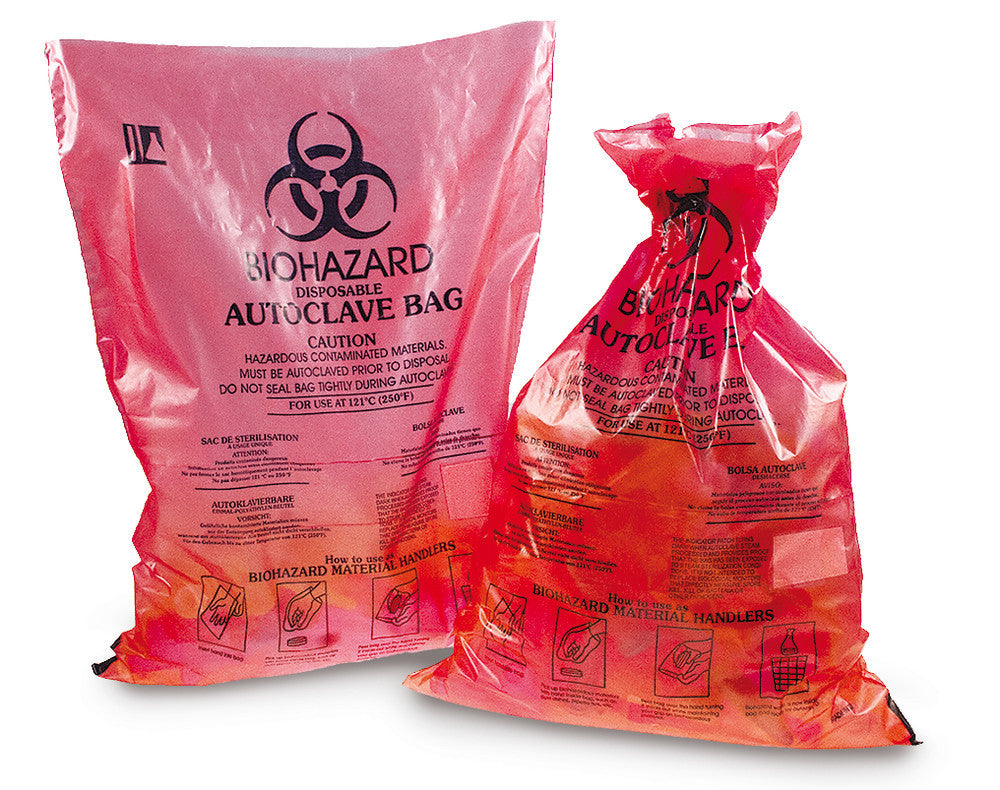
Les sacs d'élimination Sekuroka® - Biohazard sont des sacs à déchets en polyéthylène destinés à la collecte et au confinement sûrs de matériaux de laboratoire marqués d'une identification biohazard. Chaque sac mesure L 210 × H 290 mm avec une épaisseur de film de 20 µm, offrant un format compact adapté aux bacs de paillasse, aux contenants secondaires et aux points d'élimination courants dans les laboratoires des sciences de la vie et cliniques. Fabriqués en PE, les sacs constituent une barrière pratique pour la conservation de courte durée de consommables contaminés avant le traitement institutionnel des déchets. Le paquet contient 1000 pièces et a un poids total de 2.5 kg, pour les laboratoires à haut débit qui ont besoin d'un stock fiable de sacs biohazard clairement désignés. Ces sacs Sekuroka® (Carl ROTH) s'intègrent aux flux de travail de sécurité au travail et de protection individuelle où l'élimination séparée de déchets potentiellement infectieux ou biologiquement marqués est requise. Ils appartiennent aux catégories de matériel de laboratoire couvrant l'élimination, les sacs à déchets et les systèmes de sacs liés à l'autoclave, et sont choisis lorsque des dimensions standardisées et une construction en PE sont spécifiées pour la manipulation quotidienne des déchets biohazard à la paillasse.
Cet article fait partie de Sacs d'autoclave & d'élimination, dans Élimination des déchets.
Caractéristiques
- Conditionnement: 1000 pièces
- Type de produit: Sacs d'élimination Biohazard
- Matériau: PE
- Dimensions: W 210 x H 290 mm
- Épaisseur: 20 µm
- Poids: 2.5 kg
Récemment consulté
Vous aimerez peut-être aussi
Questions about Sacs d'élimination Sekuroka® - Biohazard, PE, L 210 x H 290 mm, épaisseur 20 µm
What is this article?
Sacs d'élimination Sekuroka® - Biohazard, PE, L 210 x H 290 mm, épaisseur 20 µm is the article on this page. Luminix Health distributes Carl Roth for laboratory use. It sits in Sacs d'autoclave & d'élimination, inside Élimination des déchets, in Sécurité.
An autoclave bag survives the steriliser and then holds the waste. A disposal bag is only the second half. Printed indicators, the temperature rating and the volume are the specification. A bag that melts at 121 °C is not an autoclave bag.
Laboratory waste is sorted before it is carried away. A solvent waste can has a cap and often a funnel that limits vapour. A sharps container is rigid and closable. An autoclave bag is for material that will be sterilised before it is ordinary waste. The container has to survive the chemical that goes into it. A bag that dissolves is not a container. Classification of the chemicals is on ECHA. Transport of dangerous goods is the UNECE framework. Workplace practice is EU-OSHA.
Which category should I open next?
The category is Élimination des déchets. The sub-category is Sacs d'autoclave & d'élimination. The catalogue is Sécurité.
Shelves beside this one are Bouchons pour déchets de solvants, entonnoirs de sécurité & bidons, Conteneurs à déchets & bidons and Conteneurs pour objets tranchants, absorbants & kits anti-déversement.
What should I check before I order?
The technical information on this page is the manufacturer's sheet. Read that, not a rewritten specification.
When this page shows a safety data sheet, use that manufacturer file. Hazard text does not belong in the sales description. For a pack size, a grade or a certificate that is not on the page, send a quote request or contact the team.
How does ordering and shipping work?
Luminix Health distributes this article from the heart of Europe. Articles in stock ship within 2–5 business days. Standard delivery is free from €250 excl. VAT. Cold-chain goods and dangerous goods under ADR are never included in that free delivery. The terms are in the Shipping Policy. The full brand index is on shop by brand. Who we are is on about us.
Which other categories should I open?
The seven catalogues are Labware, Lab chemicals, Lab instruments, Lab consumables, Chromatography equipment, Lab safety equipment and Life Science & Microbiology.