


Description
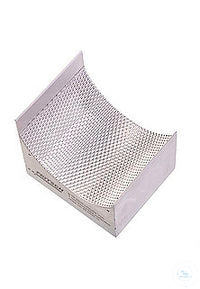
Sieve cassette P-19 L chromium-free steel 2 mm trapezoidal hole defines the final fineness of the processed sample in cutting-mill applications. Trapezoidal-hole sieve inserts deliver additional comminution through elevated shear action, making them especially suitable when finer particle reduction is required alongside controlled sizing. Manufactured from chromium-free steel ST12, this cassette is particularly recommended for sample preparation under RoHS and WEEE requirements, for instance when hexavalent chromium must be determined, and for subsequent XRF analysis where chromium contamination must be avoided. For all other laboratory applications, stainless-steel cassettes may be preferred because of their greater hardness and abrasion resistance. The unit is supplied as one piece with a net weight of 1,00 kg and belongs to the P-19 L series from manufacturer Fritsch. Square-hole variants remain available for brittle materials and medium-fineness samples that demand a narrow particle-size band. Together these design choices support reproducible laboratory sample preparation while matching the mechanical demands of modern cutting mills.
This article is part of Histology cassettes & moulds, in Microscopy & histology.
Key features
- Pack size: 1 pc
- Material: chromium-free steel ST12
- Hole size: 2 mm
- Hole type: trapezoidal
- Series: P-19 L
Récemment consulté
Vous aimerez peut-être aussi
Browse related categories
Category
Sub-category
Catalogue
Brand
Questions about sieve cassette P-19 L 2 mm trapezoidal perf.
What is this article?
sieve cassette P-19 L 2 mm trapezoidal perf. is the article on this page. Luminix Health distributes Fritsch for laboratory use. It sits in Histology cassettes & moulds, inside Microscopy & histology, in Instruments de précision.
A histology cassette holds a tissue through processing, and a mould forms the paraffin block. The cassette's holes have to let solvents through and still keep the specimen. A fine biopsy and a large organ are different cassettes.
A light microscope forms an image with glass lenses and transmitted or reflected light. A stereo microscope is the lower-magnification instrument for dissecting and for looking at a surface. Fluorescence needs a light source and filters matched to the dye. Histology is the preparation that makes a tissue readable: fixation, a cassette, a section, a stain. The objective's magnification and numerical aperture decide the resolution. The slide and the cover glass decide whether the section sits in the focal plane. Stains and dyes as substances are identified on PubChem. Papers on the methods are on PubMed.
Which category should I open next?
The category is Microscopy & histology. The sub-category is Histology cassettes & moulds. The catalogue is Instruments de précision.
Shelves beside this one are Microscope slides & cover glasses, Microscope objectives, eyepieces & optics, Counting chambers & haemocytometers, Stereo microscopes, Light & fluorescence microscopes, Histology reagents & consumables, Microscopy accessories, Cold light sources & lighting and Digital & USB microscopes.
What should I check before I order?
When this page shows a safety data sheet, use that manufacturer file. Hazard text does not belong in the sales description. For a pack size, a grade or a certificate that is not on the page, send a quote request or contact the team.
How does ordering and shipping work?
Luminix Health distributes this article from the heart of Europe. Articles in stock ship within 2–5 business days. Standard delivery is free from €250 excl. VAT. Cold-chain goods and dangerous goods under ADR are never included in that free delivery. The terms are in the Shipping Policy. The full brand index is on shop by brand. Who we are is on about us.
Which other categories should I open?
The seven catalogues are Labware, Lab chemicals, Lab instruments, Lab consumables, Chromatography equipment, Lab safety equipment and Life Science & Microbiology.