


Description
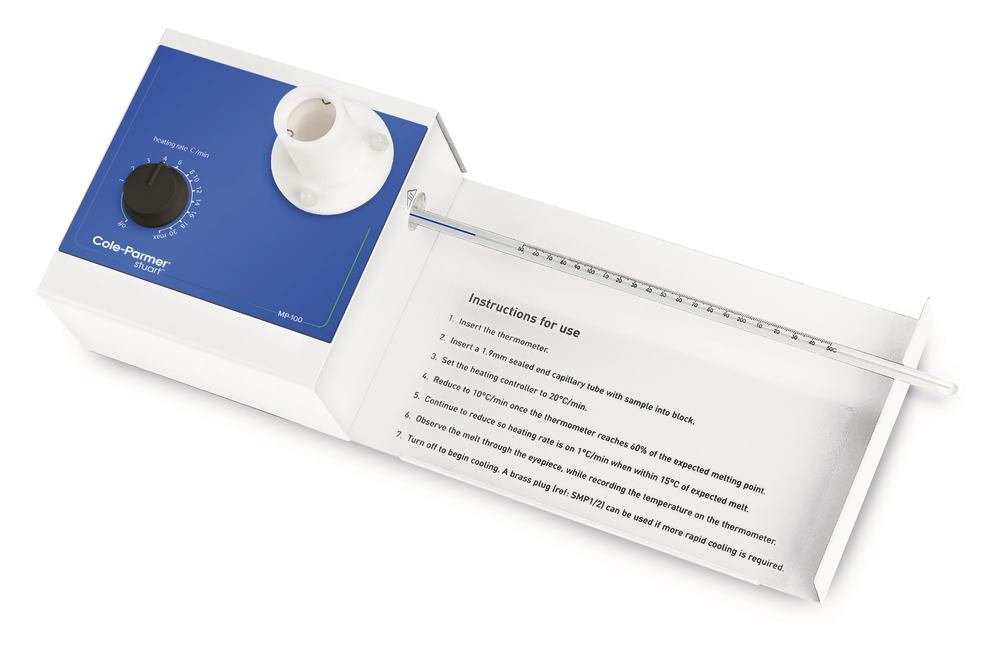
L'appareil de détermination du point de fusion MP-100 est un instrument analogique permettant d'observer et de tester jusqu'à trois échantillons en parallèle lors d'analyses classiques du point de fusion. La disposition pour trois échantillons permet une comparaison côte à côte des échantillons inconnus et des références dans les mêmes conditions de chauffage, ce qui est utile en chimie organique, pour les contrôles d'identité pharmaceutiques et dans les laboratoires d'enseignement. La livraison comprend 100 tubes à point de fusion ouverts d'un côté, de sorte que le poste de travail peut être mis en service sans commande séparée de capillaires pour les premiers essais. L'unité complète pèse 3,000 kg et est fournie en une seule pièce dans la catégorie des appareils de mesure du point de fusion des équipements de laboratoire. Le fonctionnement analogique simplifie le flux de travail : charger les capillaires, chauffer et enregistrer visuellement le comportement à la fusion de chaque échantillon. L'appareil de détermination du point de fusion MP-100 du fabricant Stuart/Cole-Parmer prend en charge la caractérisation de routine des solides lorsqu'une observation multi-échantillons est préférée. Les laboratoires spécifiant une station analogique de point de fusion à trois échantillons avec tubes de démarrage trouveront cette configuration conforme aux pratiques standard de mesure du point de fusion par capillaire.
Cet article fait partie de la catégorie Photomètres et spectrophotomètres, dans Spectroscopie et photométrie.
Caractéristiques principales
- Conditionnement : 1 unité
- Type de produit : Appareil de mesure du point de fusion
- Modèle : MP-100
- Fonctionnement : Analogique
- Capacité d'échantillonnage : Observer et tester 3 échantillons
- Inclus : 100 tubes à point de fusion, ouverts d'un côté
- Fiche technique :

Récemment consulté
Vous aimerez peut-être aussi
Questions about Appareil de mesure du point de fusion MP-100, analogique, observation et test de 3 échantillons,
What is this article?
Appareil de mesure du point de fusion MP-100, analogique, observation et test de 3 échantillons, is the article on this page. Luminix Health distributes Stuart/Cole-Parmer for laboratory use. It sits in Photometers & spectrophotometers, inside Spectroscopy & photometry, in Instruments de laboratoire.
A photometer reads absorbance at one or a few wavelengths. A spectrophotometer scans or selects many. Both send light through a cuvette or a well. The wavelength range, UV or visible, and the bandwidth decide what can be measured. A visible-only instrument cannot read a nucleic acid at 260 nm.
A photometer or spectrophotometer sends light through a sample and reads how much was absorbed. In the range where the Beer–Lambert relation holds, absorbance tracks concentration. A refractometer reads how a liquid bends light, which tracks dissolved solids. A polarimeter reads the rotation of polarised light, the classical measurement for sugars. The lamp, the wavelength and the cuvette path length are the three things that have to be right before the number means anything. The optical quantities trace to NIST and the BIPM.
Which category should I open next?
The category is Spectroscopy & photometry. The sub-category is Photometers & spectrophotometers. The catalogue is Instruments de laboratoire.
Shelves beside this one are Refractometers & polarimeters and Lamps, cuvette holders & accessories.
What should I check before I order?
The technical information on this page is the manufacturer's sheet. Read that, not a rewritten specification.
When this page shows a safety data sheet, use that manufacturer file. Hazard text does not belong in the sales description. For a pack size, a grade or a certificate that is not on the page, send a quote request or contact the team.
How does ordering and shipping work?
Luminix Health distributes this article from the heart of Europe. Articles in stock ship within 2–5 business days. Standard delivery is free from €250 excl. VAT. Cold-chain goods and dangerous goods under ADR are never included in that free delivery. The terms are in the Shipping Policy. The full brand index is on shop by brand. Who we are is on about us.
Which other categories should I open?
The seven catalogues are Labware, Lab chemicals, Lab instruments, Lab consumables, Chromatography equipment, Lab safety equipment and Life Science & Microbiology.