
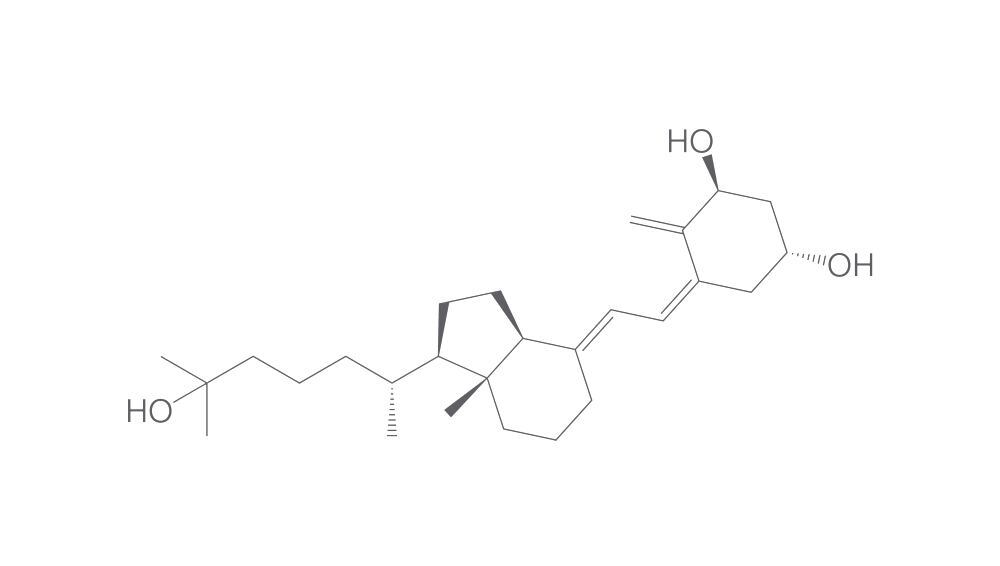


Beschrijving
1α,25-Dihydroxyvitamine D₃ is een hoogwaardig secosteroïde-biochemisch product met een zuiverheid van minimaal 95 %, met CAS-nummer 32222-06-3 en de brutoformule C₂₇H₄₄O₃. Dit formaat is bedoeld voor gevoelige onderzoekstoepassingen waarbij de actieve digehydroxyleerde vitamine D₃-metaboliet in kleine, nauwkeurig gedefinieerde hoeveelheden nodig is. Laboratoria gebruiken deze verbinding bij endocrinologisch onderzoek, cel-signalerings-, receptorbindings- en metabole studies die afhankelijk zijn van een gekarakteriseerd vitamine D-derivaat. De identiteit is verankerd in de CAS-registratie en de molecuulformule, wat traceerbare documentatie en methode-afstemming in analytische en biologische workflows ondersteunt. Materiaal van dit type wordt door fabrikant Carl ROTH aangeboden voor gespecialiseerde biochemische programma's en niet voor bulkverwerking. De compacte milligramhoeveelheid is geschikt voor assay-ontwikkeling, kalibratie van onderzoeksmethoden en exploratief biologisch onderzoek waarbij een gecontroleerde toevoeging van de dihydroxy-metaboliet essentieel is. Duidelijke zuiverheids- en formulegegevens helpen bij het handhaven van een consistente bereiding van voorraadoplossingen en experimentele registraties in gereguleerde of sterk gedocumenteerde laboratoriumomgevingen.
Dit artikel hoort bij Co-enzymen, nucleotiden & vitaminen, in Biochemicaliën & reagentia.
Belangrijkste kenmerken
- Kleur: wit tot gebroken wit
- Vorm: poeder tot kristallijn poeder
- Zuiverheid (HPLC): ≥98 %
- CAS-nummer: 32222-06-3
- Verpakkingsgrootten: 5 mg, 10 mg, 25 mg
- Zuiverheid: min. 95 %
- Brutoformule: C₂₇H₄₄O₃
- Opslagtemperatuur: -20 °C
- Gewicht: 0,001 kg
- Technisch informatieblad:

- Veiligheidsinformatieblad:
Compliance & Safety Information

 Gevaar
Hazard Statements (H-Phrases)
Recent bekeken
Misschien vind je dit ook leuk
Questions about 1a,25-Dihydroxyvitamine D3, min. 95 %, 5 mg
What is this article?
1a,25-Dihydroxyvitamine D3, min. 95 %, 5 mg is the article on this page. Luminix Health distributes Carl Roth for laboratory use. It sits in Coenzymes, nucleotides & vitamins, inside Biochemicals & reagents, in Microbiologische media.
Coenzymes, nucleotides and vitamins are the small molecules enzymes and cells consume: NAD, ATP, a vitamin cofactor. Purity, salt form and hydration are the specification, and many are unstable in solution or in the light. The lot is stored as the label says, often cold.
A biochemical is a molecule of life, sold as a reagent: an amino acid, a sugar, a nucleotide, a lipid, an enzyme, an antibiotic. The difference from a bulk chemical is that the use is a biological one, and the impurities that matter are the ones that change that use. An enzyme is specified by activity, not only by mass. An antibiotic is specified by potency. Papers are on PubMed. Structures are on PubChem. Strains and lines that consume these reagents are at ATCC.
Which category should I open next?
The category is Biochemicals & reagents. The sub-category is Coenzymes, nucleotides & vitamins. The catalogue is Microbiologische media.
Shelves beside this one are Amino acids & peptides, Carbohydrates & sugars, Biochemicals (other), Enzymes & substrates, Antibiotics & antimycotics, Lipids, steroids & fatty acids and Detergents & surfactants.
What should I check before I order?
When this page shows a safety data sheet, use that manufacturer file. Hazard text does not belong in the sales description. For a pack size, a grade or a certificate that is not on the page, send a quote request or contact the team.
How does ordering and shipping work?
Luminix Health distributes this article from the heart of Europe. Articles in stock ship within 2–5 business days. Standard delivery is free from €250 excl. VAT. Cold-chain goods and dangerous goods under ADR are never included in that free delivery. The terms are in the Shipping Policy. The full brand index is on shop by brand. Who we are is on about us.
Which other categories should I open?
The seven catalogues are Labware, Lab chemicals, Lab instruments, Lab consumables, Chromatography equipment, Lab safety equipment and Life Science & Microbiology.