



Beschrijving
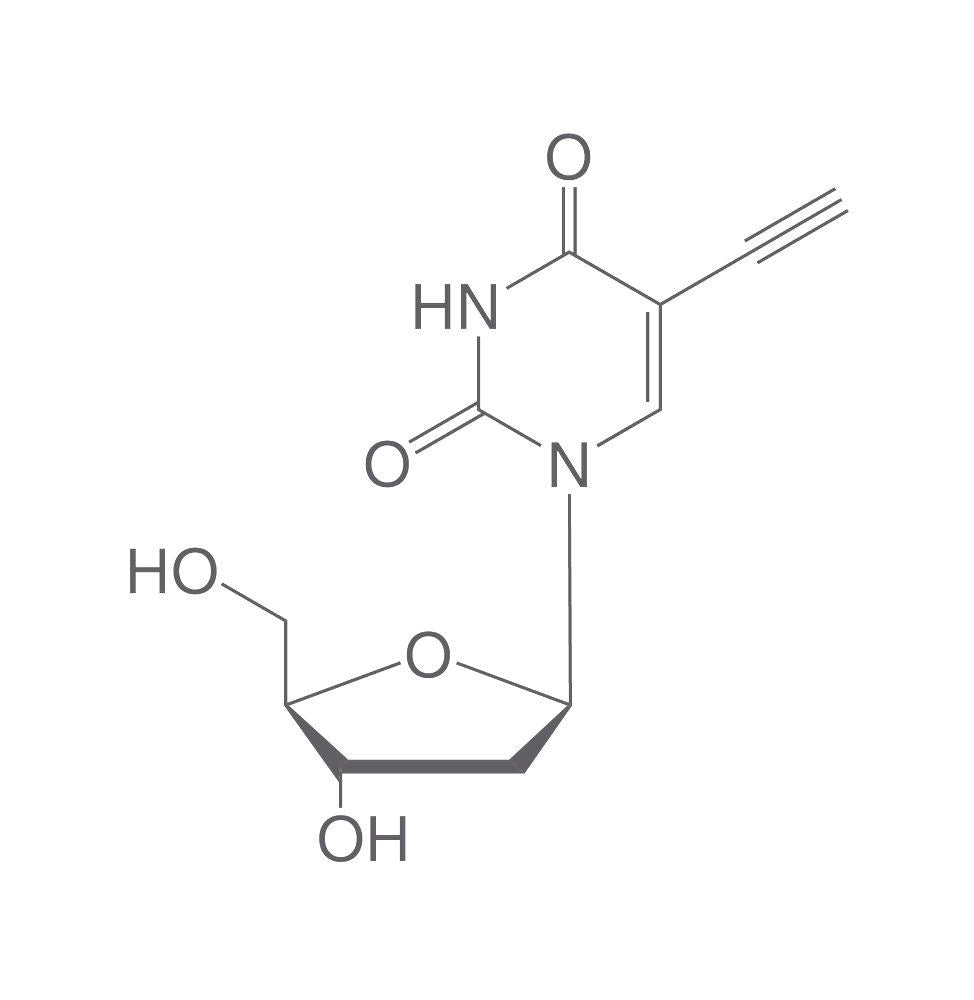
5-Ethynyl-2-deoxyuridine (EdU) is een nucleoside-analoog met een zuiverheid van minimaal 98 %, CAS-nummer 61135-33-9 en brutoformule C₁₁H₁₂N₂O₅. De molaire massa is 252,23 g/mol. De ethynyl-gemodificeerde deoxyuridine-structuur ondersteunt klikchemie-workflows die in DNA-toepassingen worden gebruikt, waarbij de alkyngroep na metabole inbouw selectieve azide-alkyn-conjugatie mogelijk maakt. Het reagens wordt aangeboden door de fabrikant baseclick en EdU biedt een goed gedefinieerde chemische identiteit voor protocollen die berusten op bio-orthogonale detectie van nieuw gesynthetiseerd DNA. Een zuiverheid van minimaal 98 % helpt bij het handhaven van consistentie bij labeling, beeldvorming en verwante experimenten met nucleïnezuren. Het is geschikt voor methodeontwikkeling en herhaalde kleinschalige assays zonder overmatige blootstelling door het openen van vials. Opslag in de kou behoudt de integriteit van het materiaal zoals aangegeven in de productgegevens. Laboratoria die werken met klikchemie en DNA-analyse kunnen deze verbinding integreren in vastgestelde ethynyl-nucleoside-procedures. Raadpleeg het veiligheidsinformatieblad voor instructies over het gebruik voor aanvang van de werkzaamheden.
Dit artikel hoort bij Co-enzymen, nucleotiden & vitaminen, in Biochemicaliën & reagentia.
Belangrijkste kenmerken
- Uiterlijk: witte tot gebroken witte vaste stof
- Analyse (HPLC): ≥98 %
- CAS-nummer: 61135-33-9
- Verpakkingsgroottes: 50 mg, 100 mg, 500 mg, 1 g
- Zuiverheid: min. 98 %
- Brutoformule: C₁₁H₁₂N₂O₅
- Molaire massa: 252,23 g/mol
- Opslagtemperatuur: −20 °C
- Technisch informatieblad:

- Veiligheidsinformatieblad:
Compliance & Safety Information
 Gevaar
Hazard Statements (H-Phrases)
Precautionary Statements (P-Phrases)
Recent bekeken
Misschien vind je dit ook leuk
Questions about 5-Ethynyl-2-deoxyuridine (EdU), min. 98 %, 50 mg, plastic
What is this article?
5-Ethynyl-2-deoxyuridine (EdU), min. 98 %, 50 mg, plastic is the article on this page. Luminix Health distributes baseclick for laboratory use. It sits in Coenzymes, nucleotides & vitamins, inside Biochemicals & reagents, in Microbiologische media.
Coenzymes, nucleotides and vitamins are the small molecules enzymes and cells consume: NAD, ATP, a vitamin cofactor. Purity, salt form and hydration are the specification, and many are unstable in solution or in the light. The lot is stored as the label says, often cold.
A biochemical is a molecule of life, sold as a reagent: an amino acid, a sugar, a nucleotide, a lipid, an enzyme, an antibiotic. The difference from a bulk chemical is that the use is a biological one, and the impurities that matter are the ones that change that use. An enzyme is specified by activity, not only by mass. An antibiotic is specified by potency. Papers are on PubMed. Structures are on PubChem. Strains and lines that consume these reagents are at ATCC.
Which category should I open next?
The category is Biochemicals & reagents. The sub-category is Coenzymes, nucleotides & vitamins. The catalogue is Microbiologische media.
Shelves beside this one are Amino acids & peptides, Carbohydrates & sugars, Biochemicals (other), Enzymes & substrates, Antibiotics & antimycotics, Lipids, steroids & fatty acids and Detergents & surfactants.
What should I check before I order?
When this page shows a safety data sheet, use that manufacturer file. Hazard text does not belong in the sales description. For a pack size, a grade or a certificate that is not on the page, send a quote request or contact the team.
How does ordering and shipping work?
Luminix Health distributes this article from the heart of Europe. Articles in stock ship within 2–5 business days. Standard delivery is free from €250 excl. VAT. Cold-chain goods and dangerous goods under ADR are never included in that free delivery. The terms are in the Shipping Policy. The full brand index is on shop by brand. Who we are is on about us.
Which other categories should I open?
The seven catalogues are Labware, Lab chemicals, Lab instruments, Lab consumables, Chromatography equipment, Lab safety equipment and Life Science & Microbiology.