


Beschrijving
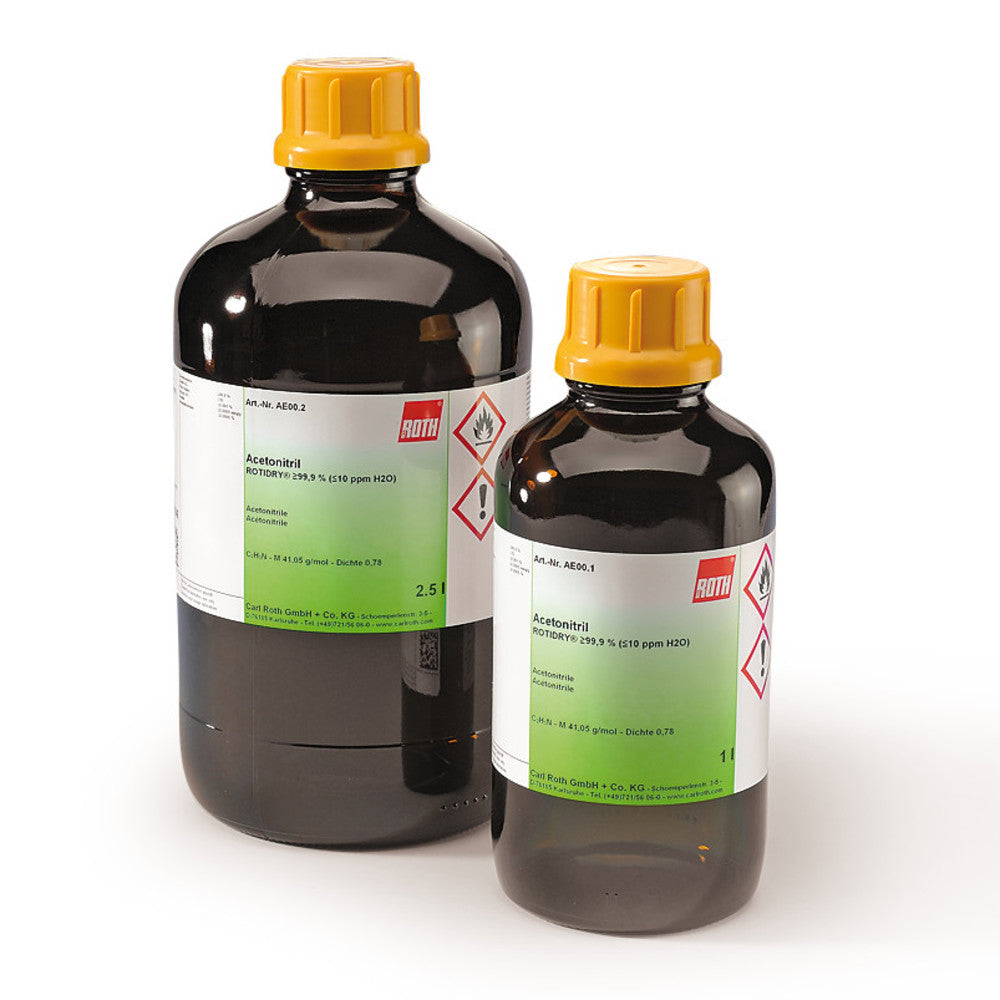
Azijnzuurethylester (ethylacetaat) is een veelzijdig organisch oplosmiddel dat wordt geleverd in ROTIDRY®-kwaliteit met een minimale zuiverheid van 99,8 % en een maximaal watergehalte van 100 ppm H₂O. Het heeft CAS-nummer 141-78-6 en de brutoformule C₄H₈O₂, met een molaire massa van 88,11 g/mol, een dichtheid van 0,9003 g/cm³, een vlampunt van −4 °C en een kookpunt van 77,1 °C. Deze ester met een laag vochtgehalte is verpakt in een glazen fles van 1 l van fabrikant Carl ROTH en is zeer geschikt voor extracties, mobiele fasen voor chromatografie, reinigingsstappen en algemene organische synthese waarbij een gecontroleerd restwatergehalte bijdraagt aan reproduceerbare resultaten. De stof is geregistreerd onder EG-nr. 205-500-4. Laboratoria kiezen voor droge ethylacetaatkwaliteiten wanneer vochtgevoelige reacties, monsterbewerking of analytische methoden een oplosmiddel met een hoog gehalte en een gedefinieerde waterlimiet vereisen. De ROTIDRY®-specificatie en de glazen verpakking bieden een praktisch formaat voor dagelijks laboratoriumgebruik en preparatieve werkzaamheden binnen chemische en biowetenschappelijke processen.
Dit artikel hoort bij Droge & gedeutereerde oplosmiddelen (NMR, synthese), in Oplosmiddelen.
Belangrijkste kenmerken
- Gehalte (GC): ≥99,8 %
- Water (KF): ≤0,01 %
- Zuurtegraad: ≤0,0005 meq/g
- Dampresidu: ≤0,0005 %
- CAS-nummer: 141-78-6
- Verpakkingsgrootte: 1 l glas
- EG-nr.: 205-500-4
- Zuiverheid: ROTIDRY® min. 99,8 % (max. 100 ppm H₂O)
- Brutoformule: C₄H₈O₂
- Molaire massa: 88,11 g/mol
- Technisch informatieblad:

- Veiligheidsinformatieblad:
Compliance & Safety Information

 Gevaar
Hazard Statements (H-Phrases)
Precautionary Statements (P-Phrases)
Recent bekeken
Misschien vind je dit ook leuk
Browse related categories
Category
Sub-category
Dry & deuterated solvents (NMR, synthesis)
Catalogue
Brand
Questions about Azijnzuurethylester
What is this article?
Azijnzuurethylester is the article on this page. Luminix Health distributes Carl Roth for laboratory use. It sits in Dry & deuterated solvents (NMR, synthesis), inside Solvents, in Chemicaliën.
A dry solvent has had water removed to a stated level, for a reaction that water would stop. A deuterated solvent replaces hydrogen with deuterium so an NMR spectrum is not drowned by the solvent signal. The isotopic enrichment and the water content are the two specifications. Caps and septa matter, because either product picks up moisture from the air.
A solvent dissolves. The grade says which impurities are low enough for the method. Analytical grade is the ordinary pure solvent. HPLC and LC-MS grades limit the absorbance and the ions that would become peaks or background. A dry solvent has had water removed. A deuterated solvent is for NMR, where the hydrogen signal would otherwise drown the sample. Technical grade is for cleaning and for synthesis that does not need a chromatogram. Identity is on PubChem. Names follow IUPAC. Hazards follow ECHA, the CLP Regulation and REACH.
Which category should I open next?
The category is Solvents. The sub-category is Dry & deuterated solvents (NMR, synthesis). The catalogue is Chemicaliën.
Shelves beside this one are Analytical grade solvents (p.a.), HPLC & LC-MS grade solvents, Technical & synthesis grade solvents and Green & alternative solvents.
What should I check before I order?
The technical information on this page is the manufacturer's sheet. Read that, not a rewritten specification.
When this page shows a safety data sheet, use that manufacturer file. Hazard text does not belong in the sales description. For a pack size, a grade or a certificate that is not on the page, send a quote request or contact the team.
How does ordering and shipping work?
Luminix Health distributes this article from the heart of Europe. Articles in stock ship within 2–5 business days. Standard delivery is free from €250 excl. VAT. Cold-chain goods and dangerous goods under ADR are never included in that free delivery. The terms are in the Shipping Policy. The full brand index is on shop by brand. Who we are is on about us.
Which other categories should I open?
The seven catalogues are Labware, Lab chemicals, Lab instruments, Lab consumables, Chromatography equipment, Lab safety equipment and Life Science & Microbiology.