
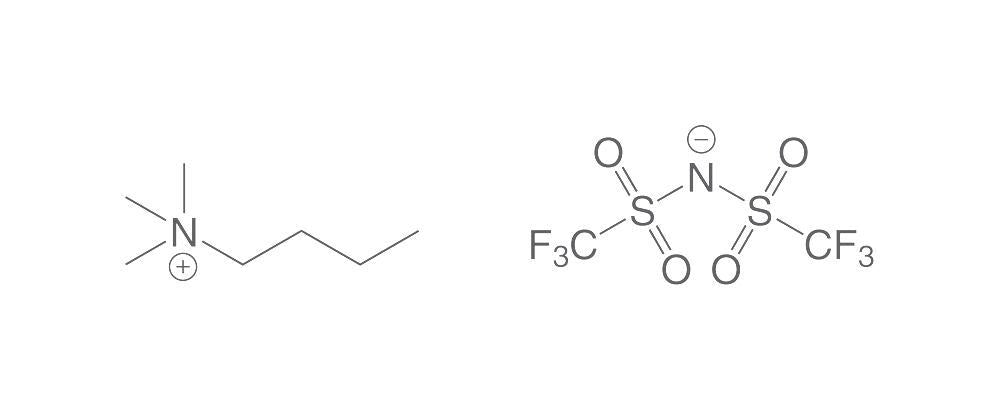


Beschrijving
Butyl-trimethyl-ammonium-bis-(trifluormethylsulfonyl)-imide (N1114 BTA) is een reagens van het type ionische vloeistof dat met een zuiverheid van min. 99 % wordt aangeboden voor geavanceerde chemische en oplosmiddeltoepassingen. Het heeft CAS-nummer 258273-75-5 en de empirische formule C₉H₁₈F₆N₂O₄S₂, met een molaire massa van 396,36 g/mol en een dichtheid van 1,398 g/cm³. Deze gedefinieerde fysisch-chemische waarden ondersteunen een nauwkeurige dosering en methodeontwikkeling in onderzoeksomgevingen die zich richten op groene alternatieve oplosmiddelen en speciale media. De verpakkingsgrootte is praktisch voor screening, formuleringsproeven en kleinschalig synthetisch werk. Dit N1114 BTA-materiaal is verkrijgbaar bij fabrikant Carl ROTH en sluit aan bij de behoeften van laboratoria in het segment van oplosmiddelen en groene alternatieven, waar bis(trifluormethylsulfonyl)imide-zouten met een hoge zuiverheid worden geselecteerd vanwege hun goed gekarakteriseerde samenstelling. Hanteer het product volgens de bijbehorende veiligheidsdocumentatie en goede laboratoriumpraktijken. De combinatie van de vermelde zuiverheid, molaire massa en dichtheid maakt een duidelijke integratie in experimentele protocollen mogelijk zonder aanvullende prestatieclaims buiten de gegevens van de fabrikant.
Dit artikel hoort bij Fotometers & spectrofotometers, in Spectroscopie & fotometrie.
Belangrijkste kenmerken
- Uiterlijk: gelige vloeistof
- Analyse: ≥99 %
- Water (KF): ≤0,01 %
- Halogenen: ≤0,01 %
- CAS-nummer: 258273-75-5
- Verpakkingsgrootten: 25 g, 100 g
- Zuiverheid: min. 99 %
- Empirische formule: C₉H₁₈F₆N₂O₄S₂
- Molaire massa: 396,36 g/mol
- Dichtheid: 1,398 g/cm³
- Technisch informatieblad:

- Veiligheidsinformatieblad:
Compliance & Safety Information

 Gevaar
Hazard Statements (H-Phrases)
Precautionary Statements (P-Phrases)
Recent bekeken
Misschien vind je dit ook leuk
Questions about Butyl-trimethyl-ammonium-bis-(trifluormethylsulfonyl)-imide (N1114 BTA), 25 g
What is this article?
Butyl-trimethyl-ammonium-bis-(trifluormethylsulfonyl)-imide (N1114 BTA), 25 g is the article on this page. Luminix Health distributes Carl Roth for laboratory use. It sits in Photometers & spectrophotometers, inside Spectroscopy & photometry, in Instrumenten.
A photometer reads absorbance at one or a few wavelengths. A spectrophotometer scans or selects many. Both send light through a cuvette or a well. The wavelength range, UV or visible, and the bandwidth decide what can be measured. A visible-only instrument cannot read a nucleic acid at 260 nm.
A photometer or spectrophotometer sends light through a sample and reads how much was absorbed. In the range where the Beer–Lambert relation holds, absorbance tracks concentration. A refractometer reads how a liquid bends light, which tracks dissolved solids. A polarimeter reads the rotation of polarised light, the classical measurement for sugars. The lamp, the wavelength and the cuvette path length are the three things that have to be right before the number means anything. The optical quantities trace to NIST and the BIPM.
Which category should I open next?
The category is Spectroscopy & photometry. The sub-category is Photometers & spectrophotometers. The catalogue is Instrumenten.
Shelves beside this one are Refractometers & polarimeters and Lamps, cuvette holders & accessories.
What should I check before I order?
The technical information on this page is the manufacturer's sheet. Read that, not a rewritten specification.
When this page shows a safety data sheet, use that manufacturer file. Hazard text does not belong in the sales description. For a pack size, a grade or a certificate that is not on the page, send a quote request or contact the team.
How does ordering and shipping work?
Luminix Health distributes this article from the heart of Europe. Articles in stock ship within 2–5 business days. Standard delivery is free from €250 excl. VAT. Cold-chain goods and dangerous goods under ADR are never included in that free delivery. The terms are in the Shipping Policy. The full brand index is on shop by brand. Who we are is on about us.
Which other categories should I open?
The seven catalogues are Labware, Lab chemicals, Lab instruments, Lab consumables, Chromatography equipment, Lab safety equipment and Life Science & Microbiology.