


Beschrijving
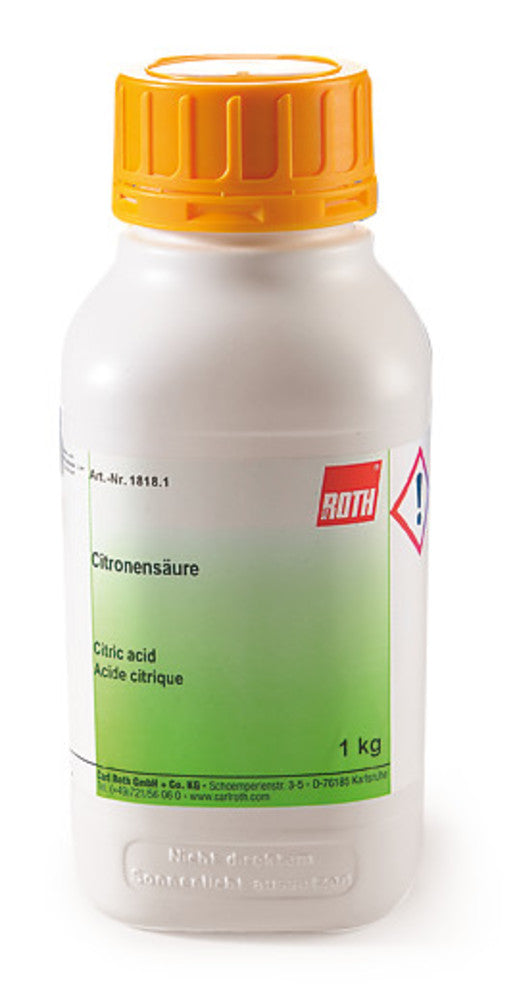
Citroenzuur (monohydraat) is een laboratoriumvaste stof die wordt gebruikt in reinigingsmiddelen, speciale schoonmaakmiddelen en aanverwante verzorgingstoepassingen. Het is geïdentificeerd met CAS-nummer 5949-29-1 en EG-nr. 611-842-9, met een dichtheid van 1,54 g/cm³ en een kookpunt boven 170 °C volgens de gegevens van de fabrikant. Binnen de categorieën voor reiniging en onderhoud van laboratoriumapparatuur dient citroenzuurmonohydraat als een veelzijdig organisch zuur voor het ontkalken, verwijderen van residuen en algemeen laboratoriumonderhoud. Dit materiaal van fabrikant Carl ROTH past in routines die een gedocumenteerde monohydraatkwaliteit vereisen met duidelijke fysische referentiewaarden voor dichtheid en thermisch gedrag. Het ondersteunt herhaaldelijk doseren zonder onnodige bulk voor kleinere faciliteiten. Gebruik het wanneer reinigingsprotocollen of speciale reinigingspreparaten om citroenzuurmonohydraat met vermelde CAS- en EG-identificatiecodes vragen.
Dit artikel hoort thuis in Organische bouwstenen & synthesereagentia, in Organische chemicaliën & synthesereagentia.
Belangrijkste kenmerken
- CAS-nummer: 5949-29-1
- Verpakkingsgrootten: 1 kg, 50 kg
- EG-nr.: 611-842-9
- Dichtheid: 1,54 g/cm³
- Kookpunt: >170 °C
- Technisch informatieblad:

- Veiligheidsinformatieblad:
Compliance & Safety Information
 Waarschuwing
Hazard Statements (H-Phrases)
Precautionary Statements (P-Phrases)
Recent bekeken
Misschien vind je dit ook leuk
Browse related categories
Category
Organic chemicals & synthesis reagents
Sub-category
Organic building blocks & synthesis reagents
Catalogue
Brand
Questions about Citroenzuur (monohydraat), , 1 kg, plastic
What is this article?
Citroenzuur (monohydraat), , 1 kg, plastic is the article on this page. Luminix Health distributes Carl Roth for laboratory use. It sits in Organic building blocks & synthesis reagents, inside Organic chemicals & synthesis reagents, in Chemicaliën.
A building block is an organic molecule bought to become part of a larger one. The structure, the CAS number and the purity decide it. A 95 percent reagent and a 99.9 percent reagent of the same name leave different impurities in the product. The functional groups are the reason it was chosen.
An organic chemical is built on carbon. In this category it is a building block or a reagent for making another molecule: a starting material, a coupling agent, a polymer, a PEG. Purity is a specification of which impurities remain. The structure, the CAS number and the grade decide whether two bottles are the same substance. Structures and properties are on PubChem. Nomenclature is IUPAC. Classification follows ECHA and the CLP Regulation.
Which category should I open next?
The category is Organic chemicals & synthesis reagents. The sub-category is Organic building blocks & synthesis reagents. The catalogue is Chemicaliën.
Shelves beside this one are Polymers, PEGs & silicones and Click chemistry, bioconjugation & synthesis reagents.
What should I check before I order?
The technical information on this page is the manufacturer's sheet. Read that, not a rewritten specification.
When this page shows a safety data sheet, use that manufacturer file. Hazard text does not belong in the sales description. For a pack size, a grade or a certificate that is not on the page, send a quote request or contact the team.
How does ordering and shipping work?
Luminix Health distributes this article from the heart of Europe. Articles in stock ship within 2–5 business days. Standard delivery is free from €250 excl. VAT. Cold-chain goods and dangerous goods under ADR are never included in that free delivery. The terms are in the Shipping Policy. The full brand index is on shop by brand. Who we are is on about us.
Which other categories should I open?
The seven catalogues are Labware, Lab chemicals, Lab instruments, Lab consumables, Chromatography equipment, Lab safety equipment and Life Science & Microbiology.