


Beschrijving
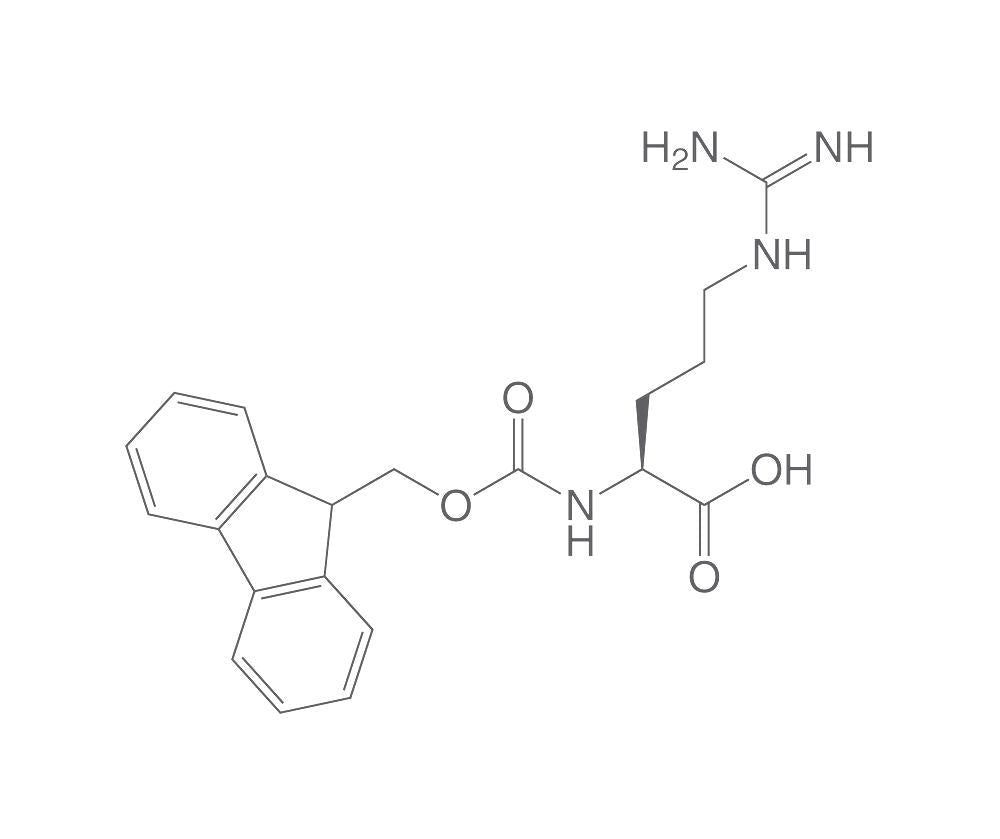
Fmoc-L-Arginine, PEPTIPURE® is een met Fmoc beschermd L-argininederivaat dat wordt geleverd met een minimale zuiverheid van 98 % voor biochemietoepassingen. Het is geregistreerd onder CAS-nummer 91000-69-0, heeft de empirische formule C₂₁H₂₄N₄O₄ en een molaire massa van 396.44 g/mol, wat duidelijke identiteitsgegevens geeft voor de planning en documentatie van peptidesynthese. Als bouwsteen van PEPTIPURE®-kwaliteit is het geschikt voor peptidechemie in de vaste fase en in de oplossingsfase waarin gecontroleerde N-terminale bescherming en een gedefinieerde optische configuratie vereist zijn. Het product is Fysische en samenstellingsparameters ondersteunen nauwkeurig wegen en molaire berekeningen in geautomatiseerde of handmatige workflows. Aangeboden door fabrikant Carl ROTH helpt deze Fmoc-L-arginine-kwaliteit laboratoria om voorraden beschermde aminozuren te standaardiseren voor reproduceerbare synthesecampagnes. Onderzoekers kunnen het integreren in op Fmoc gebaseerde strategieën voor bioactieve peptiden, bibliotheken en structuur–activiteitsstudies, terwijl zij vertrouwen op het vermelde gehalte en de moleculaire gegevens voor kwaliteitsrecords en methodeoverdracht tussen locaties.
Dit artikel maakt deel uit van Klikchemie, bioconjugatie & synthesereagentia, in Biochemicaliën & reagentia.
Kenmerken
- Uiterlijk: wit tot gebroken wit poeder
- Gehalte: ≥98 %
- CAS-nummer: 91000-69-0
- Verpakkingsgroottes: 5 g, 25 g
- Zuiverheid: min. 98 %
- Brutoformule: C₂₁H₂₄N₄O₄
- Molaire massa: 396.44 g/mol
- Technisch datablad:

- Veiligheidsinformatieblad:
Recent bekeken
Misschien vind je dit ook leuk
Browse related categories
Category
Sub-category
Klikchemie, bioconjugatie & synthesereagentia
Catalogue
Brand
Questions about Fmoc-L-Arginine, PEPTIPURE®, min. 98 %, voor biochemie, 5 g, glas
What is this article?
Fmoc-L-Arginine, PEPTIPURE®, min. 98 %, voor biochemie, 5 g, glas is the article on this page. Luminix Health distributes Carl Roth for laboratory use. It sits in Klikchemie, bioconjugatie & synthesereagentia, inside Biochemicaliën & reagentia, in Microbiologische media.
Click and bioconjugation reagents join two molecules under mild conditions, often an azide to an alkyne, or an NHS ester to an amine. The linker length and the reactive group are the specification. They are small bottles of a reactive compound, and moisture often ruins them.
A biochemical is a molecule of life, sold as a reagent: an amino acid, a sugar, a nucleotide, a lipid, an enzyme, an antibiotic. The difference from a bulk chemical is that the use is a biological one, and the impurities that matter are the ones that change that use. An enzyme is specified by activity, not only by mass. An antibiotic is specified by potency. Papers are on PubMed. Structures are on PubChem. Strains and lines that consume these reagents are at ATCC.
Which category should I open next?
The category is Biochemicaliën & reagentia. The sub-category is Klikchemie, bioconjugatie & synthesereagentia. The catalogue is Microbiologische media.
Shelves beside this one are Aminozuren & peptiden, Koolhydraten & suikers, Co-enzymen, nucleotiden & vitaminen, Biochemicaliën (overig), Enzymen & substraten, Antibiotica & antimycotica, Lipiden, steroïden & vetzuren and Detergenten & oppervlakteactieve stoffen.
What should I check before I order?
The technical information on this page is the manufacturer's sheet. Read that, not a rewritten specification.
When this page shows a safety data sheet, use that manufacturer file. Hazard text does not belong in the sales description. For a pack size, a grade or a certificate that is not on the page, send a quote request or contact the team.
How does ordering and shipping work?
Luminix Health distributes this article from the heart of Europe. Articles in stock ship within 2–5 business days. Standard delivery is free from €250 excl. VAT. Cold-chain goods and dangerous goods under ADR are never included in that free delivery. The terms are in the Shipping Policy. The full brand index is on shop by brand. Who we are is on about us.
Which other categories should I open?
The seven catalogues are Labware, Lab chemicals, Lab instruments, Lab consumables, Chromatography equipment, Lab safety equipment and Life Science & Microbiology.